The automotive industry is undergoing a paradigm shift, transitioning from traditional fossil fuels to more sustainable alternatives. While battery electric vehicles (BEVs) are often heralded as the ultimate solution for a zero-emission future, the reality of global infrastructure, varied consumer needs, and supply chain constraints dictates that a multi-pathway approach is essential. Among these alternative pathways, the concept of the Electrified Flex-Fuel Vehicle (FFV-SHEV) stands out as one of the most promising, particularly for developing nations with robust agricultural sectors. At the forefront of this technological convergence is the Toyota Innova HyCross E85 Flex Fuel prototype.
This article takes a deep dive into the technology, implications, and future potential of flex-fuel hybrid cars, using the revolutionary Toyota Innova HyCross E85 as our primary case study. We will explore how blending strong hybrid technology with high-ethanol fuel could provide an immediate, practical, and highly effective solution to reducing carbon emissions and dependence on imported crude oil.
---
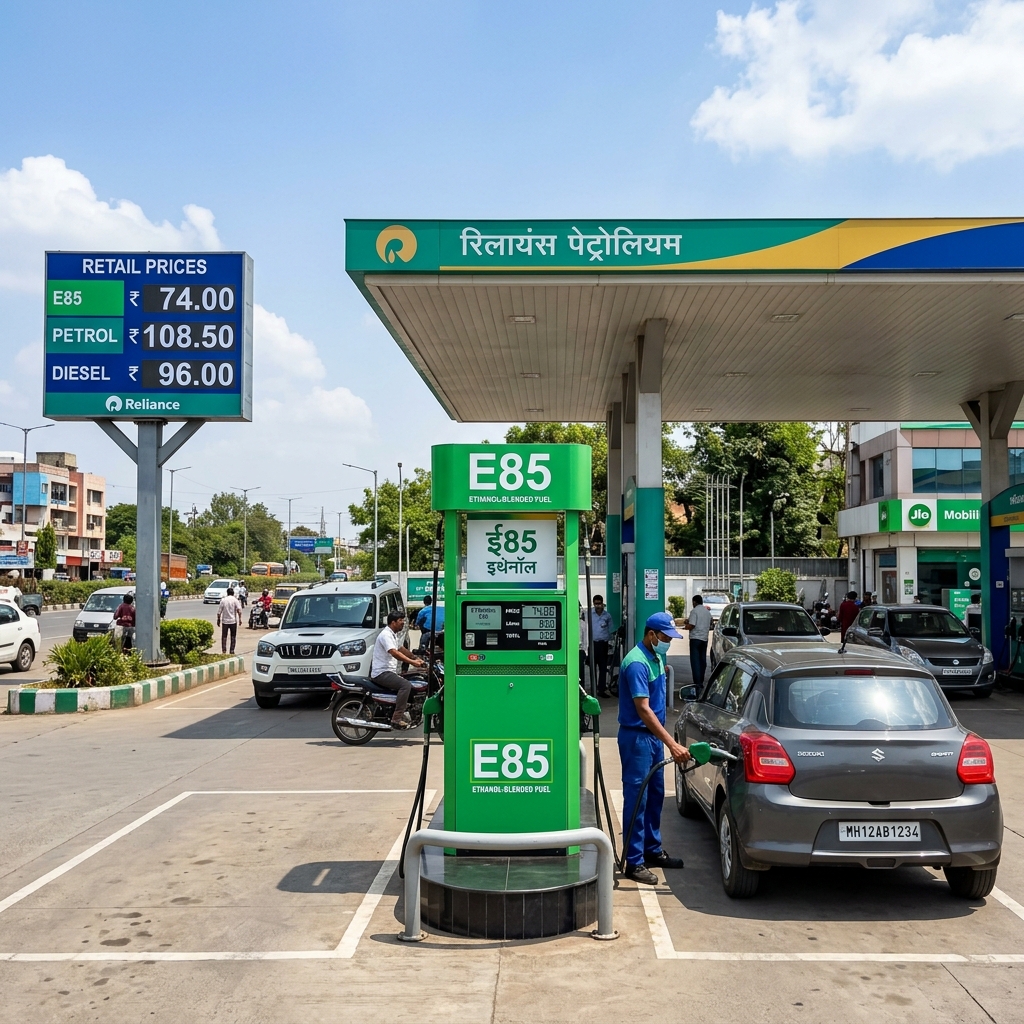
1. Understanding Flex Fuel Technology (E85)
Before delving into the specifics of the Innova HyCross, it is crucial to understand what flex-fuel technology entails, specifically E85.
What is E85?
E85 is a high-level ethanol-petrol blend consisting of anywhere from 51% to 83% ethanol, depending on geography and season, with the remainder being standard unleaded petrol. In the context of India and many upcoming flex-fuel initiatives, E85 is generally standardized as 85% ethanol and 15% petrol. Ethanol (ethyl alcohol) is a renewable fuel made from various plant materials, collectively known as "biomass." In India, the primary sources for ethanol production are sugarcane molasses, broken rice, and maize.
The Mechanics of a Flex-Fuel Vehicle (FFV)
A Flex-Fuel Vehicle is designed to run on more than one type of fuel, usually petrol blended with either ethanol or methanol fuel, and both fuels are stored in the same common tank. Modern FFVs are capable of burning any proportion of the resulting blend in the combustion chamber.
To achieve this, several critical modifications must be made to a standard internal combustion engine (ICE): - Fuel System Upgrades: Ethanol is corrosive to certain plastics, rubbers, and metals. Therefore, an FFV requires specialized fuel lines, tanks, and fuel pumps constructed from ethanol-resistant materials like stainless steel and specific synthetic rubbers. - Engine Control Unit (ECU) recalibration: The ECU must constantly monitor the ethanol-petrol ratio using a fuel composition sensor. It dynamically adjusts the fuel injection timing and spark ignition timing to account for the varying characteristics of the fuel blend. - Fuel Injectors: Because ethanol has a lower energy density than petrol (meaning you need more of it to generate the same amount of power), the fuel injectors must be capable of delivering a higher volume of fuel to the engine when running on high ethanol blends.
Why Ethanol? The Indian Context
For a rapidly developing economy like India, the push for ethanol blending is driven by three main pillars: 1. Economic Security: India imports over 80% of its crude oil requirements, resulting in a massive import bill. Substituting a significant portion of petrol with domestically produced ethanol directly reduces this economic burden and improves the balance of trade. 2. Environmental Benefits: Ethanol burns cleaner than petrol. Higher ethanol blends significantly reduce greenhouse gas (GHG) emissions, carbon monoxide, and particulate matter, which is vital for combating severe air pollution in Indian metropolises. Furthermore, the carbon dioxide absorbed by the plants grown to produce ethanol largely offsets the carbon dioxide emitted when the ethanol is burned, making it a nearly carbon-neutral cycle. 3. Agricultural Boost: Increased demand for ethanol provides a new, lucrative market for Indian farmers. It turns agricultural surplus and waste (like sugarcane bagasse or damaged food grains) into a valuable energy commodity, boosting rural incomes and contributing to the agrarian economy.
---
2. The Toyota Innova HyCross: A Benchmark Hybrid
To understand why an E85 Innova HyCross is so significant, we must first look at the foundation upon which it is built. Launched to immense critical and commercial success, the standard Toyota Innova HyCross redefined the MPV segment in India.
The Shift to TNGA and Monocoque
Unlike its predecessor, the ladder-frame Innova Crysta, the HyCross is built on Toyota's TNGA-C (Toyota New Global Architecture) platform. This shift to a monocoque chassis drastically improved ride quality, handling, and interior space packaging, making it behave more like a premium crossover than a utilitarian people-mover.
The 2.0L Strong Hybrid Powertrain
The crown jewel of the standard HyCross is its 5th-generation Self-Charging Hybrid Electric (SHEV) powertrain. It pairs a naturally aspirated 2.0-liter, 4-cylinder Atkinson cycle petrol engine with an electric motor and a small battery pack.
The Atkinson cycle is inherently more thermally efficient than the traditional Otto cycle but lacks low-end torque. Toyota brilliantly compensates for this by using the instant torque of the electric motor to get the heavy MPV moving. This synergy results in exceptional fuel efficiency—often exceeding 20 km/l in real-world city driving—a figure previously unimaginable for a vehicle of this size.
---
3. The Marriage of Two Technologies: The FFV-SHEV Concept
The Toyota Innova HyCross E85 prototype represents a technological leap known as an Electrified Flex-Fuel Vehicle (FFV-SHEV). It combines the advanced self-charging hybrid system of the standard HyCross with a flex-fuel engine capable of running on E85.
This combination is far more than just a marketing gimmick; it is a highly synergistic engineering solution that addresses the individual shortcomings of both hybrid and flex-fuel technologies.
Solving the Energy Density Problem
The biggest drawback of ethanol is its lower energy content. A liter of E85 contains roughly 25-30% less energy than a liter of pure petrol. In a conventional flex-fuel vehicle, running on E85 usually results in a noticeable drop in fuel efficiency (miles per gallon or kilometers per liter) compared to running on petrol.
This is where the strong hybrid system comes to the rescue. Because a strong hybrid relies heavily on the electric motor for low-speed driving, acceleration, and coasting, the internal combustion engine is used far less frequently and operates mostly in its most efficient RPM range. The electric assistance masks the reduced energy density of the E85 fuel, ensuring that the vehicle maintains excellent fuel efficiency and driving range, overcoming the primary consumer objection to E85.
Maximizing the Atkinson Cycle
The 2.0L engine in the HyCross operates on the Atkinson cycle, which relies on a high compression ratio for efficiency. Ethanol naturally has a much higher octane rating (around 100-105) compared to standard unleaded petrol (87-91). A higher octane rating means the fuel is more resistant to "knocking" or pre-ignition under high pressure.
This characteristic makes ethanol perfectly suited for high-compression Atkinson cycle engines. In an optimized FFV-SHEV, the engine can potentially be tuned to take advantage of this high octane rating, running even more efficiently and generating more power when operating on E85, thus further bridging the efficiency gap caused by lower energy density.
The Result: Drastic Carbon Reduction
When you combine a powertrain that is inherently highly efficient (SHEV) with a fuel that is largely carbon-neutral (E85), the results are staggering. Toyota has claimed that the carbon emissions of an FFV-SHEV running on E85 can be lower than those of a Battery Electric Vehicle (BEV) when evaluated on a "Well-to-Wheel" basis in countries where the electricity grid is still heavily reliant on coal.
In a "Well-to-Wheel" analysis, you account for the emissions generated while producing the energy (mining coal for electricity vs. growing sugarcane for ethanol) in addition to the tailpipe emissions. In India's current scenario, where coal dominates power generation, the FFV-SHEV presents a compellingly rapid path to decarbonization.
---
4. Deep Dive: Toyota Innova HyCross E85 Prototype
Toyota Kirloskar Motor (TKM) showcased the Innova HyCross Flex-Fuel prototype in India, signaling their commitment to the government's ethanol blending roadmap. Let's look at the specific engineering that goes into this prototype.
Engine Modifications
The 2.0-liter M20A-FXS engine has undergone rigorous modifications to handle the corrosive nature and different combustion characteristics of E85. 1. Material Upgrades: The fuel lines, pump, injectors, and engine valves are treated or replaced with ethanol-resistant materials to prevent degradation over time. 2. Advanced Sensors: A highly sensitive ethanol sensor is integrated into the fuel line. This sensor detects the exact percentage of ethanol in the fuel mixture (as it can vary wildly depending on what the user pumps) and relays this information to the ECU in milliseconds. 3. ECU Mapping: The engine control unit features complex, dynamic fuel maps. It adjusts spark timing and fuel injector pulse width on the fly to ensure optimal combustion, whether the tank is filled with E10 (standard petrol today), E20, or E85. 4. Cold Start Assist: Ethanol has a lower vapor pressure than petrol, making it harder to vaporize in cold temperatures. This can lead to difficult engine starts in winter. The prototype features advanced cold-start mechanisms, potentially including heated fuel rails or specialized fuel injection strategies, to ensure reliable starting even in colder regions of India.
The Hybrid Integration
The electric motor, battery pack, and power control unit (PCU) remain largely identical to the standard strong hybrid HyCross. The genius lies in the software integration. The hybrid management system must communicate seamlessly with the flex-fuel engine ECU, determining exactly when to draw power from the battery and when to fire up the engine, taking into account the slightly altered torque curve of the engine when running on E85.
Design and Aesthetics
Visually, the E85 prototype is virtually indistinguishable from the standard Innova HyCross. It retains the bold SUV-like stance, the large hexagonal grille, and the premium interior. The only telltale signs are specialized "Flex Fuel" badging and perhaps a green-colored fuel filler cap to indicate its eco-friendly nature. This intentional design choice reinforces the idea that adopting green technology does not require sacrificing the comfort, space, or prestige associated with the Innova badge.
---
5. Performance and Efficiency Expectations
While Toyota has not released exhaustive technical specifications for a commercial version, we can extrapolate the expected performance based on the technology.
Power Output
Because of ethanol's high octane rating, the engine could potentially produce slightly more peak horsepower when running on E85 compared to standard petrol, provided the ECU is tuned to take advantage of it. However, because the hybrid system is the primary driver of low-end torque, the everyday driving feel—the immediate off-the-line acceleration—will remain identical to the standard hybrid.
Running Costs and Mileage
This is the most critical factor for Indian consumers. E85 has lower energy density, meaning the physical fuel efficiency (km/l) will be lower than the standard petrol hybrid. However, the economic viability depends entirely on the pricing of E85 fuel.
For flex-fuel to succeed, E85 must be priced significantly cheaper than standard petrol to offset the lower mileage. If the government provides adequate subsidies or tax breaks for E85, the cost per kilometer (Running Cost) for the consumer could be equivalent to, or even cheaper than, running a standard petrol hybrid.
For example, if the standard HyCross delivers 20 km/l on petrol costing ₹100/liter (Cost = ₹5/km), the E85 version might deliver 15 km/l. Therefore, E85 fuel needs to be priced at ₹75/liter or lower to offer the same or better running cost.
---
6. The Indian Context: Infrastructure and Policy
The success of the Innova HyCross E85—and the flex-fuel movement in general—hinges entirely on government policy and infrastructure development.
The Ethanol Blending Programme (EBP)
The Indian government has been aggressively pursuing its Ethanol Blended Petrol (EBP) programme. The target to achieve 20% ethanol blending (E20) nationwide was advanced from 2030 to 2025. While E20 requires minor tweaks to regular vehicles, moving to E85 requires purpose-built FFVs like the HyCross prototype.
Infrastructure Challenges
The biggest hurdle is fuel dispensing infrastructure. 1. Dedicated Pumps: Fuel stations require dedicated underground tanks and specialized dispensing pumps capable of handling E85, as it cannot be mixed with standard fuels in storage. 2. Supply Chain: The logistics of transporting high volumes of ethanol from sugar mills and distilleries to fuel stations across the country need massive scaling. 3. Availability: Initially, E85 availability will likely be restricted to specific corridors or major cities. The flex-fuel nature of the vehicle is a safety net here—if a driver cannot find E85, they can simply fill up with regular E10 or E20 petrol without any issues.
Policy Support
To incentivize both manufacturers and consumers, consistent policy support is required. This includes lower GST rates on flex-fuel vehicles (similar to the concessions given to EVs) and subsidized pricing for E85 fuel at the pump. Without a clear economic advantage, consumers will be hesitant to adopt the new technology.
---
7. Environmental Impact and Sustainability
The widespread adoption of vehicles like the Innova HyCross E85 would have profound environmental implications for India.
Well-to-Wheel Advantage
As mentioned earlier, the well-to-wheel carbon footprint of an FFV-SHEV can be incredibly low. The carbon dioxide emitted by the vehicle is roughly equal to the carbon dioxide absorbed by the sugarcane or maize crops during their growth phase. When paired with a highly efficient hybrid system that burns very little fuel overall, the net greenhouse gas emissions are drastically reduced.
Air Quality Improvements
E85 burns much cleaner than petrol. It produces significantly fewer toxic pollutants, including carbon monoxide (CO), nitrogen oxides (NOx), and unburned hydrocarbons. In cities choking on vehicular pollution, a transition to E85 would lead to a measurable improvement in local air quality and public health.
The Agrarian Economy
This is perhaps the most unique benefit for India. The money spent on E85 fuel stays within the domestic economy, going directly to farmers and local distilleries rather than foreign oil conglomerates. This creates wealth in rural areas, reduces agricultural waste, and provides a sustainable livelihood for millions of farmers.
---
8. Challenges and Roadblocks
Despite the immense promise, the path to commercializing flex-fuel hybrids is not without obstacles.
1. The "Food vs. Fuel" Debate: A major concern with biofuel production is that it might divert agricultural land and resources away from food production, leading to food scarcity and inflation. India is attempting to mitigate this by encouraging the use of 2G (second-generation) ethanol, which is produced from agricultural waste (bagasse, stalks) and damaged grains unfit for human consumption, rather than primary food crops. 2. Water Consumption: Sugarcane, a primary source of ethanol in India, is a highly water-intensive crop. Expanding sugarcane cultivation in water-scarce regions could lead to ecological imbalances. Sustainable farming practices and alternative feedstocks like maize are being explored. 3. Component Durability: Even with specialized materials, long-term exposure to high concentrations of ethanol can cause increased wear on engine components. Manufacturers must ensure the long-term reliability that consumers expect, especially from a brand like Toyota. 4. Consumer Education: Educating the public on how flex-fuel works, its benefits, and the economic math of running on E85 will be crucial for market acceptance.
---
9. The Future of Flex Fuel Hybrids in India
The Toyota Innova HyCross E85 is more than just a prototype; it is a statement of intent. It proves that the technology to drastically reduce automotive emissions using domestic resources exists today.
Will it Launch Commercially?
While Toyota has successfully demonstrated the technology, a commercial launch in India depends entirely on the rollout of E85 infrastructure. It is a "chicken-and-egg" scenario: manufacturers won't launch cars without fuel availability, and fuel companies won't install pumps without cars on the road. The government must act as the catalyst, mandating infrastructure rollout and providing necessary incentives to break this deadlock.
A Stepping Stone or a Long-Term Solution?
Some critics view flex-fuel hybrids as a mere stepping stone or a "transition technology" until battery electric vehicles (BEVs) take over completely. However, given India's vast geography, varying power grid capabilities, and the massive socio-economic benefits of the agrarian economy, the FFV-SHEV could be a long-term parallel solution.
For heavy-duty applications, long-distance touring, and regions with poor charging infrastructure, a flex-fuel hybrid MPV like the Innova HyCross makes far more practical sense than a massive, heavy, battery-electric equivalent.
---
10. Conclusion
The Toyota Innova HyCross E85 represents the pragmatic middle ground in the race toward sustainable mobility. It is a masterclass in combining multiple technologies—the high thermal efficiency of the Atkinson cycle, the intelligent energy management of a strong hybrid system, and the renewable, carbon-neutral properties of ethanol fuel—into a single, highly effective package.
By addressing the inherent flaws of ethanol (lower energy density) with the strengths of hybrid technology (electric assistance and high efficiency), the FFV-SHEV offers a compelling proposition. It provides the comfort, range, and convenience that Indian consumers demand, while simultaneously tackling the critical issues of oil imports, air pollution, and agrarian distress.
Whether the Innova HyCross E85 makes it to dealership floors in the near future depends on policy and infrastructure. But as an engineering achievement and a blueprint for sustainable mobility in the developing world, it stands as a shining example of innovation driven by practical necessity. The flex-fuel hybrid is not just a car; it is a vital component of a broader, more sustainable energy ecosystem.