The global automotive landscape is undergoing a monumental shift. As concerns over climate change and depleting fossil fuel reserves intensify, the quest for sustainable and economically viable alternative fuels has never been more urgent. While passenger vehicles often dominate headlines with electric and hybrid technologies, the commercial vehicle sector is quietly experiencing its own green revolution. A significant player in this transformation is the adoption of E85 fuel—a blend of 85% ethanol and 15% gasoline.
In India, a country heavily reliant on road transport for its burgeoning economy, finding the right alternative fuel is crucial. Enter the Tata Ace Flex Fuel, a pioneering light commercial vehicle (LCV) that promises to redefine urban logistics. This comprehensive article delves into the significance of E85 for commercial vehicles, offering an in-depth analysis of the Tata Ace Flex Fuel, its economic and environmental benefits, and its role in shaping the future of sustainable transport.
---
1. The Shift Towards Alternative Fuels in Commercial Vehicles
Commercial vehicles, ranging from light trucks to heavy-duty haulers, form the backbone of global supply chains. However, they are also significant contributors to greenhouse gas emissions. Historically, diesel has been the fuel of choice due to its energy density and fuel economy. But tightening emission norms and fluctuating crude oil prices have forced fleet operators and manufacturers to explore alternatives.
The Need for Green Logistics
The "last-mile delivery" segment has exploded with the rise of e-commerce. This surge in urban freight has led to increased pollution in city centers. Governments worldwide are mandating stricter emission standards, pushing the industry towards cleaner solutions. While Electric Vehicles (EVs) are gaining traction, they face challenges like high upfront costs, payload penalties due to heavy batteries, and a lack of pervasive charging infrastructure.
This gap creates an opportunity for biofuels like E85. Flex-fuel technology offers a pragmatic, transitionary, and in many ways, a long-term solution that leverages existing internal combustion engine (ICE) technology while significantly reducing emissions.
---
2. Understanding E85 Fuel: What It Is and Why It Matters
Before examining the vehicles themselves, it is essential to understand the fuel powering them.
What is E85?
E85 is an abbreviation for an ethanol fuel blend that contains up to 85% denatured ethanol and 15% gasoline or other hydrocarbon by volume. Ethanol is a renewable biofuel typically produced from plant materials—primarily corn, sugarcane, or agricultural waste.
Why Does E85 Matter for Commercial Use?
1. High Octane Rating: Ethanol naturally has a higher octane rating than standard gasoline. This allows engines to run at higher compression ratios, improving thermal efficiency and performance. For commercial vehicles carrying heavy loads, this translates to better torque and pulling power. 2. Reduced Emissions: E85 burns cleaner than conventional gasoline and diesel. It produces significantly fewer particulate matter (PM), carbon monoxide (CO), and nitrogen oxide (NOx) emissions, which are major components of urban smog. 3. Renewable Resource: Because it is made from biomass, ethanol is renewable. The carbon dioxide emitted when burning E85 is partially offset by the carbon dioxide absorbed by the plants grown to produce it, creating a more balanced carbon cycle. 4. Energy Independence: By producing fuel domestically from agricultural outputs, countries can reduce their reliance on imported crude oil, enhancing national energy security.
---
3. Enter the Tata Ace: A Legacy of Commercial Success
To appreciate the impact of the Tata Ace Flex Fuel, one must understand the legacy of the original Tata Ace. Launched in 2005 by Tata Motors, the Ace, affectionately known as the "Chhota Hathi" (Small Elephant), revolutionized the light commercial vehicle segment in India.
Bridging the Gap
Before the Ace, the Indian market was polarized between three-wheelers (which lacked safety, power, and payload capacity) and larger, more expensive trucks. The Tata Ace bridged this gap perfectly. It offered the safety and comfort of a four-wheeler with the maneuverability and operating economics of a three-wheeler.
Over the years, the Ace family has expanded to include various powertrains, including diesel, CNG, and electric. Selling millions of units, it has empowered countless entrepreneurs and logistics operators. The introduction of the Flex Fuel variant is the latest chapter in its illustrious history, aligning with India's ambitious ethanol blending mandates.
---
4. Unveiling the Tata Ace Flex Fuel
The Tata Ace Flex Fuel represents a bold step towards sustainable urban mobility. Unveiled as part of Tata Motors' commitment to zero-emission and low-emission solutions, this vehicle is designed to run seamlessly on a range of ethanol-gasoline blends, up to E85.
Design and Architecture
Visually, the Tata Ace Flex Fuel retains the iconic, robust design of its siblings. It is built on a rugged chassis designed to withstand the varied and often harsh conditions of Indian roads. The key differences lie beneath the surface—specifically in the fuel system and engine management.
The Flex-Fuel Concept in the Ace
Unlike a standard gasoline or diesel vehicle, a flex-fuel vehicle (FFV) can operate on varying mixtures of fuel. The Tata Ace Flex Fuel is equipped with sensors that detect the ethanol-to-gasoline ratio in the fuel tank. The Engine Control Unit (ECU) then instantaneously adjusts the fuel injection and spark timing to ensure optimal combustion, regardless of whether the tank is filled with E20, E85, or standard gasoline.
---
5. Technical Specifications and Engine Adaptations
Running an engine on a high concentration of ethanol requires specific engineering adaptations. Ethanol has different chemical properties than gasoline—it is more corrosive and has a lower energy density.
Engine Modifications
The heart of the Tata Ace Flex Fuel is a specially modified internal combustion engine. Tata Motors has engineered this powertrain to handle the unique characteristics of E85:
1. Corrosion Resistance: Ethanol can degrade certain types of rubber, plastics, and metals. The fuel lines, fuel pump, injectors, and tank in the Ace Flex Fuel are upgraded with ethanol-compatible materials like stainless steel and specialized elastomers to prevent corrosion and wear. 2. Fuel Delivery System: Because E85 has a lower energy density than gasoline (meaning you need more fuel to produce the same amount of energy), the vehicle is equipped with higher-capacity fuel injectors and a more robust fuel pump to deliver a higher volume of fuel to the engine when running on E85. 3. Advanced Engine Control Unit (ECU): The ECU is the brain of the flex-fuel system. It relies on an ethanol content sensor to constantly monitor the fuel mix. It dynamically recalibrates engine timing and fuel mapping on the fly, ensuring smooth performance, preventing engine knock, and optimizing fuel economy. 4. Cold Start Enhancements: Ethanol has a higher latent heat of vaporization, making it harder to ignite in cold weather. The Ace Flex Fuel incorporates advanced cold-start technologies, potentially including heated fuel rails or specialized starting maps, to ensure reliability across varied climatic conditions.
Performance Output
While exact figures can vary based on the specific generation and tune, the flex-fuel engine is tuned to deliver performance comparable to or better than its CNG and diesel counterparts. The higher octane of E85 allows the engine to produce excellent low-end torque—a critical requirement for an LCV carrying heavy payloads in stop-and-go city traffic.
---
6. Economic Benefits for Fleet Operators and Small Businesses
The true test of any commercial vehicle lies in its operating economics. For the micro-entrepreneurs and fleet operators who rely on the Tata Ace, the bottom line is paramount. The Flex Fuel variant offers compelling economic advantages.
Lower Fuel Costs
Historically, heavily subsidized or locally produced ethanol can be cheaper per liter than conventional petrol or diesel. While E85 provides slightly lower fuel efficiency (kilometers per liter) due to its lower energy density, the cost per kilometer can still be highly competitive, especially if government policies subsidize ethanol prices to promote adoption.
Reduced Volatility
Crude oil prices are subject to global geopolitical tensions and market fluctuations. Ethanol, being an agriculturally derived product, often enjoys more stable pricing, insulating operators from sudden spikes in operating costs.
Total Cost of Ownership (TCO)
The Total Cost of Ownership is the holy grail metric for commercial vehicles. The Tata Ace Flex Fuel boasts a favorable TCO due to: * Lower Initial Acquisition Cost: Compared to fully electric LCVs, flex-fuel vehicles are significantly cheaper to purchase. They utilize established ICE manufacturing supply chains, keeping upfront costs low. * Extended Engine Life: E85 burns cooler and cleaner, leaving behind fewer carbon deposits. This can potentially lead to less engine wear and tear, reducing maintenance costs over the vehicle's lifespan.
---
7. Environmental Impact: Reducing the Carbon Footprint
The commercial transport sector is under immense pressure to decarbonize. The Tata Ace Flex Fuel offers a substantial step in the right direction.
Life Cycle Emissions
When evaluating the environmental impact of a fuel, one must look at the entire lifecycle—from production to combustion (Well-to-Wheel).
Plants like sugarcane and corn absorb CO2 from the atmosphere as they grow. When the ethanol derived from these plants is burned, the CO2 released is essentially the same CO2 that was recently captured, creating a loop. While the farming, processing, and transportation of ethanol do generate some emissions, the overall net carbon footprint of E85 is significantly lower than that of fossil fuels.
Urban Air Quality
For cities grappling with severe air pollution, E85 is a breath of fresh air. It drastically reduces the emission of harmful pollutants. The lack of sulfur in ethanol means no sulfur dioxide (SO2) emissions, and the cleaner burn results in a massive reduction in particulate matter. By deploying E85-powered LCVs for last-mile delivery, cities can tangibly improve localized air quality.
---
8. Government Policies and Infrastructure Push in India
The success of the Tata Ace Flex Fuel is inextricably linked to the Indian government's aggressive push towards biofuels.
The Ethanol Blended Petrol (EBP) Programme
The Government of India has been proactively promoting ethanol blending. Having successfully achieved the target of 10% ethanol blending (E10) ahead of schedule, the target for 20% blending (E20) has been advanced to 2025.
Moving Towards E85 and FFVs
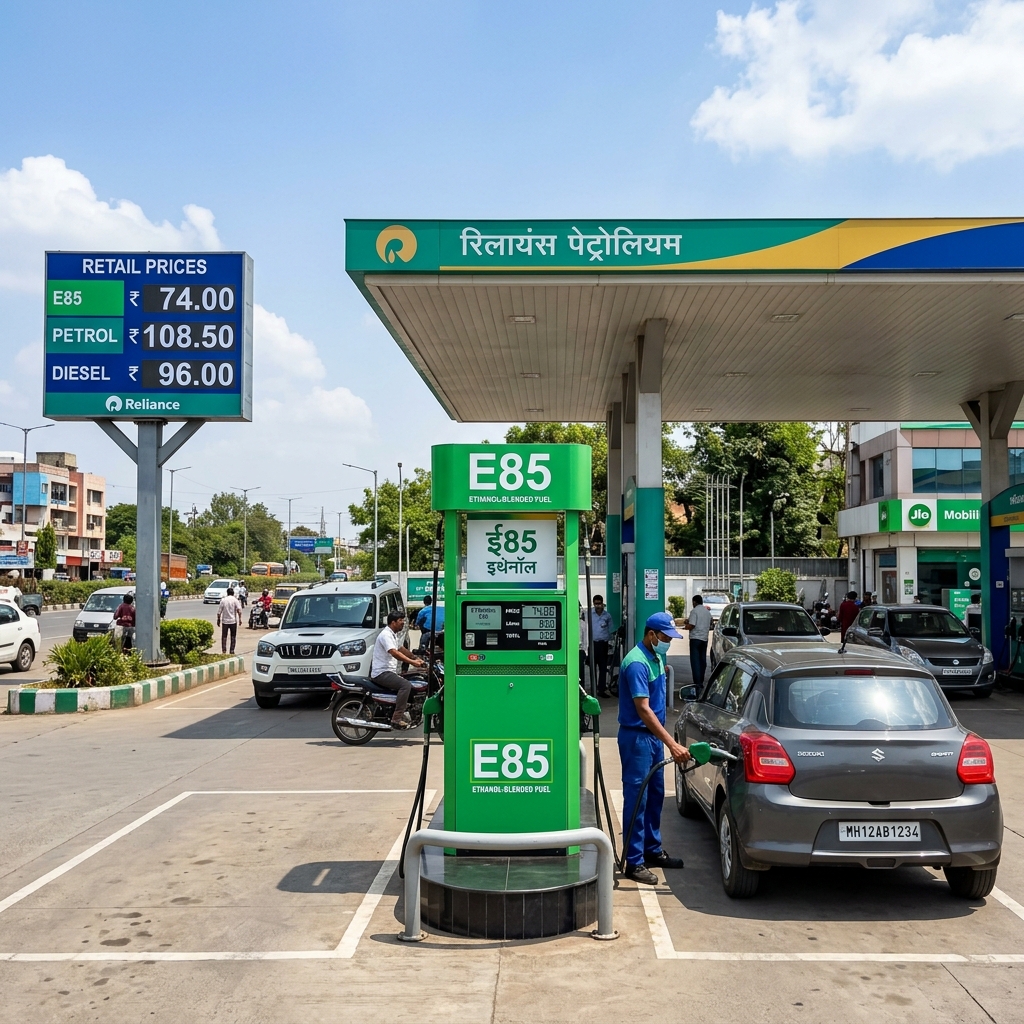
To absorb the massive increase in ethanol production, the government is incentivizing automakers to develop Flex Fuel Vehicles (FFVs) that can run on blends up to E85 or even E100. Guidelines and standards for FFVs have been drafted by regulatory bodies like the Automotive Research Association of India (ARAI).
Infrastructure Development
The biggest hurdle for E85 adoption has always been the dispensing infrastructure. However, with the government mandate, Oil Marketing Companies (OMCs) are rapidly upgrading fuel stations to dispense higher blends of ethanol. Specialized E85 pumps are expected to proliferate, starting with major metropolitan areas and agricultural hubs where ethanol production is concentrated.
---
9. Challenges in Adopting E85 in Commercial Vehicles
Despite the myriad benefits, the transition to E85 and vehicles like the Tata Ace Flex Fuel is not without challenges.
Lower Energy Density
As mentioned, ethanol contains roughly 30% less energy per unit of volume than gasoline. This means a vehicle running on E85 will consume more fuel to travel the same distance. Fleet operators must adjust to more frequent refueling stops or require larger fuel tanks, which can marginally affect payload capacity.
Infrastructure Bottlenecks
While the government is pushing for ethanol pumps, creating a ubiquitous E85 network comparable to diesel or petrol takes time and massive capital investment. A lack of reliable E85 availability outside major corridors can limit the geographical utility of these vehicles.
Food vs. Fuel Debate
A long-standing criticism of first-generation biofuels is the "food vs. fuel" debate. Diverting agricultural land and crops like sugarcane and corn to produce ethanol can theoretically drive up food prices. However, India is increasingly focusing on second-generation (2G) ethanol, which is produced from agricultural waste, crop residues (like paddy straw), and non-food biomass, mitigating this concern.
---
10. Comparisons: Flex Fuel vs. EVs vs. CNG in Commercial Vehicles
To contextualize the Tata Ace Flex Fuel, it is helpful to compare it against other clean technologies vying for dominance in the LCV segment.
Flex Fuel vs. Electric Vehicles (EVs)
* Upfront Cost: Flex-fuel vehicles are substantially cheaper to buy than EVs. * Payload: EVs suffer a payload penalty due to heavy battery packs. The Ace Flex Fuel maintains a payload capacity similar to standard ICE variants. * Refueling/Recharging: Refueling with E85 takes minutes, identical to standard fueling. Recharging an EV can take hours, leading to downtime for commercial operators. * Emissions: EVs have zero tailpipe emissions, but their overall carbon footprint depends on how the electricity is generated. E85 has low tailpipe emissions and a favorable lifecycle carbon footprint.Flex Fuel vs. Compressed Natural Gas (CNG)
* Performance: E85 often provides better torque and performance than CNG, which is crucial for carrying heavy loads. * Infrastructure: CNG infrastructure is well-established in many Indian cities, giving it a current advantage over E85. However, CNG is still a fossil fuel, whereas E85 is renewable. * Packaging: CNG cylinders are bulky and heavy, eating into cargo space and payload. Flex-fuel tanks are identical to standard fuel tanks, preserving cargo volume.---
11. Maintenance and Total Cost of Ownership (TCO)
For a commercial operator, maintenance downtime means lost revenue. The Tata Ace Flex Fuel is engineered to be as reliable as its conventional counterparts.
Routine Maintenance
The maintenance schedule for an E85 Tata Ace is remarkably similar to a standard petrol vehicle. Oil changes, filter replacements, and standard check-ups follow standard intervals.
Engine Longevity
Because E85 burns cleaner, it leaves fewer carbon deposits on valves and pistons. This clean burn can theoretically extend the life of engine components. Furthermore, the specialized corrosion-resistant materials used in the fuel system are designed for long-term durability.
Cost Analysis
When calculating TCO, operators must factor in the lower initial purchase price compared to EVs, the potentially lower fuel costs per kilometer (subject to ethanol pricing), and standard maintenance costs. For many use cases, especially where daily driving ranges exceed EV capabilities but require cleaner operations than diesel, the Flex Fuel Ace presents the optimal economic balance.
---
12. The Future of Flex Fuel in the Commercial Sector
The Tata Ace Flex Fuel is not merely a single product; it is a harbinger of a broader industry trend.
Technological Advancements
Future iterations of flex-fuel engines will likely feature direct injection and turbocharging, maximizing the high-octane benefits of E85 to deliver unprecedented efficiency and power in small displacement engines.
Integration with Hybrid Tech
We may soon see Flex-Fuel Hybrid vehicles. Combining the efficiency of an electric drivetrain for low-speed city driving with the range and payload capacity of an E85 ICE could create the ultimate commercial vehicle.
A Circular Economy
The adoption of E85 drives a circular economy. It boosts the agricultural sector, providing farmers with additional income streams from crop residues. It reduces urban pollution, leading to lower healthcare costs. It also keeps fuel capital within the domestic economy rather than sending it overseas for crude oil.
---
13. Conclusion
The transition toward sustainable commercial transport cannot rely on a single "silver bullet" technology. Different use cases, geographies, and economic realities demand a multifaceted approach. The Tata Ace Flex Fuel, powered by E85, emerges as a vital, pragmatic, and highly effective solution in this transition.
By marrying the proven reliability, affordability, and utility of the iconic Tata Ace platform with the environmental and economic benefits of high-blend ethanol, Tata Motors has created a vehicle perfectly tailored for the current era. It offers fleet operators a way to significantly reduce their carbon footprint and comply with strict emission norms without the paralyzing upfront costs or operational limitations associated with early-stage electric vehicles.
As India aggressively scales its ethanol production and dispensing infrastructure, the Tata Ace Flex Fuel stands ready to lead the charge. It is more than just a commercial vehicle; it is a catalyst for agricultural growth, energy independence, and cleaner air, proving that economic progress and environmental stewardship can, indeed, drive forward together.
---
14. FAQs
1. Can the Tata Ace Flex Fuel run on regular petrol? Yes. The flex-fuel system is designed to run on any mixture of petrol and ethanol, from standard unblended petrol (E0) all the way up to 85% ethanol (E85). The vehicle's sensors automatically adjust engine parameters based on the fuel in the tank.
2. Will using E85 void the warranty of a standard Tata Ace? Yes. You should never use E85 in a standard, unmodified vehicle. High concentrations of ethanol will damage fuel lines and engine components not designed for it. The Tata Ace Flex Fuel has specialized components specifically built to handle E85 safely under warranty.
3. Does E85 provide better fuel efficiency (mileage) than standard petrol? No, in terms of volume, E85 has a lower energy density than petrol. You will typically experience slightly lower kilometers per liter (KMPL). However, because E85 is often priced lower than petrol, the cost per kilometer can still be more economical.
4. Where can I find E85 fuel for commercial vehicles? E85 infrastructure is currently in the development phase in many regions, heavily driven by government mandates. It is primarily available at designated fuel stations, often situated in major transport corridors or regions with high ethanol production.
5. Is E85 safe for the environment? Yes. E85 is a renewable biofuel. It burns significantly cleaner than diesel or standard petrol, drastically reducing particulate matter, carbon monoxide, and greenhouse gas emissions over its lifecycle, making it an excellent choice for eco-friendly commercial logistics.