The global transition toward sustainable energy has thrust biofuels into the spotlight, with ethanol emerging as a frontrunner in the race to decarbonize the transportation sector. As nations strive to reduce their reliance on imported fossil fuels and curb greenhouse gas emissions, the adoption of higher ethanol blends, such as E85 (a mixture containing up to 85% ethanol and 15% gasoline), is gaining significant traction.
For India, a rapidly growing economy with immense energy demands and a heavy dependence on crude oil imports, the ethanol blending program is not just an environmental imperative but a strategic economic necessity. The country has successfully navigated its way to achieving a 20% ethanol blend (E20) ahead of schedule and is now setting its sights on higher blends, exploring the feasibility and infrastructure requirements for E85 and Flex-Fuel Vehicles (FFVs).
However, the foundation of any successful ethanol program lies in its feedstock. Globally, the two heavyweights in ethanol production are sugarcane and corn (maize). Brazil has championed the sugarcane model, while the United States dominates with corn-based ethanol. India, uniquely positioned with massive agricultural output, utilizes a dynamic mix of feedstocks.
This comprehensive guide delves deep into the "Sugarcane vs Corn Ethanol" debate, analyzing their differences in production, efficiency, and environmental impact. Furthermore, we will explore the intricate ecosystem of how India produces ethanol to meet its ambitious targets and the roadmap toward a future powered by E85.
---
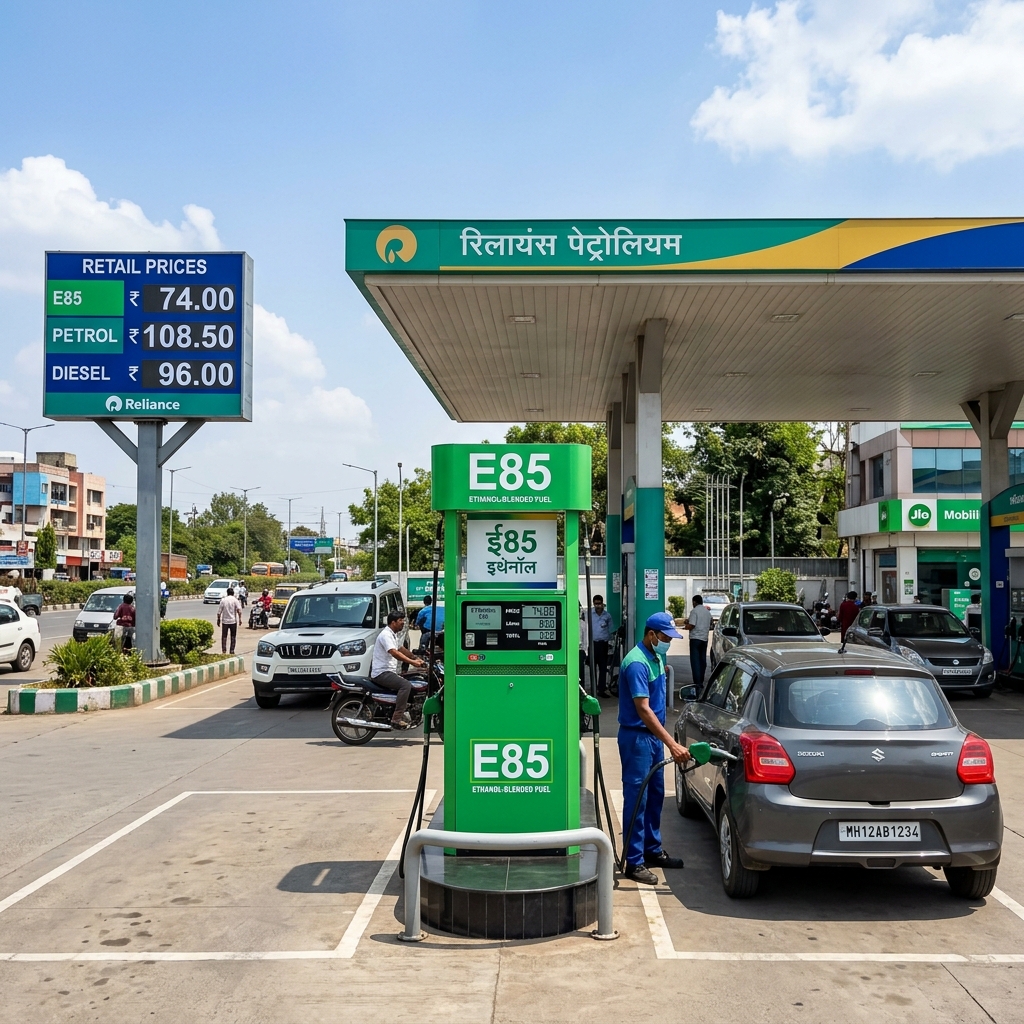
What is E85 Fuel?
Before comparing the feedstocks, it is essential to understand what E85 is and why it matters.
E85, often referred to as flex-fuel, is a high-level biofuel blend consisting of 51% to 83% ethanol (depending on geography and season) and the remainder gasoline. The "85" denotes the historical maximum ethanol content.
The Benefits of E85
1. Significant Emission Reductions: E85 burns cleaner than traditional gasoline. It significantly lowers tailpipe emissions of carbon monoxide, particulate matter, and other ozone-forming pollutants. Over its lifecycle, ethanol can reduce greenhouse gas emissions by 40% to 50% compared to fossil fuels. 2. Enhanced Engine Performance: Ethanol has a higher octane rating (typically over 100) than regular gasoline. This higher octane prevents engine knocking and allows for higher compression ratios, which can translate to increased horsepower and torque in vehicles specifically designed or tuned to run on it. 3. Energy Security: By blending domestically produced ethanol with gasoline, countries can drastically reduce their dependence on imported crude oil, insulating their economies from volatile global oil prices.To use E85, vehicles must be equipped with flexible-fuel engines (Flex-Fuel Vehicles or FFVs). These engines contain specialized sensors and corrosion-resistant fuel system components capable of handling any blend of ethanol and gasoline from E0 up to E85.
---
The Core Feedstocks: Sugarcane vs. Corn
Ethanol (ethyl alcohol) is produced through the fermentation of sugars by yeast. The primary difference between various ethanol feedstocks lies in how easily those sugars can be accessed.
Sugarcane Ethanol: The Direct Sugar Route
Sugarcane is widely considered the most efficient first-generation feedstock for ethanol production.
#### The Production Process The process of creating ethanol from sugarcane is relatively straightforward because the plant naturally stores its energy as sucrose (sugar). 1. Milling: Harvested sugarcane is brought to the mill and crushed to extract the sugary juice. 2. Clarification and Evaporation: The juice is filtered and concentrated. At this stage, some of the juice can be diverted to make crystallized sugar, while the rest (or the resulting molasses) is used for ethanol. 3. Fermentation: Yeast is added to the juice or molasses, which ferments the naturally occurring sugars directly into ethanol and carbon dioxide. 4. Distillation and Dehydration: The resulting "beer" (a low-alcohol liquid) is distilled to concentrate the ethanol. Finally, it undergoes dehydration to remove any remaining water, producing anhydrous ethanol suitable for blending with gasoline.
#### Efficiency and Byproducts Sugarcane ethanol boasts a highly favorable Energy Return on Investment (EROI). For every unit of fossil energy expended in its production, sugarcane ethanol yields roughly 8 to 9 units of energy.
A critical component of this efficiency is bagasse, the fibrous residue left over after crushing the cane. Sugar mills burn bagasse in cogeneration plants to produce steam and electricity. This makes the ethanol production facility entirely self-sufficient in energy, and often, surplus electricity is sold back to the national grid.
Corn Ethanol: The Starch Conversion Route
Corn (maize) is the dominant feedstock in the United States. Unlike sugarcane, corn stores its energy as starch, which must be converted into simple sugars before fermentation can occur.
#### The Production Process Corn ethanol is typically produced via dry milling. 1. Milling: The corn kernels are ground into a fine powder (meal). 2. Cooking and Liquefaction: The meal is mixed with water and enzymes (alpha-amylase) and heated. This breaks the long starch chains into shorter dextrins. 3. Saccharification: A second enzyme (glucoamylase) is added as the mixture cools, converting the dextrins into fermentable simple sugars (glucose). 4. Fermentation and Distillation: Yeast ferments the glucose into ethanol, followed by distillation and dehydration, similar to the sugarcane process.
#### Efficiency and Byproducts The extra step of converting starch to sugar means corn ethanol is more energy-intensive to produce than sugarcane ethanol. Its EROI is generally estimated to be between 1.5 and 2.5, significantly lower than sugarcane.
However, corn ethanol produces a highly valuable byproduct: Distillers Dried Grains with Solubles (DDGS). DDGS is a premium, high-protein animal feed used extensively in the livestock and poultry industries. This byproduct significantly offsets the economic and environmental costs of corn ethanol production.
---
Comparative Analysis: Sugarcane vs Corn
When deciding which feedstock to prioritize, policymakers and energy experts analyze several critical factors.
| Feature | Sugarcane Ethanol | Corn (Maize) Ethanol | | :--- | :--- | :--- | | Primary Energy Source | Sucrose (Direct Sugar) | Starch (Requires conversion) | | Energy Return (EROI) | Very High (8:1 to 9:1) | Moderate (1.5:1 to 2.5:1) | | Lifecycle GHG Reduction | 60% to 90% | 40% to 50% | | Valuable Byproduct | Bagasse (Electricity) | DDGS (Animal Feed) | | Water Requirement | High (Often irrigated) | Moderate (Often rain-fed) | | Climate Suitability | Tropical / Sub-tropical | Temperate |
1. Environmental Impact and GHG Emissions
Sugarcane ethanol is generally considered more environmentally friendly. The use of bagasse for power generation minimizes the use of fossil fuels during the industrial phase. Consequently, sugarcane ethanol can reduce lifecycle greenhouse gas emissions by up to 90% compared to gasoline. Corn ethanol's reliance on fossil fuels (often natural gas) for the cooking and distillation phases limits its GHG reduction potential to roughly 40-50%.2. Land Use and Yield
Sugarcane typically yields significantly more gallons of ethanol per acre of cultivated land compared to corn. This higher yield means less land is required to produce the same volume of fuel, reducing the pressure on agricultural expansion and mitigating direct land-use change.3. Water Intensity
One of the main criticisms of sugarcane is its high water requirement. In regions where rainfall is insufficient, sugarcane heavily relies on irrigation, which can deplete local water tables. Corn, particularly in the US Midwest, is often rain-fed, though it requires substantial nitrogen-based fertilizers that can lead to water pollution (eutrophication).---
India's Ethanol Landscape: Why Sugarcane Dominates
India's Ethanol Blended Petrol (EBP) Programme is one of the most successful biofuel initiatives globally. Historically, the Indian ethanol story has been almost entirely synonymous with sugarcane.
The Sugar Surplus Conundrum
India is the world's second-largest producer of sugarcane, trailing only Brazil. For years, India grappled with a structural overproduction of sugar. Bumper crops led to a glut in the domestic market, crashing sugar prices. Sugar mills, unable to generate sufficient revenue, accumulated massive arrears—money owed to millions of sugarcane farmers.The government realized that diverting excess sugarcane to ethanol production could solve multiple problems simultaneously: 1. Reduce the sugar surplus and stabilize domestic prices. 2. Provide immediate liquidity to sugar mills, enabling them to clear farmer dues. 3. Produce indigenous biofuel to cut the massive crude oil import bill.
B-Heavy Molasses and Sugarcane Juice
Traditionally, Indian mills only produced ethanol from C-heavy molasses, the final byproduct of sugar extraction that contains very little fermentable sugar. This limited ethanol production capacity.To boost output, the Indian government introduced a differential pricing policy. They offered higher procurement prices for ethanol produced directly from sugarcane juice/syrup and B-heavy molasses (an intermediate molasses with higher sugar content). This policy was a game-changer. It incentivized mills to sacrifice some sugar production in favor of ethanol, drastically increasing the country's total blending capacity.
---
The Pivot: The Growing Role of Corn (Maize) in India
While sugarcane has been the backbone of India's ethanol success, relying solely on a single crop poses significant risks. Sugarcane production is highly cyclical and heavily dependent on the monsoon. A poor monsoon year could jeopardize the entire EBP target. Furthermore, sugarcane is a water-guzzling crop primarily concentrated in states like Maharashtra, Uttar Pradesh, and Karnataka.
To achieve the massive volumes required for higher blends and eventually E85, India is actively diversifying its feedstock basket. This is where corn (maize) enters the equation.
Why Maize?
1. Geographical Diversification: Maize can be grown across various regions in India, including states that lack the water resources for sugarcane. This decentralizes ethanol production and reduces transportation costs. 2. Crop Rotation and Shorter Cycles: Maize has a shorter cultivation cycle compared to sugarcane (which remains in the ground for a year or more). It fits well into varied crop rotation patterns. 3. Less Water Intensive: Maize requires significantly less water per hectare than sugarcane, making it a more sustainable option for water-stressed regions.Government Push for Grain-Based Distilleries
The Indian government is heavily promoting the establishment of grain-based distilleries and dual-feed distilleries (capable of processing both molasses and grains).To ensure farmers have an incentive to grow maize for fuel, the government has facilitated long-term procurement agreements. Cooperative giants like NAFED and NCCF procure maize from farmers at the Minimum Support Price (MSP) and supply it directly to distilleries. This ensures a steady feedstock supply while boosting farmer incomes in non-sugarcane belts.
---
How India Produces E85: Infrastructure and Ecosystem
Scaling up to an E85 ecosystem is a colossal undertaking that goes far beyond agricultural production. It requires an overhaul of the entire supply chain, from the distillery to the gas station nozzle.
1. Expanding Distillation Capacity
To meet the demands of an E20 and potential E85 future, India has facilitated massive investments in new distillation infrastructure. The government provides interest subvention schemes (subsidized loans) to entrepreneurs setting up new distilleries or expanding existing ones. The focus has shifted from standalone molasses distilleries to flexible, multi-feedstock plants capable of processing sugarcane juice, B-heavy molasses, maize, and damaged food grains (like broken rice).2. The Role of Oil Marketing Companies (OMCs)
Public sector OMCs (like Indian Oil Corporation, Bharat Petroleum, and Hindustan Petroleum) are the linchpins of the distribution network. * Procurement: OMCs sign long-term purchase agreements with distilleries, providing demand certainty. * Storage and Blending: OMCs have invested heavily in expanding storage infrastructure at their depots. Ethanol is hygroscopic (it absorbs water), meaning it cannot easily be transported through existing petroleum pipelines. Therefore, ethanol is transported via trucks or railways to OMC depots, where it is blended with gasoline just before being loaded into fuel tanker trucks for delivery to retail outlets.3. The Introduction of Flex-Fuel Vehicles (FFVs)
Producing E85 is only half the battle; vehicles must be able to consume it. The Indian government has aggressively pushed automakers to develop and launch Flex-Fuel Vehicles.Several major manufacturers have already showcased FFV prototypes customized for Indian conditions. These vehicles feature robust engine components, advanced Engine Control Units (ECUs) to instantly detect the ethanol blend, and specialized fuel lines to prevent corrosion. For E85 to become mainstream, these vehicles must achieve mass-market penetration, which will require economies of scale and potentially consumer incentives.
---
Challenges in Scaling to E85 in India
Despite the rapid progress, the road to an E85-powered India is fraught with challenges.
1. The "Food vs. Fuel" Debate
As more agricultural land and output are diverted to biofuel production, concerns about food security inevitably arise. While utilizing surplus sugar and damaged grains is uncontroversial, diverting primary food crops like healthy maize or rice toward fuel production requires a delicate balancing act to prevent inflation in food prices.2. Water Stress
While maize is less water-intensive, India's continued heavy reliance on sugarcane in water-stressed states remains an environmental concern. Transitioning farmers toward sustainable irrigation practices, such as drip irrigation, is crucial but capital-intensive.3. Infrastructure Bottlenecks
Moving vast quantities of ethanol from rural distilleries to urban depots requires a robust logistics network. The lack of dedicated ethanol pipelines means relying on road and rail transport, which adds to the carbon footprint and cost of the fuel.4. Pricing and Consumer Adoption
For consumers to choose E85, it must be economically attractive. Because ethanol has a lower energy density than gasoline, a vehicle running on E85 will experience a drop in fuel economy (miles per gallon). Therefore, E85 must be priced significantly lower than pure gasoline at the pump to compensate the consumer. Achieving this price differential without massive government subsidies requires hyper-efficient production and distribution.---
The Future: 2G Ethanol (Cellulosic)
While sugarcane and corn (1G or first-generation feedstocks) are the current focus, the ultimate solution to the food vs. fuel debate and feedstock limitations lies in Second-Generation (2G) ethanol.
2G ethanol is produced from cellulosic biomass—agricultural residues that are not edible. In India, this primarily means paddy straw, wheat stalk, and empty corn cobs.
Solving the Stubble Burning Crisis
Every winter, the burning of agricultural crop residue (especially paddy straw in Punjab and Haryana) causes severe air pollution across Northern India. By commercializing 2G ethanol technology, this agricultural waste can be converted into a valuable economic resource. Farmers can sell their stubble instead of burning it, effectively turning pollution into fuel.India is currently operationalizing its first few commercial 2G ethanol biorefineries. While the technology (breaking down tough cellulose into fermentable sugars) is complex and currently more expensive than 1G processes, continuous innovation is expected to drive down costs, making cellulosic ethanol a critical pillar of India's long-term E85 strategy.
---
Conclusion
The debate between sugarcane and corn ethanol is not about finding a single absolute winner, but about understanding regional advantages.
In the context of how India is scaling its biofuel production, the strategy is brilliantly pragmatic. Sugarcane remains the undisputed king*, providing the high efficiency and volume necessary to anchor the program, solve the sugar sector's financial woes, and drastically cut emissions. However, *corn/maize is emerging as the vital balancing force, providing geographical diversity, year-round feedstock supply, and a lower-water alternative.
By strategically blending the strengths of both sugarcane and corn, aggressively expanding distillation and blending infrastructure, and laying the groundwork for Flex-Fuel Vehicles and 2G cellulosic technologies, India is not just following the global biofuel trend—it is forging a unique, resilient path toward energy independence. The journey to E85 is complex, but the roadmap is clear, promising a greener, more self-reliant future for the nation.
--- Disclaimer: The biofuel landscape is rapidly evolving. Policies, production statistics, and technological advancements mentioned in this article are based on current data and projections as of 2026.