The Indian automotive landscape is undergoing a massive transformation, driven by an urgent need to reduce carbon emissions and decrease reliance on imported crude oil. At the forefront of this shift is the transition towards renewable energy and alternative fuels. While electric vehicles (EVs) dominate headlines, biofuels, particularly ethanol blends like E85, are emerging as a crucial component of India's green mobility strategy.
Shell, one of the world's leading energy companies, has a significant presence in India. With a growing focus on sustainability and biofuels globally, many are asking: When will Shell India launch E85 at its fuel stations? In this comprehensive article, we delve deep into Shell India's biofuel initiatives, the potential timeline for an E85 launch, the state of ethanol blending in India, and what this all means for consumers and the environment.
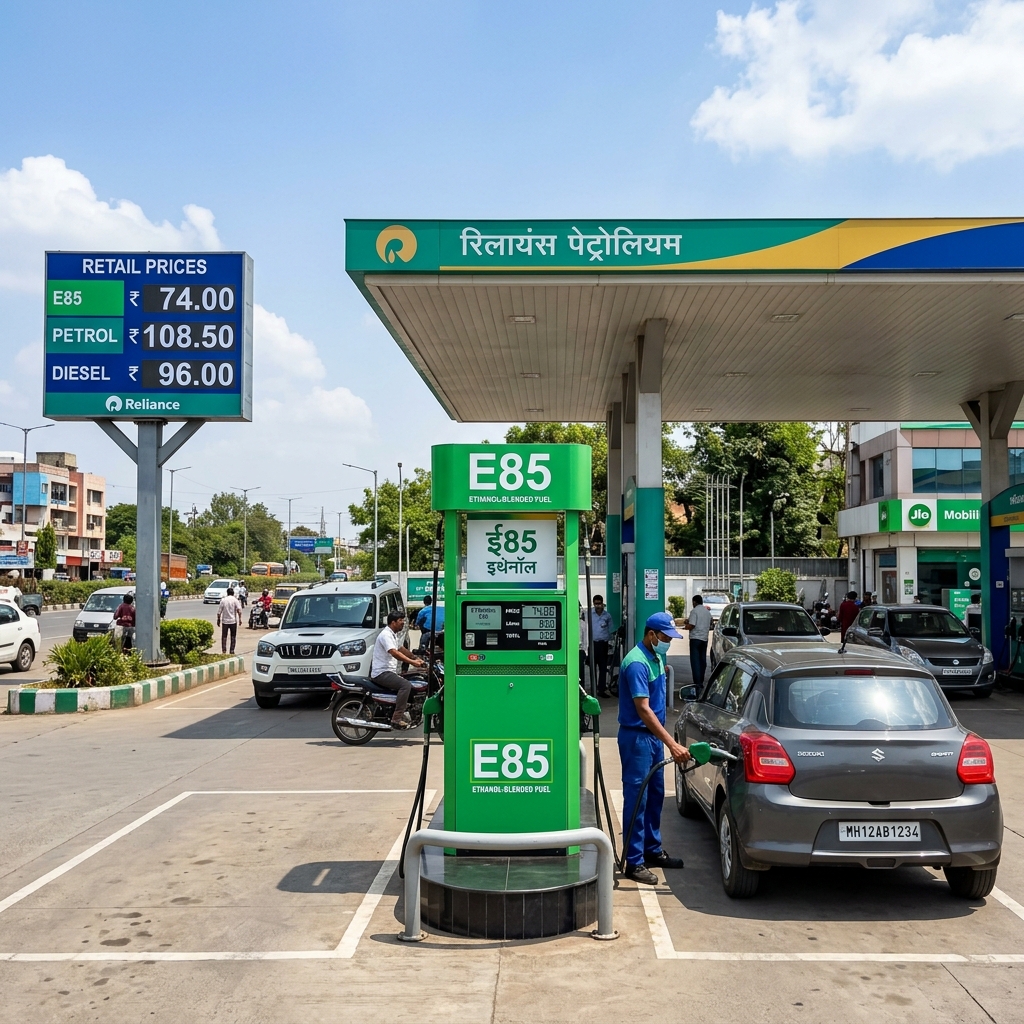
The Global Shift Towards Biofuels and E85
Before analyzing Shell's specific plans in India, it's essential to understand the global context of biofuels. Biofuels, derived from organic matter such as sugarcane, corn, and agricultural residue, offer a renewable alternative to traditional fossil fuels. Ethanol, the most common type of biofuel, is typically blended with gasoline to reduce greenhouse gas emissions.
What is E85?
E85 is a high-level ethanol blend containing up to 85% ethanol and 15% gasoline. Unlike lower blends like E10 (10% ethanol) or E20 (20% ethanol), which can be used in most conventional internal combustion engine (ICE) vehicles, E85 requires specially designed Flex-Fuel Vehicles (FFVs). These vehicles are engineered to run on any blend of gasoline and ethanol, up to 85%.
Why is E85 Important?
1. Significant Emission Reductions: E85 can significantly lower greenhouse gas emissions compared to standard gasoline, contributing to cleaner air and a reduced carbon footprint. 2. Energy Security: By utilizing domestically produced ethanol, countries can reduce their dependence on imported oil, enhancing national energy security. 3. Agricultural Boost: Increased demand for ethanol creates a broader market for agricultural products, boosting the rural economy.
India's Ethanol Blending Programme (EBP)
India has been aggressive in its push for ethanol blending. The government's Ethanol Blended Petrol (EBP) programme aims to increase the use of alternative fuels. Initially targeting 20% blending (E20) by 2030, the government successfully advanced this target to 2025.
The Progress So Far
India achieved its target of 10% ethanol blending (E10) in mid-2022, well ahead of schedule. Since then, the rollout of E20 fuel has been rapid, with major public sector oil marketing companies (OMCs) like Indian Oil (IOCL), Bharat Petroleum (BPCL), and Hindustan Petroleum (HPCL) dispensing E20 at thousands of retail outlets nationwide.
The Next Frontier: E85 and Flex-Fuel Vehicles
With E20 becoming mainstream, the next logical step in India's biofuel journey is the introduction of flex-fuel vehicles and higher ethanol blends like E85. The government and the Society of Indian Automobile Manufacturers (SIAM) have been actively promoting the development of FFVs. Several automakers, including Toyota and Maruti Suzuki, have showcased flex-fuel prototypes in India.
Shell's Global Biofuel Strategy
Shell is a major player in the global biofuels market. The company recognizes that biofuels will play a critical role in decarbonizing the transport sector, particularly in hard-to-electrify segments like heavy-duty road transport, aviation, and shipping.
Shell's global strategy involves: - Investing in Production: Shell is investing in advanced biofuels production facilities. - Retail Expansion: Expanding the availability of lower-carbon fuels, including ethanol blends, at its retail stations worldwide. - Partnerships: Collaborating with industry partners, governments, and agricultural sectors to scale up biofuel supply chains.
In markets like Brazil, Shell (through its joint venture Raízen) is a massive producer and distributor of ethanol. Brazil is a pioneer in flex-fuel technology, and Shell's experience there provides invaluable expertise that can be leveraged in emerging biofuel markets like India.
Shell India: Current Footprint and Operations
Shell India operates across the entire energy value chain, from upstream oil and gas exploration to downstream retail and lubricants. While public sector OMCs dominate the Indian fuel retail market, Shell has established a premium niche with a growing network of retail stations known for high-quality fuels and customer service.
Shell V-Power and Premium Fuels
Shell India is renowned for its premium fuels, particularly Shell V-Power, which is designed to enhance engine performance and efficiency. Shell's focus has traditionally been on offering differentiated, high-performance gasoline and diesel.
Shell's Stance on Renewable Energy in India
Shell has been steadily expanding its renewable energy footprint in India. This includes investments in solar power, EV charging infrastructure (Shell Recharge), and exploring opportunities in biofuels. However, the company's approach to fuel retail has primarily aligned with the prevailing market standards and regulatory requirements.
The Big Question: When Will Shell India Launch E85?
As of mid-2026, Shell India has not officially announced a specific launch date for E85 fuel at its retail outlets. The introduction of a new, highly specialized fuel like E85 involves a complex interplay of several factors. To predict when Shell might launch E85, we must examine the prerequisites and challenges.
1. The Availability of Flex-Fuel Vehicles (FFVs)
The most significant barrier to the launch of E85 is the lack of a substantial flex-fuel vehicle fleet in India. E85 cannot be used in standard cars; it requires FFVs. - Current Status: While automakers have showcased prototypes and expressed commitment, mass-market FFVs are not yet widely available in Indian showrooms. - The Chicken-and-Egg Problem: Automakers are hesitant to mass-produce FFVs without a widespread E85 dispensing infrastructure, and fuel retailers like Shell are reluctant to invest in specialized E85 pumps without a critical mass of FFVs on the road. - Shell's Move: Shell is likely waiting for clear signals from the automotive industry regarding the mass rollout of FFVs before committing to E85 infrastructure.
2. Government Policy and Incentives
Government policy plays a crucial role in shaping the fuel market. - Current Focus: The government's immediate focus is heavily concentrated on ensuring the nationwide availability and adoption of E20 by the end of 2025 or 2026. - Future Mandates: For E85 to take off, the government may need to implement specific policies, such as tax incentives for FFVs or mandates for fuel retailers to offer E85 at a certain percentage of their outlets. - Shell's Alignment: Shell will align its strategy with government directives. Once the regulatory framework strongly supports or mandates E85 availability, Shell will likely move quickly to comply and capture market share.
3. Supply Chain and Logistics
Procuring, transporting, and storing high-level ethanol blends require specialized infrastructure. - Sourcing: Shell would need to secure a stable and large-scale supply of ethanol to support an E85 rollout. - Infrastructure: Ethanol is hygroscopic (absorbs water), meaning it cannot be easily transported through existing petroleum pipelines. It requires specialized transportation and dedicated storage tanks at retail stations to prevent phase separation and corrosion. - Investment: Retrofitting existing stations or building new infrastructure for E85 requires significant capital expenditure. Shell will evaluate the return on investment based on projected demand.
4. Pricing and Consumer Economics
For E85 to be successful, it must make economic sense for the consumer. - Energy Density: Ethanol has lower energy density than gasoline. This means a vehicle running on E85 will experience lower fuel efficiency (fewer miles per gallon/kilometers per liter) compared to regular gasoline. - Price Differential: To compensate for the lower mileage, E85 must be priced significantly lower than standard gasoline. In markets where E85 is successful, this price gap is maintained through government subsidies or abundant, cheap ethanol supply. - The Indian Context: Shell will need to ensure it can offer E85 at a competitive price point that justifies the consumer's switch to a flex-fuel vehicle, while still maintaining profitability.
Predicting the Timeline for Shell's E85 Launch
Given the complexities outlined above, we can project a tentative timeline for the potential launch of E85 by Shell India:
Short-Term (2026-2027): Focus on E20 and EV Charging
In the immediate future, Shell India's primary focus in the retail sector will remain on consolidating its E20 offerings, expanding its premium V-Power network, and rapidly scaling up its 'Shell Recharge' EV charging infrastructure. We are unlikely to see a widespread E85 launch during this period.
Mid-Term (2028-2030): Pilot Programs and Strategic Rollouts
As mass-market FFVs begin to enter the Indian market around 2027-2028, we might see the first signs of E85 infrastructure. - Targeted Rollouts: Shell may initiate pilot programs, introducing E85 pumps at select, high-traffic stations in states with strong ethanol production (like Maharashtra or Uttar Pradesh) or in major metropolitan areas with higher early adoption rates of FFVs. - Partnerships: Shell could partner with specific automakers launching FFVs to guarantee fuel availability for early adopters, similar to how EV charging tie-ups are formed.
Long-Term (2030 and Beyond): Mainstream Availability
If the government's push for FFVs is successful and a robust domestic ethanol supply chain is established, E85 could become a mainstream offering by 2030. In this scenario, Shell India, leveraging its global expertise in biofuels, would likely roll out E85 across a significant portion of its retail network to remain competitive and meet sustainability targets.
The Advantages of Shell Leading the E85 Charge
If and when Shell India decides to launch E85, the company possesses several unique advantages that could make it a leader in this space:
1. Global Expertise: Shell's extensive experience with high-level ethanol blends in markets like Brazil gives it a massive operational advantage in handling, storing, and marketing E85. 2. Premium Brand Image: Shell is perceived as a premium fuel provider. They could position their E85 offering not just as a greener alternative, but as a high-quality, performance-oriented biofuel blend, perhaps integrating their proprietary additive technologies. 3. Integrated Energy Hubs: Shell is transforming its retail stations into integrated energy hubs offering multiple fuels (petrol, diesel, CNG, EV charging, and potentially E85) alongside premium convenience retail. This comprehensive offering attracts a wider customer base.
Challenges Ahead for E85 in India
While the prospect of E85 is promising, the broader Indian market faces significant challenges that Shell and other stakeholders must overcome:
Food vs. Fuel Debate
As ethanol production scales up, there are concerns about diverting agricultural land and crops away from food production to fuel production. The government must carefully balance this to ensure food security is not compromised. Second-generation (2G) ethanol, produced from agricultural waste, is a solution, but the technology is still maturing in India.Infrastructure Bottlenecks
Creating a nationwide, specialized infrastructure for transporting and storing high-level ethanol blends is a massive logistical undertaking that requires coordinated efforts between the government, OMCs, and private players like Shell.Consumer Awareness
Educating the Indian consumer about the benefits of E85, the nature of flex-fuel vehicles, and the economics of running on higher ethanol blends will be crucial for widespread adoption.Conclusion
The launch of E85 by Shell India is not a question of 'if', but 'when'. The transition to biofuels is a critical pillar of India's strategy to reduce emissions and achieve energy independence.
However, Shell's timeline for launching E85 is heavily dependent on external factors: the mass availability of flex-fuel vehicles, supportive government policies, and the development of a robust supply chain. While a widespread rollout is unlikely in the immediate short term, we can expect to see strategic pilot programs and targeted availability towards the late 2020s.
When the market conditions are ripe, Shell India, backed by its global expertise and premium retail network, is well-positioned to be a significant player in delivering high-quality E85 to Indian consumers, driving the nation further along its green mobility journey. Until then, the company will likely continue to champion its E20 offerings and rapidly expand its EV charging infrastructure, catering to the evolving energy needs of the modern Indian motorist.
*
Disclaimer: This article is based on market analysis, global trends, and current policy frameworks. Corporate strategies are subject to change based on evolving market conditions. Please refer to official announcements from Shell India for confirmed product launch dates.