The automotive landscape in India is undergoing a massive transformation, driven by environmental concerns, energy security, and government mandates. One of the most significant shifts is the transition towards ethanol-blended fuels. With the successful implementation of E20 (20% ethanol, 80% petrol) across various parts of the country, the conversation is naturally shifting towards higher blends, specifically E85 (85% ethanol, 15% petrol). For motorcycle enthusiasts, particularly fans of the iconic Royal Enfield brand, this raises a crucial question: What does the future hold for classic thumping engines? Specifically, what is the reality of Royal Enfield E85 compatibility, and can the beloved Classic 350 realistically run on flex fuel?
In this comprehensive guide, we will dive deep into the technical nuances of ethanol blends, analyze the engineering of the Royal Enfield Classic 350, explore what happens when you introduce high-ethanol fuels to standard engines, and discuss what it would take to create a true E85-compatible Classic 350. Whether you are a daily commuter, a weekend tourer, or a motorcycle tuning aficionado, understanding the intersection of retro motorcycling and alternative fuels is essential for the road ahead.
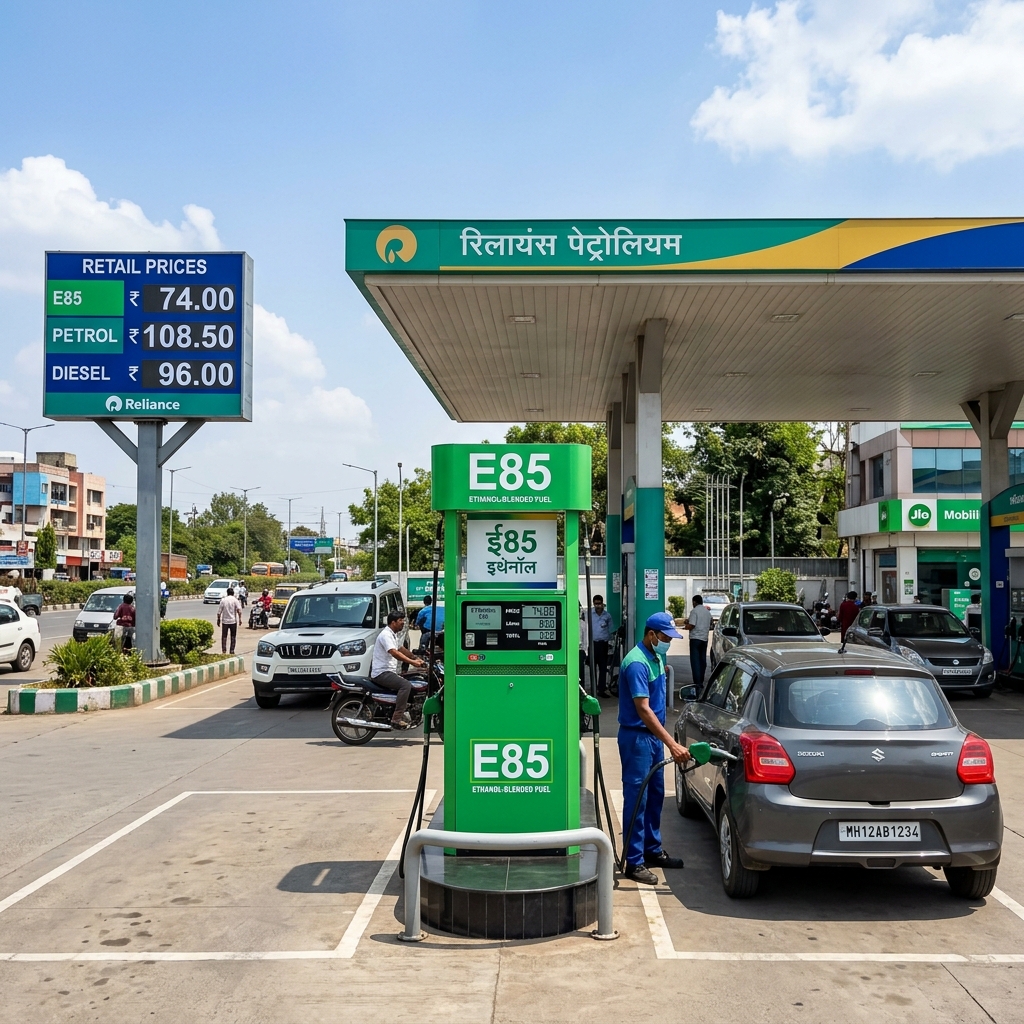
The Shift Towards Ethanol Blending in India
Before we dissect the Royal Enfield Classic 350's engine, it is vital to understand why ethanol is becoming a focal point in the Indian fuel market. The Government of India has been aggressively pushing the Ethanol Blended Petrol (EBP) program to reduce the nation's reliance on imported crude oil and curb vehicular emissions.
The E20 Milestone
The initial target was to achieve 20% ethanol blending (E20) by 2030, a goal that was fast-tracked to 2025-2026 due to rapid progress and increased agricultural output of ethanol feedstocks like sugarcane and broken rice. Today, many fuel stations dispense E20 petrol, and modern motorcycles are rolling out of factories with E20-compliant engines. Royal Enfield, like other major two-wheeler manufacturers in India, has adapted its lineup to handle E20 fuel safely without compromising performance or longevity.The Road to E85 and Flex Fuel
While E20 requires minor material upgrades and ECU (Engine Control Unit) adjustments, moving to E85 represents a paradigm shift. E85 is considered a "flex fuel" because vehicles designed to run on it must also be able to run on standard petrol or any blend in between. A flex-fuel vehicle (FFV) automatically adjusts its fuel injection and spark timing based on the ethanol content it detects in the tank.The Indian government has signaled its intent to introduce flex-fuel vehicles, drawing inspiration from countries like Brazil, where high-ethanol blends and flex-fuel technology have been commonplace for decades. However, the transition for two-wheelers, especially retro-styled ones like the Royal Enfield Classic 350, presents unique engineering challenges.
Understanding E85 Fuel: Characteristics and Challenges
To grasp why running a standard Royal Enfield on E85 is problematic, we must first look at the chemical and physical properties of ethanol compared to traditional gasoline (petrol).
Energy Density
Ethanol has a significantly lower energy density than petrol. A gallon (or liter) of E85 contains about 25% to 30% less energy than a gallon of pure petrol. This means that to achieve the same power output, an engine must burn roughly 30% more fuel. Consequently, a vehicle running on E85 will experience a noticeable drop in fuel efficiency (mileage) compared to running on standard petrol.Stoichiometric Fuel Ratio
The stoichiometric ratio is the ideal ratio of air to fuel for complete combustion. For standard petrol, this ratio is approximately 14.7:1 (14.7 parts air to 1 part fuel). For pure ethanol (E100), the ratio is 9.0:1. For E85, it hovers around 9.7:1 to 9.8:1. This means an engine running E85 requires much more fuel relative to the air intake to run optimally. Standard fuel injectors and ECU maps designed for petrol cannot deliver the volume of fuel required for E85, leading to a lean running condition.Octane Rating
One of the primary benefits of E85 is its high octane rating, typically ranging from 100 to 105. High octane fuel resists "knocking" or pre-ignition, allowing engines to run higher compression ratios or more advanced ignition timing to extract more power. While this is fantastic for high-performance, turbocharged engines, it doesn't necessarily translate to massive gains in low-compression, air-cooled engines like those found in traditional Royal Enfields unless the engine is explicitly built to exploit it.Corrosive Nature and Hygroscopy
Ethanol is an alcohol, and it is inherently more corrosive to certain metals, plastics, and rubbers than petrol. Older fuel systems with natural rubber hoses, certain aluminum alloys, or zinc components can degrade rapidly when exposed to high ethanol concentrations. Furthermore, ethanol is hygroscopic, meaning it absorbs moisture from the air. This can lead to phase separation in the fuel tank, where the water-ethanol mixture separates from the petrol and sinks to the bottom, causing severe running issues and internal corrosion.The Royal Enfield Classic 350: Engine Architecture
To assess Royal Enfield E85 compatibility, let's examine the heart of the modern Classic 350—the J-series engine.
Introduced to replace the aging UCE (Unit Construction Engine), the 349cc, single-cylinder, air-oil cooled J-series engine is a marvel of modern retro engineering. It retains the signature long-stroke architecture (72mm bore x 85.8mm stroke) that gives the Classic 350 its distinct low-end torque and thump, while incorporating a SOHC (Single Overhead Camshaft) and a balancer shaft to minimize vibrations.
Fuel Delivery: Electronic Fuel Injection (EFI)
Crucially, the J-series engine relies on a modern Electronic Fuel Injection (EFI) system managed by an ECU. This system uses an oxygen (O2) sensor in the exhaust to monitor combustion and adjust the fuel-air mixture in real-time (closed-loop operation).Current Ethanol Compliance
As of recent model years, the Classic 350 is fully compliant with E20 fuel. This means Royal Enfield has already upgraded the fuel lines, seals, and the fuel pump to withstand 20% ethanol, and the ECU is calibrated to handle the slight changes in stoichiometry and energy density that E20 introduces.However, being E20 compliant is vastly different from being E85 ready.
What Happens If You Put E85 in a Standard Classic 350?
If you were to mistakenly (or experimentally) fill a standard, unmodified Royal Enfield Classic 350 with E85 fuel, several negative consequences would ensue, ranging from poor drivability to severe engine damage.
1. Extremely Lean Running Condition
As established, E85 requires a much richer mixture (more fuel) than petrol. The standard ECU in the Classic 350 is programmed with fueling maps designed for petrol and E10/E20. When running E85, the O2 sensor will detect a lean condition and instruct the ECU to add more fuel. However, standard fuel injectors have a maximum flow rate. They simply cannot physically flow the extra 30% fuel required for E85. The engine will run dangerously lean.Lean running causes combustion temperatures to spike. In an air-cooled engine like the Classic 350, this is catastrophic. It can lead to burnt exhaust valves, damaged piston rings, and in extreme cases, piston melting or seizing.
2. Starting Difficulties, Especially in Cold Weather
Ethanol has a higher latent heat of vaporization than petrol, meaning it requires more heat to turn from a liquid into a combustible vapor. In cold weather, E85 does not vaporize well, making engines notoriously difficult to start. A standard Classic 350 would likely crank excessively, drain the battery, and fail to start on cold mornings if running on pure E85 without specific cold-start tuning enrichments.3. Material Degradation
While the J-series is E20 compliant, the long-term effects of E85 on the specific fuel pump internals, fuel pressure regulator, and any remaining sensitive plastics in the fuel system are unknown but highly likely to be detrimental. High ethanol concentrations can cause swelling and deterioration of non-compatible seals, leading to fuel leaks or pressure loss.4. Poor Performance and Stalling
Due to the inability of the standard system to provide adequate fuel, the motorcycle would experience severe hesitation, loss of power, surging at steady speeds, and frequent stalling, making it virtually unrideable.Modifying the Classic 350 for E85 Flex Fuel
So, standard Royal Enfield E85 compatibility is a firm "no." But can it be modified to run on E85? The answer is yes, but it is a complex and relatively expensive endeavor. Converting a Classic 350 to a true flex-fuel vehicle requires addressing fuel volume, material compatibility, and engine management.
Step 1: Upgrading the Fuel Delivery System
The most critical physical limitation is fuel flow. - High-Flow Fuel Injector: The stock injector must be replaced with one capable of flowing at least 30-40% more fuel to accommodate the stoichiometric requirements of E85. - Upgraded Fuel Pump: The stock fuel pump may not be able to maintain adequate fuel pressure at the higher flow rates required by the larger injector. A higher-capacity, E85-compatible fuel pump might be necessary. - Fuel Lines and Filters: While E20 compliant lines might survive, upgrading to PTFE (Teflon) lined hoses guarantees long-term resistance to E85's corrosive properties.Step 2: Flex Fuel Sensor Integration
To make the motorcycle a true "flex fuel" vehicle (capable of running petrol, E85, or any mix), a flex fuel sensor must be installed in the fuel line. This sensor continuously measures the ethanol content of the fuel passing through it and sends a signal (usually a varying frequency) to the ECU.Step 3: Standalone or Piggyback ECU Tuning
The stock Royal Enfield ECU is locked and cannot natively read a flex-fuel sensor or switch between drastically different fueling maps on the fly. - Piggyback ECU: A sophisticated piggyback controller (like a PowerTronic or similar advanced unit) might be able to intercept the injector signals and add fuel based on input, but integrating a flex-fuel sensor seamlessly is difficult. - Standalone ECU: The ideal, albeit expensive, solution is a full standalone ECU (such as Haltech or a specialized motorcycle unit). This allows custom programming. The tuner would create a base map for pure petrol and a separate base map for pure E85. The ECU then uses the input from the flex fuel sensor to interpolate between these two maps in real-time, automatically adjusting fuel injection duration and ignition timing based on the exact ethanol blend currently in the tank.Step 4: Ignition Timing Optimization
Because E85 has a high octane rating, it burns slower and resists knock. A tuner can advance the ignition timing significantly when the sensor detects high ethanol content. This reclaims some of the low-end torque and power that might otherwise be lost, optimizing the engine's efficiency on the alternative fuel.Pros and Cons of E85 for Motorcycles
If a rider goes through the trouble of an E85 conversion, or if Royal Enfield eventually releases a factory flex-fuel Classic 350, what are the real-world advantages and disadvantages?
The Pros of E85
1. Environmental Benefits: E85 burns cleaner than petrol, producing fewer greenhouse gases and particulate emissions. Since ethanol is derived from plants that absorb CO2 during their growth cycle, it is considered a renewable and more carbon-neutral fuel over its lifecycle. 2. Cooler Engine Running: Ethanol absorbs more heat as it vaporizes in the intake tract compared to petrol. This "charge cooling" effect can actually help an air-cooled engine like the Classic 350 manage temperatures under heavy load, provided the fuel mixture is correctly tuned (not lean). 3. Potential for More Power (with tuning): Because of its high octane rating, an engine tuned specifically for E85 can run more aggressive ignition timing, potentially yielding a slight increase in horsepower and torque, though this is less pronounced in low-compression engines. 4. Supporting Local Agriculture: In India, heavy adoption of ethanol directly supports the agricultural sector, specifically sugarcane and grain farmers.The Cons of E85
1. Reduced Fuel Economy: This is the most significant drawback for average riders. Expect a 25% to 30% reduction in mileage. If your Classic 350 currently gets 35 km/l on petrol, it might drop to 24-26 km/l on E85. This means more frequent fuel stops, which is a major downside for touring. 2. Availability: While E20 is becoming common, true E85 pumps are currently rare in India. A flex-fuel system mitigates this by allowing you to use regular petrol, but finding E85 for dedicated runs will be challenging in the near term. 3. Cold Start Issues: Even with proper tuning, E85 can be stubborn in winter months, requiring longer cranking times. 4. Hygroscopic Risks: For motorcycles that sit for long periods (like weekend riders), ethanol's tendency to absorb water is a serious concern. Fuel stabilizers designed for ethanol blends become mandatory to prevent phase separation and internal tank rust.The Future of Flex Fuel Motorcycles in India
The Indian government has made its ambitions clear: flex-fuel technology is the intermediate step before mass electrification. Several mainstream manufacturers have already showcased flex-fuel prototypes of commuter motorcycles.
Will Royal Enfield Build an E85 Classic 350?
Given Royal Enfield's market position, it is highly likely that they are actively researching and developing flex-fuel capabilities for the J-series engine platform. The transition from E20 compliance to full E85 flex-fuel capability requires a slightly more robust fuel system and a smarter ECU equipped with a flex-fuel sensor.For a company that trades heavily on long-distance touring and reliability, managing the reduced range (due to lower energy density) will be a marketing and engineering hurdle. They might need to increase fuel tank capacities slightly or rely on the "flex" aspect, assuming riders will use E85 for city commutes and switch to higher-energy petrol for long highway tours.
Furthermore, Royal Enfield must ensure that the classic "thump" and low-end torque characteristics are preserved when running on ethanol, which requires meticulous engine mapping.
Conclusion
To answer the central question: No, a standard Royal Enfield Classic 350 cannot currently run on E85 flex fuel. Doing so would cause severe lean conditions, poor performance, and potential engine failure due to the fuel system's inability to deliver the required volume and the ECU's inability to adapt to the drastic change in stoichiometry.
However, Royal Enfield E85 compatibility is not a technological impossibility; it is merely a matter of calibration and hardware upgrades. For the aftermarket enthusiast, converting a Classic 350 to run on E85 is possible with aftermarket standalone ECUs, high-flow injectors, and flex-fuel sensors, though it is a niche and expensive pursuit.
As India's fuel infrastructure evolves rapidly towards higher ethanol blends, it is only a matter of time before manufacturers offer factory-ready flex-fuel motorcycles. Until Royal Enfield officially releases an E85-compatible model, Classic 350 owners should strictly adhere to the manufacturer's recommendations, utilizing standard petrol or E20 blends as specified in their owner's manuals, ensuring their beloved machines continue to thump reliably for years to come.
---
FAQs on Royal Enfield E85 Compatibility
Q1: Can I mix a little bit of E85 with regular petrol in my Classic 350? A: It is strongly advised against. While modern Classic 350s (J-series) are E20 compliant, adding E85 will unpredictably raise the total ethanol concentration beyond 20%. This can push the engine into a lean condition, risking overheating and damage. Stick to standard petrol or pump-dispensed E20.
Q2: Will E85 make my Royal Enfield faster? A: Not without extensive modifications. In a stock engine, E85 will actually decrease performance and cause stalling. If you fully modify the fuel system and tune a standalone ECU to take advantage of E85's high octane via advanced ignition timing, you might see a small power increase, but the primary result will be a massive drop in fuel efficiency.
Q3: Does ethanol damage the fuel tank of a Classic 350? A: Modern Royal Enfields have protective coatings in their fuel tanks to resist rust. However, because ethanol absorbs water from the air (hygroscopic), leaving E20 (or hypothetical E85) sitting in the tank for months without use can lead to phase separation. The water drops to the bottom and can cause internal rust over time. If storing the bike, fill it with ethanol-free fuel if possible, or use a high-quality fuel stabilizer.
Q4: How much will mileage drop if a Classic 350 runs on E85? A: Because E85 has less energy per liter than petrol, an engine must burn roughly 30% more fuel to maintain the same power. Therefore, you can expect a drop in mileage (km/l) of approximately 25% to 30% compared to running on standard petrol.
Q5: When will Royal Enfield launch a flex-fuel motorcycle? A: While Royal Enfield has not provided an official release date for a flex-fuel (E85 capable) motorcycle, the Indian government's strong push for ethanol blending suggests that all major manufacturers are developing this technology. It is highly probable that we will see flex-fuel Royal Enfield models introduced within the next few years as the national infrastructure for E85 expands.
Q6: What is a flex fuel sensor, and why is it needed? A: A flex fuel sensor is an electronic device installed in the fuel line that measures the exact percentage of ethanol in the fuel in real-time. It sends this data to the ECU. It is necessary because a "flex fuel" vehicle must be able to run on pure petrol, E85, or any random mixture of the two. The ECU uses the sensor data to instantly adjust fuel injection volume and spark timing to match the fuel currently flowing to the engine. Standard motorcycles do not have this sensor.