The Indian automotive and energy sectors are undergoing a massive transformation, driven by the urgent need to reduce carbon emissions and decrease reliance on imported fossil fuels. At the heart of this transformation is the aggressive push for ethanol blending. While the E20 (20% ethanol blend) milestone has been achieved ahead of schedule in many parts of the country, the next big leap is E85—a fuel blend containing 85% ethanol and 15% gasoline. Leading this charge is Jio-bp, the dynamic joint venture between Reliance Industries Limited (RIL) and global energy major bp.
In this comprehensive guide, we delve deep into the Reliance Jio-bp E85 pumps rollout plan for 2026. We will explore what this means for the Indian consumer, the infrastructure upgrades required, the synergy with Flex-Fuel Vehicles (FFVs), and the broader economic and environmental impacts of this ambitious project.
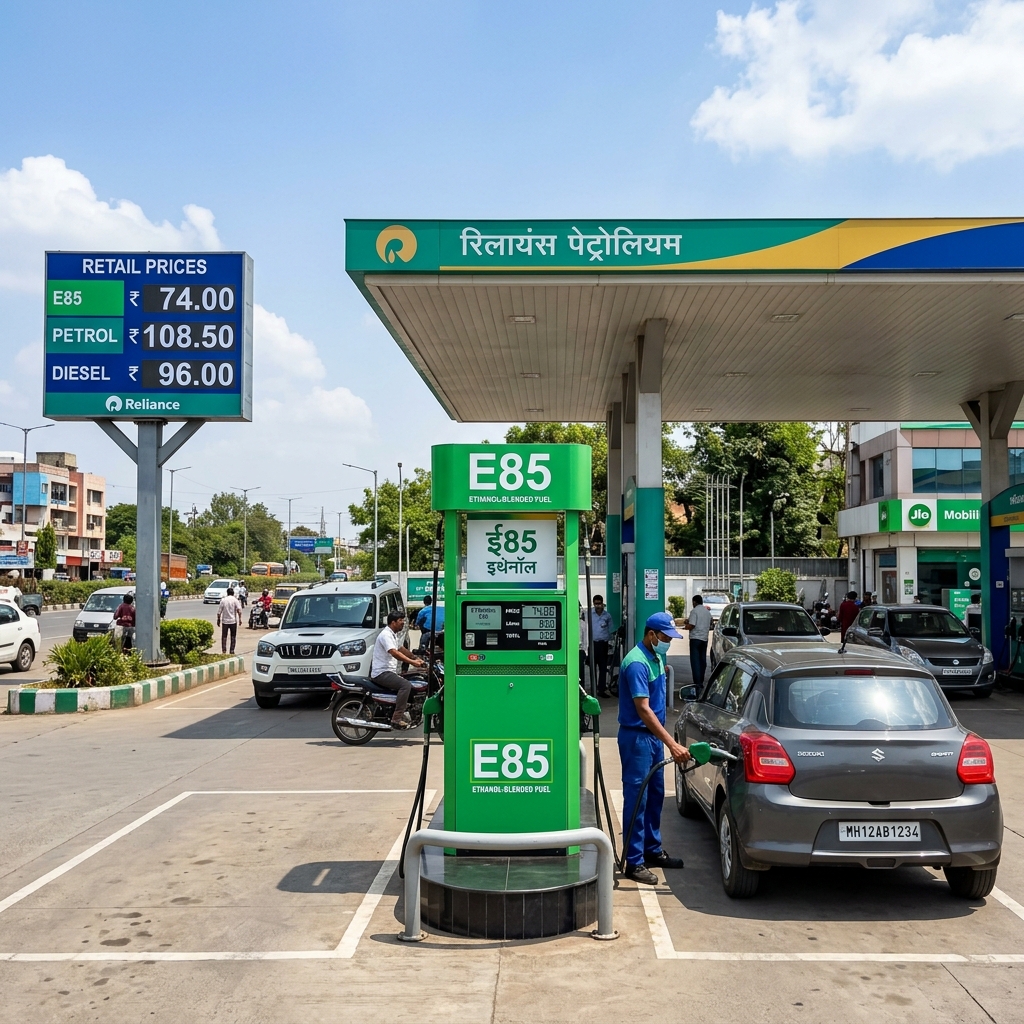
Understanding the Shift to E85
Before we examine the specifics of the Jio-bp rollout, it is essential to understand why E85 is becoming the focal point of India's green fuel strategy. E85 is a high-level ethanol blend that offers significant environmental benefits. Ethanol, derived primarily from sugarcane, corn, and agricultural waste in India, is a renewable fuel source. When burned, it produces significantly lower levels of greenhouse gases compared to pure gasoline.
The Environmental Imperative
India is the world's third-largest emitter of greenhouse gases, and the transportation sector is a major contributor. By transitioning to higher ethanol blends like E85, the country can substantially cut down on tailpipe emissions, particularly carbon monoxide and unburned hydrocarbons. The push for E85 aligns perfectly with India's commitments under the Paris Agreement and its broader goal of achieving net-zero emissions by 2070.
The Economic Rationale
Economically, E85 presents a compelling case. India imports over 80% of its crude oil requirements, which places a massive burden on the national exchequer and leaves the economy vulnerable to global oil price fluctuations. By replacing a large portion of gasoline with domestically produced ethanol, India can save billions of dollars in foreign exchange. Furthermore, it provides a massive boost to the agricultural sector, offering farmers a steady income stream for their produce and agricultural residue.
The Powerhouse Partnership: Reliance and bp
The joint venture between Reliance Industries Limited and bp brings together two colossal entities with complementary strengths. RIL possesses unparalleled reach and operational capabilities within India, while bp brings global expertise in fuel retailing, advanced fuels, and low-carbon solutions.
Jio-bp has already made significant strides in transforming the Indian fuel retail landscape. Their mobility stations are not just about dispensing fuel; they are designed as comprehensive service hubs offering EV charging, high-quality convenience stores (Wild Bean Cafe), and advanced, additized fuels. The introduction of E85 is the next logical step in their evolution as a leading provider of low-carbon mobility solutions.
Jio-bp's Vision for India's Ethanol Economy
Jio-bp's vision extends beyond merely selling fuel. They aim to be the catalyst that accelerates India's transition to a sustainable ethanol economy. This vision encompasses the entire value chain, from securing a reliable supply of high-grade ethanol to ensuring seamless dispensing at the retail level.
The 2026 rollout plan is not a standalone initiative but part of a broader strategy to establish Jio-bp as the preferred destination for eco-conscious consumers. By offering E85, Jio-bp is positioning itself ahead of the curve, ready to cater to the impending wave of Flex-Fuel Vehicles hitting Indian roads.
The 2026 Rollout Plan: Key Phases and Strategies
The rollout of E85 across a vast and diverse country like India is a monumental logistical challenge. Jio-bp has devised a meticulous, multi-phased rollout plan for 2026 to ensure a smooth transition and maximize accessibility for early adopters of FFVs.
Phase 1: Metropolitan and Tier-1 Cities (Q1-Q2 2026)
The initial phase of the rollout, scheduled for the first half of 2026, will focus on major metropolitan areas and Tier-1 cities. These regions represent the largest concentration of early adopters, tech-savvy consumers, and the initial target market for automakers launching FFVs.
Key cities targeted in Phase 1 include: - Delhi NCR - Mumbai and Pune - Bengaluru - Chennai - Hyderabad - Ahmedabad
In this phase, Jio-bp plans to upgrade existing high-throughput mobility stations to dispense E85. The focus will be on strategically located stations along major arterial roads and IT corridors to maximize visibility and convenience.
Phase 2: Major Highways and Corridors (Q3 2026)
To alleviate range anxiety and enable inter-city travel for FFV owners, Phase 2 will concentrate on upgrading mobility stations along key national highways and expressways. This phase is crucial for the widespread acceptance of E85 as a viable primary fuel.
Targeted corridors include: - Delhi-Mumbai Expressway - Mumbai-Pune Expressway - Bengaluru-Chennai Highway - Golden Quadrilateral segments
By creating a robust network of E85 pumps along these high-traffic routes, Jio-bp aims to ensure that FFV drivers can undertake long journeys with confidence.
Phase 3: Tier-2 and Tier-3 Cities (Q4 2026)
The final phase of the 2026 rollout will see the expansion of E85 availability into Tier-2 and Tier-3 cities. This broader penetration is essential for democratizing access to cleaner fuels and supporting the government's mandate for widespread ethanol adoption.
This phase will also involve establishing strategic partnerships with local distributors and agricultural cooperatives to ensure a localized and efficient supply chain for ethanol, reducing transportation costs and carbon footprint.
Infrastructure Challenges and Technological Upgrades
Upgrading a fuel station to dispense E85 is not simply a matter of changing the labels on the pumps. Ethanol has distinct chemical properties that require specific infrastructure upgrades to ensure safety, quality, and durability.
Storage Tanks and Piping
Ethanol is highly corrosive to certain metals and rubber compounds used in older fuel storage systems. Furthermore, ethanol has a strong affinity for water; if water enters the storage tank, it can cause phase separation, where the ethanol and water mixture separates from the gasoline, rendering the fuel unusable.
Jio-bp is investing heavily in upgrading underground storage tanks and piping systems. They are utilizing double-walled fiberglass tanks and specialized polymer piping that are fully compatible with high-level ethanol blends. Advanced water-sensing technology and rigorous quality control protocols are being implemented to prevent phase separation and ensure the E85 delivered to the consumer is of the highest quality.
Dispensers and Filtration
The dispensers themselves must also be E85-compatible. This involves replacing internal components such as valves, meters, and hoses with materials that resist ethanol corrosion. Jio-bp is partnering with leading global equipment manufacturers to install state-of-the-art dispensers that offer precise metering and fast flow rates.
Advanced micro-filtration systems are being integrated into the dispensers to remove any microscopic impurities or moisture before the fuel enters the vehicle's tank, ensuring optimal engine performance and longevity.
The Synergy with Flex-Fuel Vehicles (FFVs)
The success of the Jio-bp E85 rollout is inextricably linked to the availability and adoption of Flex-Fuel Vehicles (FFVs). Unlike conventional vehicles, FFVs are designed to run on any blend of gasoline and ethanol, up to 85%.
How FFVs Work
FFVs are equipped with modified fuel systems and internal combustion engines. They feature specialized sensors that detect the ethanol-to-gasoline ratio in the fuel tank and send this information to the engine control unit (ECU). The ECU then automatically adjusts the fuel injection and spark timing to optimize combustion for the specific blend being used.
This technology allows consumers the flexibility to fill up with E85 when it's available and cost-effective, or revert to standard gasoline or lower ethanol blends when necessary, completely eliminating range anxiety.
The Automaker Push in India
The Indian government has issued strong directives to automakers to accelerate the development and launch of FFVs. Major players like Toyota, Maruti Suzuki, TVS, and Bajaj are actively developing FFV models for the Indian market, ranging from two-wheelers to passenger cars.
Jio-bp is actively collaborating with these Original Equipment Manufacturers (OEMs). By providing a clear roadmap for E85 availability, Jio-bp is giving automakers the confidence to bring their FFV models to market sooner. Joint promotional campaigns and early-adopter incentives are expected to be a significant part of this synergy in 2026.
Pricing and Consumer Economics
One of the most critical factors for the success of E85 is its pricing relative to standard gasoline. Ethanol has a lower energy density than gasoline, meaning a vehicle will typically experience a slight reduction in fuel economy (miles per gallon) when running on E85.
To make E85 attractive to the consumer, it must be priced low enough to offset this decrease in fuel economy and provide a net cost saving per mile driven.
The Pricing Strategy
Jio-bp is working closely with ethanol producers and leveraging its efficient supply chain to ensure competitive pricing for E85. Given the government's strong support for the ethanol blending program, including favorable tax structures and subsidies, E85 is expected to be priced significantly lower than conventional gasoline.
Jio-bp's strategy is to create a compelling value proposition where the consumer clearly sees the financial benefit of choosing E85, in addition to the environmental benefits. Transparent pricing displays and consumer education initiatives will be vital in communicating this value proposition.
Supply Chain and Sourcing of Ethanol
The massive scale of Jio-bp's E85 rollout requires an equally massive and reliable supply of ethanol. India's ethanol production capacity has grown exponentially in recent years, primarily driven by sugarcane juice, B-heavy molasses, and increasingly, surplus grains like rice and maize.
Building a Robust Supply Network
Jio-bp is establishing long-term off-take agreements with major distilleries across the country. They are also investing in strategic ethanol storage terminals to buffer against seasonal supply fluctuations.
Furthermore, Jio-bp is exploring advanced second-generation (2G) ethanol technologies, which utilize agricultural waste (lignocellulosic biomass) rather than food crops. This approach not only ensures a sustainable, long-term supply but also addresses the issue of crop stubble burning, a major source of air pollution in northern India.
Consumer Education and Awareness
A significant challenge in the introduction of a new fuel type is consumer awareness and education. Many consumers may not understand what E85 is, whether their vehicle can use it, or what the benefits are.
The Jio-bp Awareness Campaign
Jio-bp is launching a comprehensive, multi-channel awareness campaign leading up to and during the 2026 rollout. This campaign will involve:
- At-Pump Education: Clear signage, color-coded nozzles (typically yellow for E85), and informational brochures at mobility stations. - Digital Campaigns: Extensive use of social media, the Jio-bp app, and partnerships with automotive influencers to explain the benefits of E85 and how to identify FFVs. - OEM Partnerships: Collaborative marketing with automakers launching FFVs, ensuring that buyers of these vehicles are immediately educated about E85 and directed to the nearest Jio-bp stations.
The goal is to demystify E85 and position it as the smart, responsible, and economical choice for the modern Indian driver.
The Broader Economic and Environmental Impact
The widespread adoption of E85, facilitated by Jio-bp's rollout, will have profound implications for India's economy and environment.
Boosting the Rural Economy
The increased demand for ethanol directly translates to increased income for farmers. By providing a guaranteed market for sugarcane, maize, and agricultural waste, the E85 ecosystem will inject massive capital into the rural economy, creating jobs and improving livelihoods.
Energy Security
Reducing the reliance on imported crude oil is a strategic imperative for India. The E85 rollout will significantly enhance India's energy security, insulating the economy from the volatility of global geopolitical events and oil price shocks. The foreign exchange saved can be reinvested into critical infrastructure and social development programs.
Air Quality and Climate Change
The transition to E85 will result in a noticeable improvement in urban air quality, reducing smog-forming emissions and particulate matter. On a macro level, it represents a massive step toward meeting India's climate goals, demonstrating global leadership in the transition to low-carbon fuels.
Conclusion: A Greener Road Ahead
The Reliance Jio-bp E85 rollout plan for 2026 is more than just a corporate initiative; it is a vital component of India's journey towards energy independence and environmental sustainability. By investing heavily in infrastructure, securing the supply chain, and collaborating closely with automakers and the government, Jio-bp is laying the groundwork for a flex-fuel revolution in India.
As consumers increasingly seek eco-friendly and economical mobility solutions, the widespread availability of E85 at state-of-the-art Jio-bp mobility stations will provide the catalyst needed for mass adoption. The road ahead in 2026 looks greener, cleaner, and powered by the synergy of advanced fuels and innovative retail experiences. The success of this rollout will undoubtedly set a benchmark for the rest of the world, proving that economic growth and environmental stewardship can go hand in hand.
*
Disclaimer: This article is based on projected plans and industry trends for 2026. Actual rollout schedules, locations, and pricing may vary based on market conditions, government policies, and infrastructure readiness.