The automotive landscape in India is undergoing a profound transformation. As the world pivots towards sustainable and eco-friendly mobility solutions, India is aggressively pursuing alternative fuels to reduce its immense carbon footprint and its heavy reliance on crude oil imports. At the forefront of this green revolution is the country's largest automaker, Maruti Suzuki, and its trailblazing initiative: the Maruti Suzuki WagonR Flex Fuel vehicle.
What began as an ambitious prototype showcased at various mobility expos has now evolved into a production-spec reality, marking a watershed moment in India's mass-market automotive sector. This comprehensive guide dives deep into what you can expect from the Maruti Suzuki WagonR Flex Fuel, exploring its technology, benefits, driving dynamics, and what its introduction means for the future of Indian transportation.
The Genesis of the Flex Fuel WagonR
The journey of the WagonR Flex Fuel started as a conceptual response to the Indian government's push for ethanol-blended fuels. Ethanol, a renewable biofuel produced primarily from agricultural by-products like sugarcane and maize, presents a viable alternative to pure fossil fuels. By blending ethanol with petrol, vehicles can achieve lower emissions while simultaneously boosting the agricultural economy.
Maruti Suzuki, understanding its responsibility and market position, took up the challenge to develop a mass-market car capable of running on high-ethanol blends. The prototype was initially displayed to gauge public reaction and to demonstrate the brand's technological readiness. The transition from a prototype to a production-ready vehicle designed for the commercial sector underscores the company's commitment to this technology and the government's supportive policy framework.
Understanding Flex Fuel Technology
To truly appreciate the WagonR Flex Fuel, one must first understand what "Flex Fuel" (Flexible Fuel) actually means. A flex-fuel vehicle (FFV) is designed with an internal combustion engine capable of operating on more than one type of fuel, usually petrol blended with either ethanol or methanol fuel, and both fuels are stored in the same common tank.
In the case of the Maruti Suzuki WagonR, the vehicle is designed to run on any blend of petrol and ethanol between E20 (20% ethanol, 80% petrol) and E85 (85% ethanol, 15% petrol). It is also engineered to handle up to E100 (pure ethanol) under specific conditions. This incredible flexibility is what sets it apart from standard internal combustion engine (ICE) vehicles, which are currently only optimized for E20 blends at best in the Indian market.
How Does it Work?
The heart of the WagonR Flex Fuel is the familiar 1.2-litre, four-cylinder K12N naturally aspirated engine. However, extensive modifications have been made to accommodate the unique properties of ethanol. Ethanol is inherently more corrosive than petrol and has a lower calorific value, meaning it contains less energy per unit of volume. Furthermore, ethanol has a higher latent heat of vaporization, which can make cold starts difficult in frigid conditions.
To counter these challenges, Maruti Suzuki engineers have implemented several crucial upgrades:
1. Upgraded Fuel System Components: The fuel injectors and the fuel pump have been specially designed to handle the corrosive nature of ethanol. They are made from materials that resist degradation over time. 2. Corrosion-Resistant Fuel Lines: The entire plumbing system that carries fuel from the tank to the engine has been upgraded to prevent leaks and deterioration caused by high ethanol concentrations. 3. Advanced Engine Control Unit (ECU): The ECU is the brain of the engine. In the Flex Fuel WagonR, the ECU has been completely recalibrated. It must constantly monitor the fuel mixture and adjust the ignition timing and fuel injection pulse width in real-time to ensure optimal combustion, regardless of the ethanol blend in the tank. 4. Ethanol Sensor: A critical component is the integrated ethanol sensor located in the fuel line. This sensor detects the exact percentage of ethanol in the fuel mixture and relays this information to the ECU, allowing for instantaneous adjustments. 5. Heated Fuel Rail (in some iterations): To assist with cold starts, especially in colder climates where high ethanol blends can struggle to vaporize, a heating element might be incorporated into the fuel system to warm the fuel before it reaches the combustion chamber.
Design and Aesthetics: Familiar Yet Distinct
When it comes to exterior design, the WagonR Flex Fuel doesn't stray far from the highly successful formula of the standard WagonR. It retains the tall-boy stance, the boxy yet practical silhouette, and the spacious cabin that has made it a favorite among Indian families and fleet operators alike.
However, Maruti Suzuki has added specific visual cues to distinguish the Flex Fuel variant. You can expect to see prominent "Flex Fuel" decals running along the sides of the vehicle, proudly advertising its eco-friendly credentials. A distinct badge on the tailgate further cements its identity. Inside, the cabin remains largely identical to the standard version, prioritizing practicality, ample headroom, and good visibility. The focus here is not on luxury, but on delivering a robust, proven, and accessible platform for a revolutionary new powertrain.
Environmental Impact and Sustainability
The most significant advantage of the WagonR Flex Fuel lies in its environmental benefits. The transition from pure fossil fuels to high-ethanol blends yields a substantial reduction in harmful tailpipe emissions.
Reducing Carbon Footprint
Ethanol burns cleaner than petrol. By utilizing E85 fuel, the WagonR Flex Fuel significantly lowers emissions of carbon monoxide (CO), hydrocarbons (HC), and oxides of nitrogen (NOx). Furthermore, ethanol is considered a carbon-neutral fuel over its life cycle. The carbon dioxide emitted during its combustion is roughly equal to the carbon dioxide absorbed by the crops (like sugarcane) during their growth phase. This closed carbon loop makes ethanol a vital tool in combating climate change.
Improving Air Quality in Cities
Indian cities frequently grapple with severe air pollution, much of which is attributed to vehicular emissions. The widespread adoption of mass-market flex-fuel vehicles like the WagonR could play a crucial role in improving urban air quality. Cleaner combustion means less particulate matter and fewer smog-forming pollutants released into the atmosphere, leading to healthier living conditions for millions.
Economic Implications for India
Beyond environmental benefits, the WagonR Flex Fuel carries profound economic implications for the country.
Cutting Down Crude Oil Imports
India is heavily dependent on imported crude oil to meet its energy demands, which puts a massive strain on the country's foreign exchange reserves and leaves the economy vulnerable to global oil price fluctuations. By shifting a portion of its transportation fuel to domestically produced ethanol, India can significantly reduce its crude oil import bill, enhancing its energy security and economic stability.
Boosting the Agricultural Sector
Ethanol production in India is primarily derived from agricultural sources, particularly sugarcane molasses, broken rice, and maize. An increased demand for ethanol translates directly into an increased demand for these crops. This provides a lucrative and reliable alternative revenue stream for millions of Indian farmers, helping to boost rural incomes and revitalize the agricultural sector. The WagonR Flex Fuel essentially connects the prosperity of the Indian farmer with the mobility needs of the urban commuter.
Driving Experience: What to Expect Behind the Wheel
For the average driver, the transition to the WagonR Flex Fuel should be seamless. The goal of Maruti Suzuki's engineering team is to ensure that the vehicle drives exactly like its petrol-only counterpart, regardless of the fuel blend in the tank.
Performance and Power Delivery
Because ethanol has a higher octane rating than standard petrol, it allows the engine to run at a more advanced ignition timing without knocking. In some high-performance applications, this can lead to an increase in power. However, in a commuter car like the WagonR, the ECU is tuned to prioritize efficiency and smooth operation over outright performance gains. Drivers can expect the familiar, peppy response of the 1.2-litre K-series engine. The transition between different fuel blends is handled entirely by the ECU and is imperceptible to the driver.
Fuel Efficiency Considerations
One important factor to consider is fuel efficiency. Because ethanol has a lower energy density than petrol (roughly 30% less energy per gallon), it requires more fuel to generate the same amount of power. Therefore, when running on high-ethanol blends like E85, the volumetric fuel efficiency (kilometers per liter) will be lower compared to running on pure petrol.
However, this lower fuel efficiency is expected to be offset by the lower cost of ethanol fuel at the pump. The Indian government is actively working on pricing strategies to ensure that ethanol blends are economically attractive to consumers, making the overall running cost per kilometer comparable to, or even lower than, standard petrol vehicles.
The Infrastructure Challenge
The success of the WagonR Flex Fuel is inextricably linked to the availability of the fuel itself. While the car is ready, the infrastructure is still catching up.
Expanding the E85/E100 Network
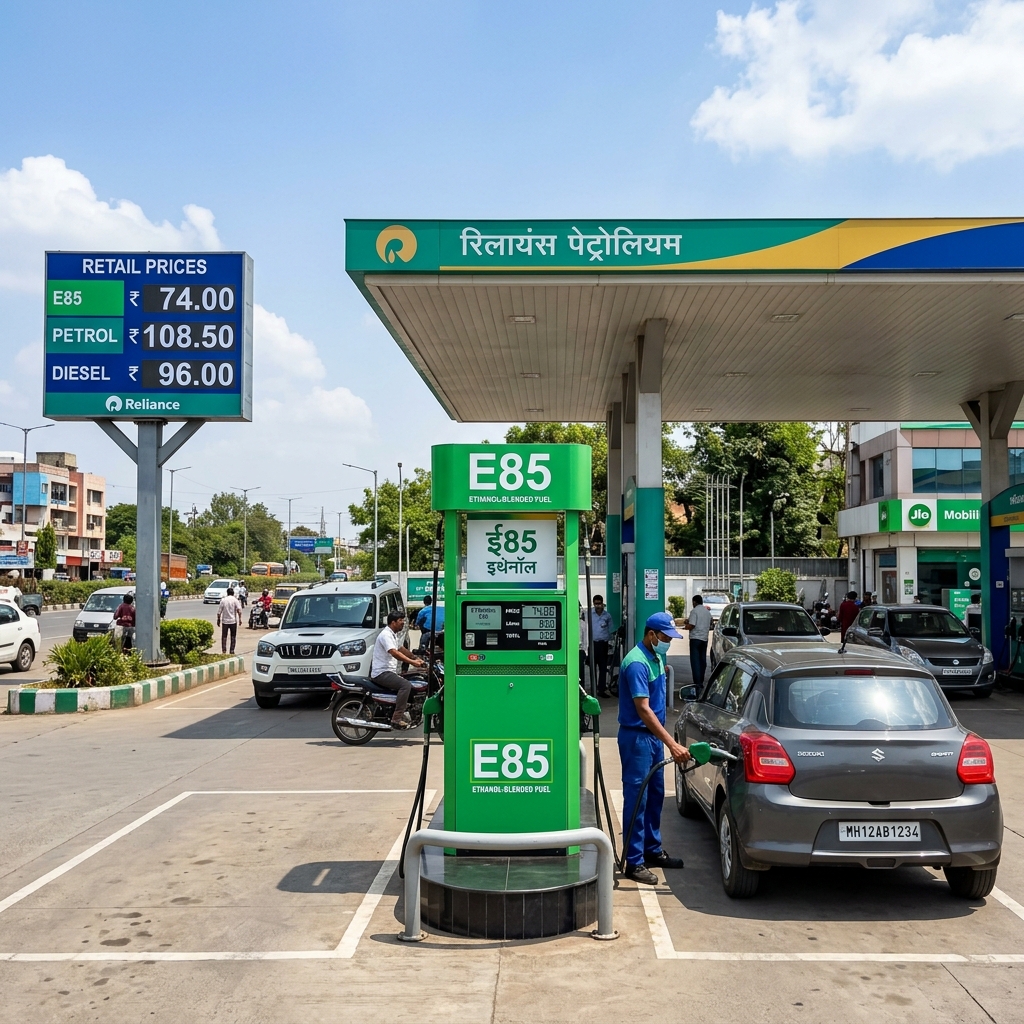
Currently, E20 fuel is being rolled out across the country, but the availability of E85 or E100 dispensing stations is limited. The government, in collaboration with oil marketing companies, has laid out an ambitious roadmap to establish a robust network of flex-fuel stations, initially targeting major highways and urban centers. The commercial launch of the WagonR Flex Fuel (initially for the yellow-plate taxi segment) is a strategic move to guarantee a consistent demand for high-ethanol blends, thereby incentivizing the rapid expansion of the necessary refueling infrastructure.
Why the Commercial Sector First?
Maruti Suzuki has chosen to introduce the production-spec WagonR Flex Fuel to the commercial sector first. This is a calculated and logical step for several reasons:
1. High Usage, High Impact: Commercial vehicles (taxis and fleet operators) clock significantly more kilometers than private vehicles. Deploying flex-fuel technology here maximizes the immediate reduction in emissions and fuel consumption. 2. Predictable Routes: Fleet operators often operate on somewhat predictable routes, making it easier to manage refueling logistics in the early stages when E85 stations might be sparse. 3. Real-World Testing at Scale: The commercial sector provides a rigorous testing ground. The high mileage and demanding usage patterns will provide Maruti Suzuki with invaluable real-world data on the long-term durability and performance of their flex-fuel technology, paving the way for a flawless rollout to the private passenger vehicle market in the future.
Comparing Flex Fuel to EVs and Hybrids
In the race towards green mobility, flex-fuel technology is often compared to Electric Vehicles (EVs) and Hybrid Electric Vehicles (HEVs).
While EVs offer zero tailpipe emissions, they require a massive overhaul of infrastructure (charging stations) and rely heavily on imported battery components. Hybrids offer excellent fuel efficiency but are mechanically complex and currently attract higher taxation in India.
Flex-fuel technology, as demonstrated by the WagonR, offers a highly pragmatic 'middle path'. It utilizes existing internal combustion engine manufacturing infrastructure, requires relatively minor modifications to the vehicle, and leverages domestically produced fuel. It provides an immediate, scalable, and cost-effective solution to reduce emissions without the range anxiety associated with early EV adoption or the high initial cost of strong hybrids.
Government Policies and Subsidies
The Indian government has been the primary catalyst for the flex-fuel movement. Initiatives like the National Policy on Biofuels and the Ethanol Blended Petrol (EBP) programme have created a supportive ecosystem.
To encourage the adoption of flex-fuel vehicles, the government may consider offering incentives such as reduced GST rates on the vehicles themselves or subsidies on the retail price of E85 fuel. Such policy interventions will be crucial in making the WagonR Flex Fuel an attractive proposition for cost-conscious Indian buyers.
The Road Ahead for Maruti Suzuki and Flex Fuel
The launch of the WagonR Flex Fuel is just the beginning. Maruti Suzuki has indicated that this technology will not be limited to a single model. As the E85 infrastructure matures and consumer acceptance grows, we can expect to see flex-fuel variants of other popular Maruti Suzuki models, such as the Swift, Baleno, and Brezza.
Furthermore, the research and development invested in the WagonR Flex Fuel will serve as a foundation for future innovations. We might see the integration of mild-hybrid technology with flex-fuel engines, creating ultra-efficient powertrains that offer the best of both worlds.
Conclusion
The Maruti Suzuki WagonR Flex Fuel is more than just a new variant of a popular car; it is a statement of intent. It represents a bold step towards a self-reliant, sustainable, and economically vibrant India. By successfully transitioning this prototype into a production reality, Maruti Suzuki has proven that green mobility does not have to be expensive, complex, or inaccessible to the masses.
While challenges regarding fuel infrastructure remain, the combined efforts of the government and the auto industry suggest a rapid resolution. For the consumer, the WagonR Flex Fuel promises the familiar reliability, space, and peace of mind associated with the Maruti Suzuki badge, coupled with the pride of contributing to a cleaner environment and a stronger national economy. The era of flex-fuel mobility in India has officially dawned, and the WagonR is leading the charge.