The global automotive and energy sectors are undergoing a massive transformation, pivoting towards more sustainable, eco-friendly alternatives. In India, this shift is characterized by a strong push towards biofuels, particularly ethanol-blended petrol. IndianOil Corporation Limited (IOCL), the largest commercial oil company in the country, is at the forefront of this green revolution. As the government sets ambitious targets for ethanol blending, consumers are increasingly encountering terms like "E20" and "E85" at the pumps.
This comprehensive guide delves into everything you need to know about the availability of E20 and E85 fuels at IndianOil stations, what these blends mean for your vehicle, the environmental benefits, and what the future holds for flex-fuel vehicles in India.
Understanding Ethanol Blended Fuels: What are E20 and E85?
Before diving into the availability specifics, it's crucial to understand what these alphanumeric codes represent.
Ethanol is a renewable biofuel made from biomass—mostly plant materials like sugarcane, corn, and agricultural waste. When blended with regular unleaded petrol, it creates a cleaner-burning fuel that reduces greenhouse gas emissions and decreases the nation's reliance on imported crude oil. The number following the 'E' simply denotes the percentage of ethanol in the petrol blend.
What is E20 Fuel?
E20 fuel is a blend consisting of 20% ethanol and 80% regular petrol. This blend is currently the primary focus of the Indian government's ethanol blending program (EBP). It represents a significant step up from the E10 (10% ethanol) blend, aiming to double the environmental and economic benefits.
Modern vehicles, specifically those manufactured after a certain date (often 2023 or later in India, depending on the manufacturer's compliance with new norms), are designed to be "material compatible" with E20. This means their fuel lines, seals, and engine components can withstand the slightly more corrosive nature of ethanol without degrading.
What is E85 Fuel?
E85 fuel, on the other hand, is a much higher concentration blend, typically containing anywhere from 51% to 83% ethanol, with the remainder being petrol. Because of its high ethanol content, E85 cannot be used in standard petrol engines. It requires a specially designed engine found in Flex-Fuel Vehicles (FFVs).
FFVs are equipped with specialized sensors that detect the ratio of ethanol to petrol in the fuel tank and automatically adjust the engine's ignition timing and air-fuel mixture to optimize performance. E85 is popular in countries like Brazil and the United States, but it is relatively new to the Indian market.
IndianOil's Crucial Role in India's Ethanol Blending Program
India is one of the world's largest consumers of fossil fuels. To combat pollution and reduce the import bill, the government advanced its target for achieving 20% ethanol blending in petrol from 2030 to 2025. This ambitious goal requires a massive overhaul of supply chains, production capacities, and retail infrastructure.
As the leading public sector oil marketing company (OMC), IndianOil plays an indispensable role in this national mission. IOCL manages the largest network of fuel stations across the subcontinent. The company has invested heavily in setting up ethanol storage facilities, blending infrastructure at its terminals, and upgrading dispensing units at retail outlets to handle higher ethanol blends safely and efficiently.
Moreover, IndianOil is not just blending ethanol; it's also actively involved in producing it. The company is setting up 2G (second-generation) and 3G (third-generation) ethanol plants that utilize agricultural residue and industrial off-gases, ensuring that fuel production does not compete with food security.
The Rollout and Availability of E20 at IndianOil Stations
The introduction of E20 fuel in India was a phased process, starting with select cities and gradually expanding across the country. IndianOil has been aggressive in its rollout strategy, ensuring that E20 is accessible to a large portion of the population well ahead of the national deadlines.
Current E20 Availability Status
As of mid-2026, E20 petrol is widely available at a vast majority of IndianOil retail outlets across India. The rollout initially targeted major metropolitan areas, state capitals, and Tier-1 cities where the concentration of newer, E20-compatible vehicles is highest.
However, IndianOil has rapidly expanded this network. Today, you can expect to find E20 dispensing pumps at IOCL stations in:
- Metropolitan Hubs: Delhi NCR, Mumbai, Bengaluru, Chennai, Hyderabad, and Kolkata have near-universal availability of E20 at IndianOil stations. - Tier-2 and Tier-3 Cities: The penetration in smaller cities has grown exponentially. State highways and national highways connecting these cities are well-serviced by IOCL stations offering E20. - Rural Areas: While the rollout in deeply rural areas is ongoing, major agricultural hubs and district centers have started stocking E20, aligning with the local production of ethanol from agricultural produce.
How to Identify E20 at an IndianOil Pump
IndianOil has made it easy for consumers to identify E20 fuel. When you pull into an IOCL station, look for:
1. Clear Signage: The dispensing units specifically dedicated to E20 will have prominent, brightly colored stickers or signboards clearly marking "E20 Petrol." 2. Distinct Nozzles: In some stations, the nozzles for E20 might have a different color code (often green or a distinct shade) to prevent accidental misfueling. 3. Price Boards: The main price display board at the entrance of the station will list E20 alongside standard petrol and diesel, allowing you to confirm availability before entering.
It is absolutely crucial to verify whether your vehicle is E20 compatible before fueling up. Using E20 in an older, non-compatible vehicle can lead to long-term engine damage, fuel leaks, and performance issues. Always consult your vehicle's owner manual or contact the manufacturer to confirm compatibility.
The Future Frontier: E85 Availability and Prospects with IOCL
While E20 is becoming the new standard, E85 represents the next major leap in India's biofuel journey. The widespread availability of E85 at IndianOil stations is currently in its nascent stages, heavily tied to the adoption rate of Flex-Fuel Vehicles (FFVs) in the country.
Current E85 Pilot Programs and Limited Availability
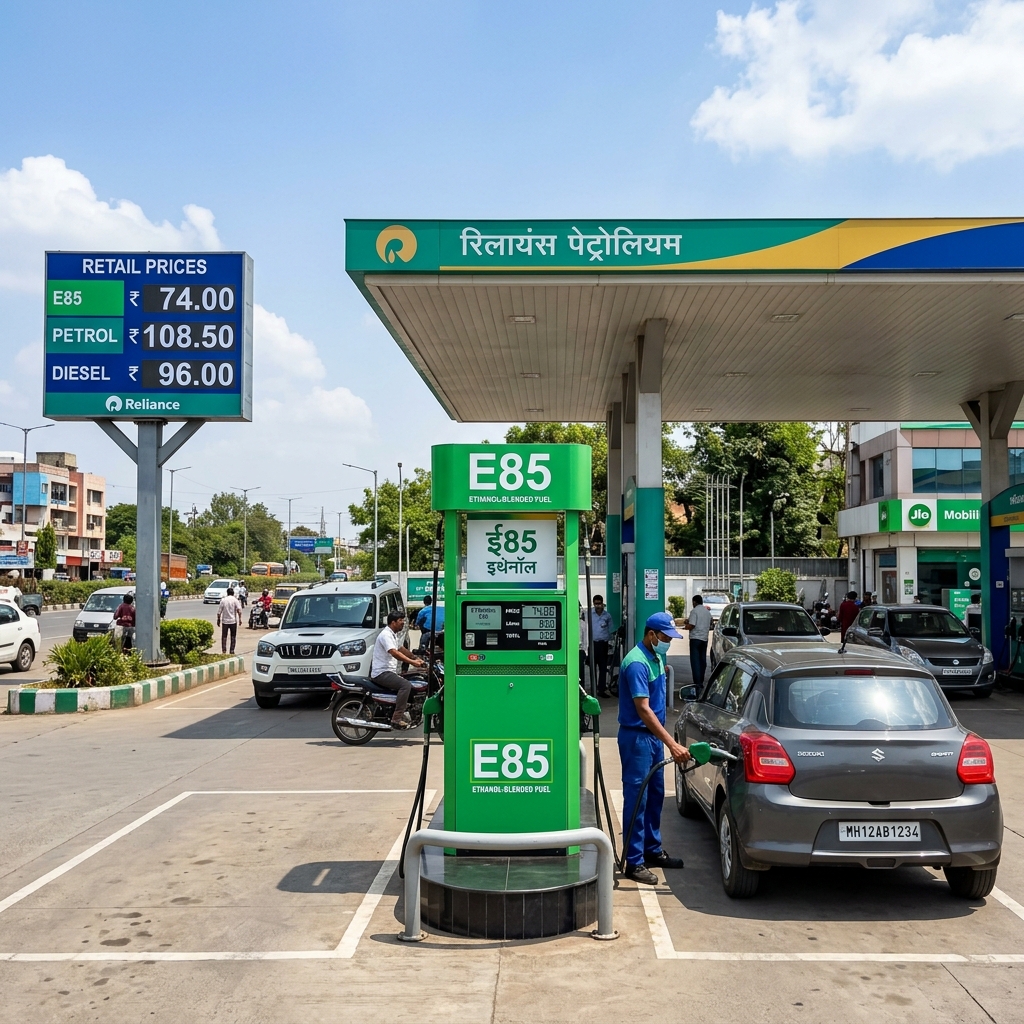
At present, E85 is not widely available to the general public across all IOCL outlets. Its availability is mostly restricted to:
- Pilot Projects: IndianOil, often in collaboration with automotive manufacturers like Toyota, Maruti Suzuki, and TVS (which have launched or showcased FFV prototypes), operates select fuel stations equipped with E85 dispensers. These are primarily located in cities like Pune, Delhi, and parts of Karnataka and Uttar Pradesh (major sugarcane-producing states). - Dedicated Green Corridors: There are plans to establish specific highway corridors equipped with high-blend ethanol dispensers to cater to commercial fleets and early adopters of FFVs.
The Roadmap for E85 Expansion
The large-scale rollout of E85 by IndianOil is a classic "chicken-and-egg" scenario. OMCs need a critical mass of FFVs on the road to justify the massive investment required for dedicated E85 storage and dispensing infrastructure. Conversely, automakers are hesitant to mass-produce FFVs until a robust E85 fueling network exists.
However, the momentum is building:
1. Government Mandates and Incentives: The government is aggressively pushing automakers to introduce FFVs. Policy incentives, lower GST rates on FFVs, and mandates for a certain percentage of production to be flex-fuel capable are driving this change. 2. IndianOil's Readiness: IOCL has publicly stated its readiness to supply E85 as the market demands. The technical know-how for blending, storing, and dispensing E85 is already in place thanks to the pilot programs. The company is progressively upgrading its retail infrastructure to be "E85-ready," so that pumps can easily switch to dispensing higher blends when the time comes. 3. Agricultural Synergy: States with high ethanol production capacity (like UP, Maharashtra, and Karnataka) will likely see the first widespread commercial rollout of E85 by IndianOil, as the logistics of transporting high-blend ethanol are more favorable locally.
We can expect a gradual but steady increase in E85 availability at IndianOil stations starting from major metro centers and expanding outward over the next 3 to 5 years, mirroring the trajectory of electric vehicle (EV) charging infrastructure.
The Compelling Benefits of Using E20 and E85
The shift towards ethanol-blended fuels is not just a regulatory mandate; it offers tangible benefits on multiple fronts.
1. Environmental Impact and Reduced Emissions
The most significant advantage of E20 and E85 is their positive impact on air quality and the environment. - Lower Greenhouse Gases: Ethanol burns cleaner than pure petrol. Using E20 significantly reduces carbon monoxide (CO) and hydrocarbon (HC) emissions. E85, with its much higher ethanol content, offers even more drastic reductions in lifecycle greenhouse gas emissions. - Improved Air Quality: In densely populated Indian cities struggling with severe air pollution, the widespread use of E20 by IOCL can contribute to noticeably cleaner air and reduced smog formation. - Renewable Nature: Because ethanol is derived from plants that absorb carbon dioxide as they grow, it creates a more balanced carbon cycle compared to extracting and burning fossil fuels.
2. Economic Benefits and National Security
- Reducing the Import Bill: India imports over 80% of its crude oil requirements. By blending 20% ethanol into petrol nationwide, India saves billions of dollars annually in foreign exchange. - Energy Independence: Relying more on domestically produced biofuels enhances national energy security, making the country less vulnerable to geopolitical shocks and volatile global oil prices. - Boosting the Agricultural Sector: The ethanol blending program is a massive boon for Indian farmers. It creates a steady, guaranteed demand for crops like sugarcane, maize, and damaged food grains, providing farmers with reliable income and revitalizing the rural economy.
3. Engine Performance Characteristics
Ethanol has a higher octane rating than standard petrol. - Higher Octane: The higher octane number helps prevent engine "knocking" or "pinging," which can occur during high-load situations. This allows engines to be tuned for higher compression ratios, potentially increasing power output and efficiency. - Cooling Effect: Ethanol has a higher heat of vaporization, meaning it absorbs more heat as it evaporates in the intake manifold. This cooling effect can lead to denser air-fuel mixtures entering the cylinders, further improving performance, particularly in turbocharged engines. - Note on Fuel Economy: It is important to note that ethanol has a lower energy density than petrol (about 30% less energy per volume). This means that while performance might improve, volumetric fuel economy (miles per gallon or kilometers per liter) will slightly decrease when using E20 or E85 compared to pure petrol. However, the lower cost of the blended fuel often offsets the slight drop in mileage.
Flex Fuel Vehicles (FFVs) in India: The Key to E85
To fully unlock the potential of E85 at IndianOil stations, you need a Flex Fuel Vehicle. While standard vehicles are capped at E20 compatibility, FFVs are engineering marvels designed to run on any blend of petrol and ethanol, up to E85.
How Do FFVs Work?
An FFV looks and operates exactly like a regular car. The magic happens behind the scenes. - Upgraded Fuel System: The fuel lines, tank, and pump are made from corrosion-resistant materials to withstand high concentrations of ethanol. - Flex-Fuel Sensor: A sophisticated sensor in the fuel line constantly analyzes the ethanol-to-petrol ratio of the fuel entering the engine. - Engine Control Unit (ECU): The ECU takes the data from the sensor and instantly adjusts the fuel injection timing and spark timing to ensure optimal combustion, regardless of whether you just filled up with pure petrol, E20, or E85.
The FFV Landscape in India
The Indian automotive market is currently in the transition phase towards FFVs. Several major players are gearing up: - Toyota Kirloskar Motor: Toyota has been a pioneer, showcasing the Corolla Altis FFV hybrid in India, demonstrating that flex-fuel technology can be combined with hybrid efficiency. - Maruti Suzuki: India's largest carmaker has committed to launching FFV models in the near future and has already showcased prototypes like the WagonR Flex Fuel. - Two-Wheelers: The two-wheeler segment is also moving fast. Companies like TVS Motor have already launched ethanol-compatible models like the Apache RTR 200 Fi E100 (capable of running on pure ethanol). - Commercial Vehicles: Manufacturers are also exploring flex-fuel options for light commercial vehicles, which could significantly reduce logistics emissions.
As these vehicles hit the market, IndianOil's E85 infrastructure will see a corresponding surge in demand and availability.
How to Locate E20 and E85 at IndianOil Stations
IndianOil has embraced digital technology to make the fueling experience seamless for its customers. Finding an IOCL station that dispenses E20 or E85 is quite straightforward:
1. The IndianOil ONE App: This is the most reliable method. The official IndianOil ONE mobile application (available on iOS and Android) features a comprehensive "Locate Pump" function. You can filter your search specifically for stations offering E20 fuel. As E85 becomes more prevalent, a similar filter will be added. The app provides real-time data, directions, and even allows you to pay digitally. 2. IndianOil Website: The official IOCL website has a pump locator tool where you can search by state, city, or PIN code and check the facilities available at each station, including fuel types. 3. Navigation Apps: Major navigation applications like Google Maps often update their point-of-interest data based on user feedback and official listings. Searching for "IndianOil E20 near me" will generally yield accurate results, especially in urban areas. 4. Customer Service Toll-Free Number: You can always call the IndianOil customer care helpline to inquire about the nearest station providing specific ethanol blends.
Frequently Asked Questions (FAQs)
Q1: Can I use E20 fuel in my older car or motorcycle? A: It is highly discouraged unless the manufacturer explicitly states that your specific model and manufacturing year are E20 compatible. Older engines have rubber seals, plastics, and metals that can degrade when exposed to 20% ethanol, leading to costly repairs. Stick to standard E10 petrol for older vehicles.
Q2: Will E20 or E85 void my vehicle's warranty? A: If your vehicle is certified as E20 compatible, using E20 at an IndianOil station will not void your warranty. However, using E20 in a non-compatible vehicle, or using E85 in a standard E20-compatible vehicle (instead of an FFV), will likely void the powertrain warranty. Always check your manual.
Q3: Is E20 cheaper than regular petrol? A: Because ethanol is generally cheaper to produce domestically than imported crude oil, higher ethanol blends often enjoy slight pricing advantages or tax benefits, making them marginally cheaper or at parity with standard petrol, despite the slightly lower energy density.
Q4: What happens if I accidentally put E85 in my standard petrol car? A: Do not start the engine. E85 in a non-FFV will cause the engine to run extremely lean, leading to misfires, rough idling, the "Check Engine" light coming on, and potential engine damage. You will need to have the fuel tank drained by a professional mechanic immediately.
Q5: Are IndianOil's fuel quality standards maintained with ethanol blends? A: Absolutely. IndianOil adheres to strict Bureau of Indian Standards (BIS) specifications for all its fuels, including E20 and E85. The blending process is highly controlled to ensure consistency, purity, and optimal performance.
Conclusion
The transition to ethanol-blended fuels is a critical pillar of India's strategy for a sustainable, energy-independent future. IndianOil Corporation Limited is playing a pivotal role in this transition by rapidly expanding the availability of E20 fuel across its massive retail network and laying the groundwork for the future of E85 and Flex-Fuel Vehicles.
For the average consumer, this means cleaner air, support for the domestic agricultural economy, and a step towards reducing global carbon emissions. As you drive into an IndianOil station, opting for E20—provided your vehicle is compatible—is a small but significant contribution to India's green revolution. While E85 is still on the horizon for widespread commercial availability, the roadmap is clear, and IOCL is perfectly positioned to fuel the next generation of eco-friendly transportation in India. Always ensure vehicle compatibility, utilize the IndianOil ONE app to locate the right fuel, and drive forward into a cleaner future.