India’s journey toward sustainable energy has been shaped by a complex interplay of economic necessity, environmental urgency, and agricultural dynamics. At the heart of this transition lies the story of ethanol fuel—a narrative that winds from the sprawling sugarcane fields of Maharashtra and Uttar Pradesh to the bustling fuel pumps across the nation. Over the last two decades, India has aggressively pursued ethanol blending to reduce its colossal crude oil import bill, empower farmers, and curb greenhouse gas emissions. The evolution of the Ethanol Blended Petrol (EBP) Programme represents one of the most ambitious and transformative energy policies in the developing world.
This comprehensive article explores the fascinating history of ethanol fuel in India. We will delve into its humble beginnings as a byproduct of the sugar industry, trace the legislative milestones that catalyzed its adoption, examine the technological and agricultural shifts that broadened its scope, and analyze the profound economic and environmental impacts of the nation's march toward the E20 target and beyond.
Early Beginnings: The Sugar Industry and Molasses
To understand the origins of ethanol fuel in India, one must first look at the nation's massive sugar industry. India has historically been one of the world's largest producers and consumers of sugar. For decades, the primary focus of this sector was the production of refined sugar for domestic consumption and export. However, the sugar extraction process yields a thick, dark syrup known as molasses—a byproduct that, for a long time, held limited economic value.
In the mid-20th century, the bulk of India's molasses was either utilized by the potable alcohol industry (liquor production) or used in the chemical sector. A significant portion was simply discarded, sometimes leading to environmental issues due to improper disposal. The concept of using ethanol (ethyl alcohol) as a fuel additive was not entirely new; countries like Brazil had pioneered large-scale ethanol fuel programs following the oil crises of the 1970s. However, in India, the idea remained largely theoretical due to a lack of infrastructure, policy framework, and the relatively low cost of subsidized fossil fuels at the time.
The initial experiments with fuel-grade ethanol in India were sporadic and isolated. Researchers and agricultural economists occasionally championed the idea, pointing to Brazil's success as a model for utilizing surplus sugarcane. Yet, it wasn't until the late 1990s and early 2000s—when global crude oil prices began to exhibit extreme volatility and India's import dependency reached alarming levels—that policymakers began to seriously consider the strategic value of molasses-derived ethanol.
The realization dawned that diverting 'C-heavy' molasses (the final byproduct of sugar extraction, with the lowest sugar content) toward the production of anhydrous ethanol could serve multiple national interests. It would provide a steady alternative revenue stream for struggling sugar mills, ensure timely payments to sugarcane farmers, and create a homegrown substitute for imported gasoline. This convergence of agricultural distress and energy insecurity set the stage for India's first formal foray into ethanol blending.
The Genesis of the Ethanol Blended Petrol (EBP) Programme
The official dawn of ethanol fuel in India occurred in 2001, when the Ministry of Petroleum and Natural Gas launched three pilot projects in Maharashtra and Uttar Pradesh—the heartlands of Indian sugarcane production. These pilot programs were designed to test the logistical feasibility and engine compatibility of blending 5% ethanol with petrol (E5).
The success of these initial trials paved the way for the launch of the Ethanol Blended Petrol (EBP) Programme in 2003. Initially, the EBP Programme mandated a 5% blend of ethanol in petrol across nine states and four Union Territories. This was a monumental policy shift, signaling the government's intent to diversify its energy basket.
However, the early years of the EBP Programme were fraught with challenges. The supply chain was severely fragmented. Sugar mills lacked the necessary distillation capacity to produce fuel-grade anhydrous ethanol (which requires an alcohol purity of 99.6%). Furthermore, the pricing mechanism was a major point of contention. Oil Marketing Companies (OMCs) and sugar mills frequently clashed over the procurement price of ethanol, leading to erratic supplies.
State-level taxation and regulatory hurdles compounded the problem. Since alcohol is a state subject under the Indian Constitution, individual states imposed varied excise duties and bureaucratic controls on the movement of ethanol, treating it similarly to potable alcohol. This resulted in interstate supply bottlenecks, making it nearly impossible for OMCs to consistently meet the 5% blending target nationwide. Consequently, the EBP Programme limped along for much of the 2000s, with actual blending rates hovering around a mere 1% to 1.5%.
Despite these early stumbles, the foundation had been laid. The government realized that a piecemeal approach would not suffice; a comprehensive, national policy was required to untangle the regulatory web and incentivize both production and procurement.
Policy Shifts and the National Policy on Biofuels
The turning point for India's ethanol journey came in the subsequent decade, marked by a growing awareness of climate change and an escalating crude oil import bill that was straining the national exchequer. In 2014, the government took decisive action by administering the price of ethanol, ensuring a fixed, remunerative price for suppliers. This removed the price uncertainty that had long plagued the industry and provided sugar mills with the financial confidence to invest in new distilleries.
The most significant legislative milestone arrived in 2018 with the introduction of the National Policy on Biofuels. This policy completely overhauled the government's approach to ethanol. It recognized that relying solely on 'C-heavy' molasses would never yield enough ethanol to meet ambitious blending targets.
Crucially, the 2018 policy allowed the use of 'B-heavy' molasses, sugarcane juice, and even sugar syrup for ethanol production. This was a paradigm shift. Previously, diverting sugar directly for fuel was prohibited due to food security concerns. By permitting the use of intermediate products (like B-heavy molasses and cane juice), the government effectively allowed sugar mills to balance their sugar output with ethanol production based on market dynamics.
To incentivize this shift, the government introduced differential pricing. Ethanol produced directly from sugarcane juice or B-heavy molasses fetched a higher price from OMCs compared to ethanol derived from C-heavy molasses. This masterstroke transformed sugar mills into integrated energy complexes. During years of surplus sugar production, mills could divert excess cane juice to produce highly profitable ethanol, thereby stabilizing domestic sugar prices and ensuring they had the liquidity to pay farmers their dues on time.
Furthermore, the National Policy on Biofuels set clear, long-term targets: achieving a 10% blending rate (E10) by 2022 and a 20% blending rate (E20) by 2030. It also lowered the GST (Goods and Services Tax) on ethanol meant for blending from 18% to 5%, significantly improving the economics for OMCs.
The Push for E10 and The E20 Roadmap
Empowered by the National Policy on Biofuels and a series of financial support schemes (such as interest subvention for setting up distilleries), India's ethanol production capacity surged. The regulatory environment was streamlined, and the movement of ethanol across state borders was facilitated with greater ease.
The results were remarkable. India achieved its target of 10% ethanol blending (E10) in June 2022, a full five months ahead of the original November 2022 deadline. This achievement translated to forex savings of over ₹41,500 crores (approximately $5 billion), a reduction of 27 lakh metric tonnes of greenhouse gas emissions, and timely payments of over ₹40,600 crores to the farming community.
Buoyed by this success, the government advanced the target for achieving 20% ethanol blending (E20) from 2030 to 2025. This acceleration required a massive scaling of infrastructure. The E20 roadmap outlined a comprehensive strategy, encompassing the expansion of distillation capacity, the upgrading of OMC storage and distribution networks, and the mandate for automobile manufacturers to produce material-compliant and flex-fuel vehicles.
In February 2023, the Prime Minister officially launched E20 fuel at select petrol pumps in 11 states and Union Territories. The rollout of E20 is being executed in a phased manner, with the goal of making it available nationwide by 2025. To support this transition, the Society of Indian Automobile Manufacturers (SIAM) committed to ensuring that all new vehicles produced from April 2023 would be E20 material-compliant, meaning the engine components would not degrade when exposed to the higher ethanol concentration.
The shift to E20 represents a monumental leap. It requires India to increase its ethanol production capacity to over 1,000 crore (10 billion) liters annually. Achieving this scale necessitates looking beyond the traditional sugarcane belt and tapping into alternative agricultural resources.
Broadening the Feedstock: Beyond Sugarcane to Grain
While sugarcane has been the bedrock of India's ethanol program, the geographic concentration of sugar mills in states like Maharashtra, Uttar Pradesh, and Karnataka presented logistical challenges for nationwide distribution. Transporting ethanol across the vast expanse of India is expensive and carbon-intensive.
To overcome this geographical limitation and to meet the colossal volume requirements of the E20 mandate, the government actively promoted grain-based ethanol production. The 2018 Biofuel Policy permitted the use of damaged food grains (unfit for human consumption) and surplus food grains, primarily rice from the Food Corporation of India (FCI) and maize (corn), for ethanol production.
This diversification of feedstock has had profound implications. It allowed for the establishment of distilleries in non-sugarcane producing states, effectively decentralizing ethanol production. Grain-based distilleries started springing up in states like Punjab, Haryana, Madhya Pradesh, and Bihar.
Maize, in particular, has emerged as a crucial crop for the future of Indian ethanol. It is a less water-intensive crop compared to sugarcane and rice, making it an environmentally sustainable option. The government has focused on increasing maize acreage and yield, envisioning it as the primary feedstock to bridge the gap between current production and the E20 target. The inclusion of grains not only ensures a steady supply of ethanol year-round (unlike the seasonal nature of sugarcane) but also provides a remunerative market for grain farmers, further bolstering rural economies.
Environmental and Economic Impact
The widespread adoption of ethanol blending has yielded significant environmental and economic benefits, fundamentally altering India's energy landscape.
Environmental Benefits
Ethanol is an oxygenate; it contains oxygen, which allows the fuel to combust more completely. This leads to a substantial reduction in tailpipe emissions of carbon monoxide (CO) and unburned hydrocarbons. According to life-cycle assessments, sugarcane-derived ethanol in India reduces greenhouse gas (GHG) emissions by a significant margin compared to fossil gasoline. The EBP program has played a vital role in helping India meet its international climate commitments under the Paris Agreement by actively decarbonizing the transport sector.Economic Benefits
The economic impact has been multifaceted: 1. Import Substitution: India imports roughly 85% of its crude oil requirements. By replacing a portion of gasoline with domestically produced ethanol, the country has saved billions of dollars in foreign exchange. 2. Farmer Empowerment: The ethanol program has transformed the agricultural economy. Sugar mills are no longer solely dependent on the volatile sugar market. The revenue from ethanol has drastically reduced the chronic issue of cane price arrears, ensuring farmers receive timely payments. Similarly, grain farmers now have an assured alternative market for their surplus or damaged produce. 3. Industrial Growth: The mandate has spurred immense investment in distillation infrastructure, creating thousands of direct and indirect jobs in rural and semi-urban areas.Challenges and the Road Ahead
Despite the phenomenal progress, the path to sustained E20 blending and beyond is not without its hurdles.
Food vs. Fuel Debate
As India diverts more agricultural produce (sugar and grains) toward fuel, the perennial "food versus fuel" debate surfaces. Ensuring that ethanol production does not compromise domestic food security or lead to an inflationary spike in food prices requires meticulous policy calibration. The government must constantly monitor crop yields and domestic consumption needs before determining the quantum of grains or sugar allowed for diversion.Water Stress
Sugarcane and rice are highly water-intensive crops. Cultivating them in water-stressed regions for the sole purpose of producing fuel is ecologically unsustainable. The shift towards maize as a feedstock is a step in the right direction, but broader agricultural reforms are needed to promote crop diversification and efficient water management techniques like micro-irrigation.Logistics and Storage
Handling E20 fuel requires specialized infrastructure. Ethanol is hygroscopic (it absorbs moisture from the air), which can lead to phase separation in fuel tanks if not stored properly. Upgrading the entire storage and distribution network—from OMC depots to retail outlets—to be E20 compliant requires significant capital expenditure.Flex-Fuel Vehicles
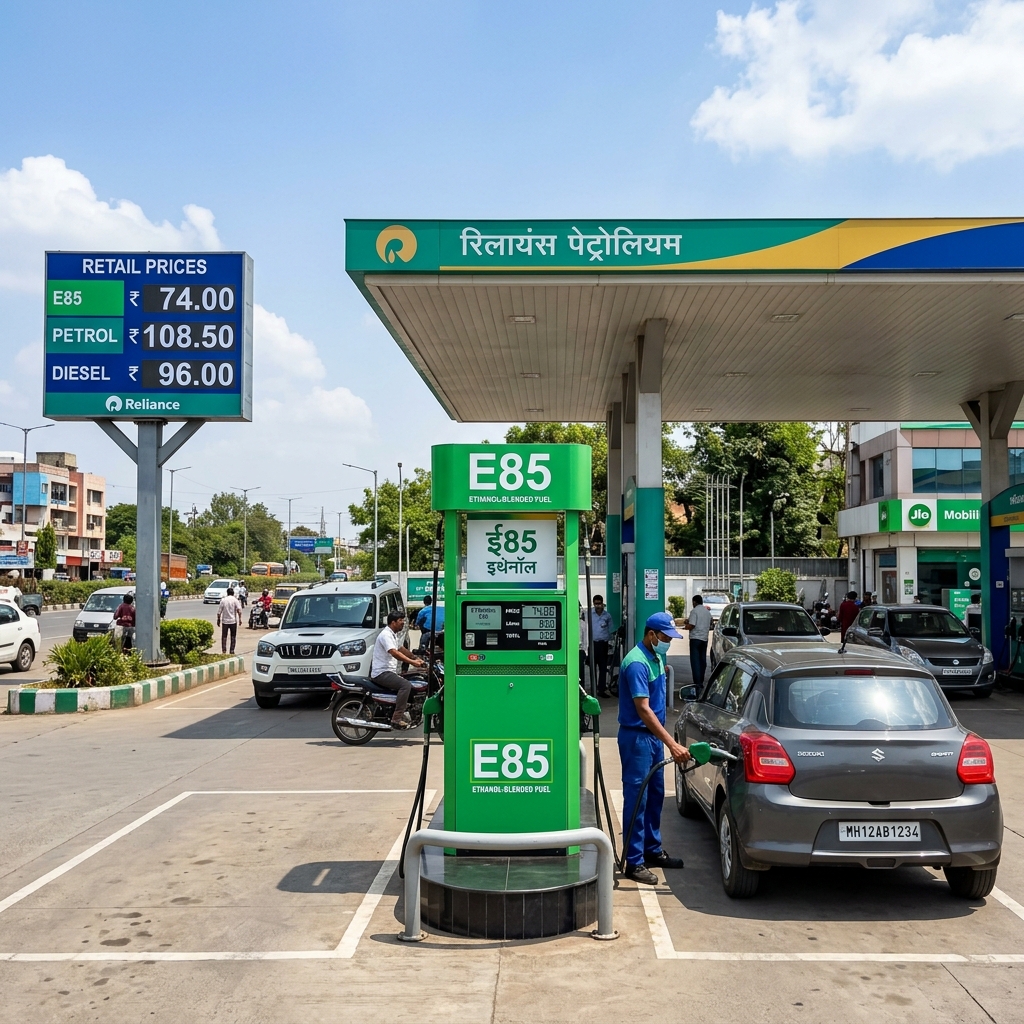
While current vehicles are E20 compliant, moving beyond 20% blending requires the widespread adoption of Flex-Fuel Vehicles (FFVs), which can run on any blend of petrol and ethanol (up to E85 or even E100). Automakers need to invest in the technology, and the government must provide the necessary policy visibility and incentives to make FFVs commercially viable for the Indian consumer.Conclusion
The history of ethanol fuel in India is a testament to the power of integrated policy-making. What began as a desperate attempt to manage the surplus byproducts of the sugar industry has evolved into a cornerstone of India's energy transition strategy. The journey from sporadic E5 trials to a robust, nationwide E20 roadmap demonstrates a remarkable evolution in infrastructure, agricultural planning, and political will.
As India looks to the future, ethanol will continue to play a pivotal role in reducing import dependence and greening the transport sector. By carefully managing the delicate balance between energy security, food security, and environmental sustainability, India can ensure that its ethanol success story continues to fuel the nation’s growth for decades to come. The transformation of agricultural fields into wellsprings of sustainable energy stands as one of modern India's most significant achievements in its pursuit of a greener tomorrow.