The automotive industry is undergoing a massive transformation, and the two-wheeler segment is no exception. With the push towards greener and more sustainable fuel alternatives, flex-fuel technology is rapidly gaining traction. As governments worldwide, including India, push for higher ethanol blending mandates like E20 and eventually E85, motorcycle manufacturers are gearing up to launch flex-fuel bikes.
However, amidst the excitement of lower emissions and reduced reliance on imported crude oil, a persistent question plagues the minds of prospective buyers and enthusiasts alike: Do flex fuel bikes have lower mileage?
The short answer is yes, theoretically, but the real-world implications are far more nuanced. To truly understand how flex-fuel affects your motorcycle's fuel economy, we need to dive deep into the science of ethanol, explore real-world testing data, and analyze the cost-to-benefit ratio for the everyday rider.
In this comprehensive guide, we will unpack everything you need to know about flex-fuel bike mileage, separating fact from fiction.
---
Understanding Flex-Fuel Technology in Motorcycles
Before we dissect the mileage debate, it is crucial to understand what a flex-fuel bike actually is. A flexible-fuel vehicle (FFV) or dual-fuel vehicle is an alternative fuel vehicle with an internal combustion engine designed to run on more than one fuel, usually gasoline blended with either ethanol or methanol fuel. Both fuels are stored in the same common tank.
In the context of modern motorcycles, "flex-fuel" typically refers to the ability to run on any blend of gasoline and ethanol—from pure petrol (E0, which is rare these days) up to 85% ethanol (E85) or even 100% ethanol (E100) in some specific markets like Brazil.
The Magic of the ECU and Sensors
What makes a bike "flexible" is its advanced Engine Control Unit (ECU) paired with specialized sensors (like an ethanol content sensor). These sensors continuously monitor the fuel composition flowing through the lines.When the sensor detects a change in the ethanol-to-petrol ratio, it sends a signal to the ECU. The ECU then instantaneously adjusts the ignition timing and the fuel injection pulse width to ensure optimal combustion for that specific blend. This dynamic adjustment is what prevents engine knocking and ensures smooth operation regardless of what pump you just visited.
---
The Science: Why Ethanol Impacts Mileage
To understand why a flex-fuel bike might return lower mileage, we have to look at the fundamental chemistry of the fuels involved. It all comes down to Energy Density.
Energy Density: Petrol vs. Ethanol
Energy density refers to the amount of energy stored in a given volume of fuel. * Gasoline (Petrol): Contains roughly 32.4 Megajoules per liter (MJ/L) of energy. * Ethanol (E100): Contains roughly 21.2 Megajoules per liter (MJ/L) of energy.This means that a liter of pure ethanol contains about 30% to 33% less energy than a liter of pure petrol.
The Volumetric Trade-off
Because ethanol has less energy per drop, an engine must burn more of it to produce the same amount of power as it would on petrol. When you fill up with E85 (85% ethanol, 15% petrol), the energy density of that mixture is significantly lower than standard petrol.To maintain the optimal air-fuel ratio (stoichiometric ratio) for combustion, the fuel injectors must stay open longer, spraying a larger volume of E85 into the cylinder. Naturally, because the engine is consuming a larger volume of liquid to travel the same distance and generate the same horsepower, the volumetric fuel efficiency—commonly known as mileage or kilometers per liter (kmpl)—decreases.
The Octane Advantage
However, the story does not end with energy density. Ethanol has a massive trump card: its Octane Rating. While regular petrol has an octane rating of around 87 to 91 (RON), pure ethanol boasts an octane rating of over 100. A higher octane rating means the fuel is far more resistant to pre-ignition (engine knocking).This high octane allows engine designers to increase the compression ratio of the engine or advance the ignition timing. Higher compression engines are inherently more thermally efficient. Therefore, a motorcycle engine designed specifically and optimized purely for high-ethanol blends can claw back some of that lost volumetric efficiency by converting the fuel's energy into motion much more effectively than a standard petrol engine.
---
Real-World Tests: What Happens on the Road?
Theoretical physics is one thing; real-world riding is another. Let us examine what happens when flex-fuel bikes hit the asphalt in real-world scenarios. We will look at data from mature flex-fuel markets like Brazil and early prototypes tested in India.
The Brazilian Experience
Brazil is the global pioneer in flex-fuel technology for both cars and motorcycles. Honda and Yamaha have been selling flex-fuel bikes (branded as "Mix" or "Blueflex") in Brazil for over a decade. The fuel available at Brazilian pumps is typically E27 (27% ethanol) or E100 (100% hydrous ethanol).Real-world reports from Brazilian riders show a clear trend: * Running on E27 (Standard Petrol): A typical 150cc commuter bike might yield around 40-45 kmpl. * Running on E100 (Pure Ethanol): The exact same bike, ridden on the exact same routes, typically sees a mileage drop to roughly 28-32 kmpl.
This represents a drop in volumetric mileage of roughly 25% to 30% when switching from a low-ethanol blend to pure ethanol. This aligns almost perfectly with the physics of energy density discussed earlier.
Indian Market Prototypes and Tests
India has been actively testing flex-fuel two-wheelers as part of the government's aggressive ethanol blending roadmap.
1. TVS Apache RTR 200 Fi E100: A few years ago, TVS launched a limited run of the Apache RTR 200 Fi E100, designed to run on pure ethanol. While not a true "flex-fuel" bike in the sense that it preferred E100, it provided valuable data. *Performance: The bike produced slightly better peak power and torque compared to its petrol counterpart due to the high octane rating and cooling effect of ethanol. *Mileage: Reviewers and testers noted a mileage drop of approximately 20-25% compared to the standard petrol version when ridden in real-world city and highway conditions.
2. Recent Flex-Fuel Showcases (Honda, Bajaj, Yamaha): At recent mobility expos in India, manufacturers have showcased flex-fuel prototypes based on popular models (like the Honda CB300F Flex-Fuel and Bajaj Pulsar NS160 Flex-Fuel). Internal testing data shared by engineers at these events suggests the following projections for the Indian market once E85 becomes widely available: * On E20 (which is rapidly becoming the standard petrol in India), the mileage drop compared to older E10 or E0 fuels is marginal—around 3% to 5%, which is practically unnoticeable to most riders. On E85**, manufacturers expect a mileage reduction of *20% to 28% compared to E20 fuel, depending on riding style and engine tuning.
The Verdict on Mileage Drop
The consensus from real-world testing is undeniable: If you run a flex-fuel bike on a high-ethanol blend like E85 or E100, you will get fewer kilometers per liter than you would on standard petrol. The drop is typically between 20% and 30%.---
The Cost-Benefit Analysis: Does Lower Mileage Mean Higher Cost?
If you are getting 30% fewer kilometers per liter, are you losing money? Not necessarily. This is where the economics of flex-fuel come into play.
The entire premise of using ethanol as a fuel additive or alternative is that it can be produced locally (from sugarcane, corn, or agricultural waste) and should theoretically be cheaper than refined, imported petroleum.
The "Price Parity" Calculation
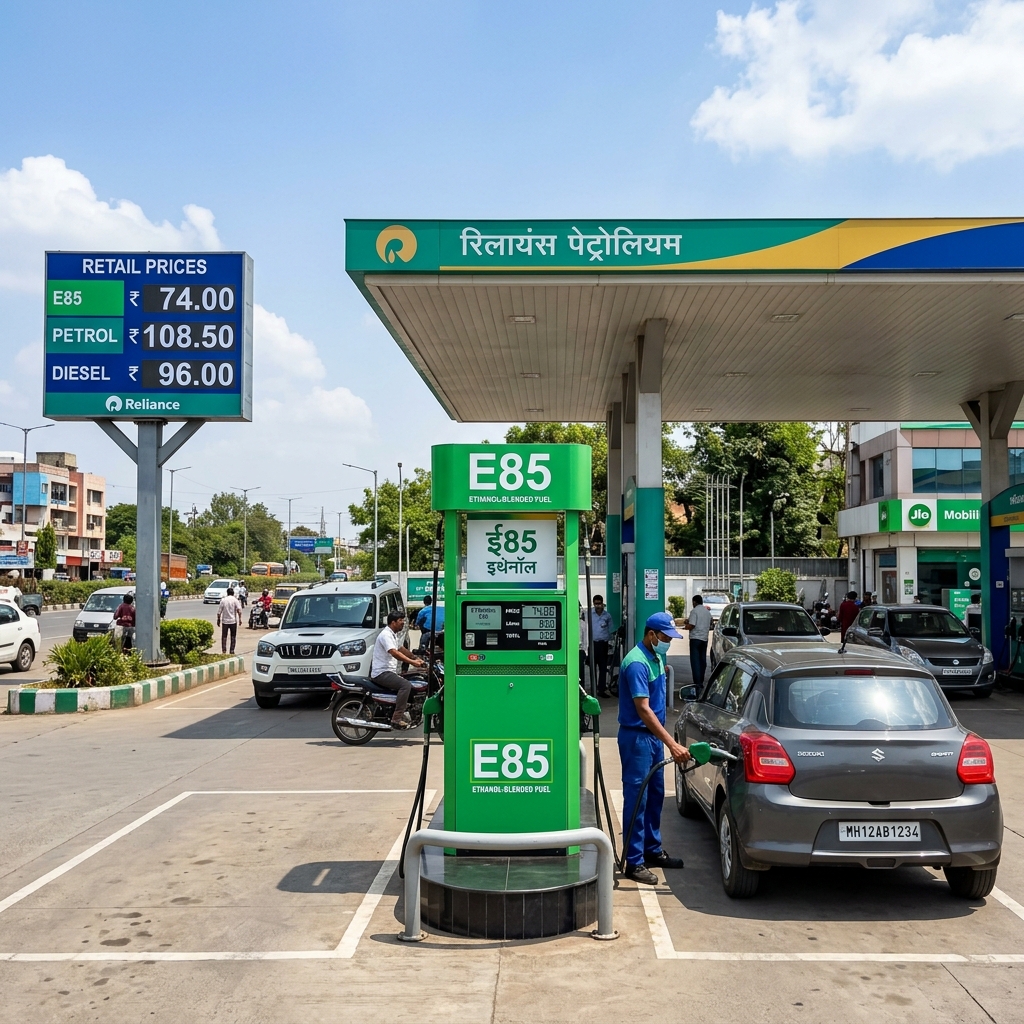
To determine if running E85 makes financial sense, you must look at the price difference between E85 and standard petrol at the pump.The Rule of Thumb: If E85 yields 25% lower mileage than regular petrol, then the price of E85 at the pump must be at least 25% cheaper than regular petrol for you to break even on your fuel costs per kilometer.
Let's run a hypothetical scenario: * Standard Petrol (E20) Price: ₹100 per liter * Bike's Mileage on Petrol: 40 kmpl * Cost per kilometer (Petrol): ₹100 / 40 = ₹2.50 per km
* E85 Price: ₹70 per liter (30% cheaper than petrol) * Bike's Mileage on E85 (25% drop): 30 kmpl * Cost per kilometer (E85): ₹70 / 30 = ₹2.33 per km
In this scenario, even though the bike gives lower mileage on E85, the fuel is cheap enough that the rider actually saves money per kilometer driven.
The Brazilian Reality Check
In Brazil, flex-fuel vehicle owners perform this calculation daily. At gas stations, prices for both E27 and E100 are prominently displayed. Consumers generally follow the "70% Rule": If the price of ethanol is less than 70% of the price of petrol, it is more economical to fill up with ethanol. If it rises above 70%, they switch to petrol.For flex-fuel bikes to be a resounding success in emerging markets like India, government subsidies, taxation policies, and robust agricultural supply chains must ensure that the retail price of high-ethanol blends significantly offsets the volumetric mileage penalty.
---
Performance and Engine Longevity
Aside from fuel economy, how does ethanol affect the actual riding experience and the life of the engine?
Performance: A Surprising Boost?
As mentioned earlier, ethanol has a high octane rating. Flex-fuel engines that can advance their ignition timing to take advantage of this high octane often feel more responsive. Furthermore, ethanol has a high "latent heat of vaporization." This means as it vaporizes in the intake manifold or cylinder, it absorbs a lot of heat, effectively cooling the incoming air charge. A cooler, denser air intake charge can lead to a slight increase in horsepower and torque. Many riders report that flex-fuel bikes feel "punchier" or smoother when running on high ethanol blends.Engine Longevity and Maintenance
A common fear is that ethanol, being corrosive and hydrophilic (it attracts water), will destroy motorcycle engines. While this is a valid concern for older bikes not designed for ethanol, modern flex-fuel bikes are built differently.* Upgraded Components: Flex-fuel motorcycles use specialized materials in the fuel system. Fuel lines, seals, O-rings, and fuel pump internals are made of fluoropolymers and specific rubbers that resist ethanol corrosion. * Valve Seats and Injectors: Engine components like valve seats are hardened to withstand the different combustion characteristics of ethanol. Fuel injectors are resized and designed to handle larger flow volumes without clogging. * Water Management: Because ethanol can absorb moisture from the air, long-term storage of E85 in a bike's tank can lead to phase separation (where water and ethanol separate from the petrol and sink to the bottom). Manufacturers recommend using fuel stabilizers if a bike is going to sit for months, or simply filling up with regular petrol before long periods of inactivity.
Overall, a purpose-built flex-fuel motorcycle engine will last just as long as a standard petrol engine, provided standard maintenance schedules are followed.
---
Environmental Impact vs. Economic Cost
The primary driver for the flex-fuel transition is environmental sustainability.
1. Reduced Greenhouse Gases: Ethanol is a biofuel. The carbon dioxide emitted when burning ethanol is roughly offset by the carbon dioxide absorbed by the crops (like sugarcane) grown to produce it. Blending ethanol significantly reduces net greenhouse gas emissions. 2. Lower Tailpipe Emissions: Ethanol contains oxygen molecules, which promotes a more complete combustion process. This leads to lower emissions of harmful pollutants like carbon monoxide (CO) and unburned hydrocarbons. 3. Energy Independence: For countries heavily reliant on crude oil imports, substituting a percentage of petrol with domestically produced ethanol dramatically reduces the import bill and strengthens the agricultural economy.
While the rider might experience lower mileage, the broader societal and environmental benefits are substantial. If the pricing structure is handled correctly, riders can contribute to a greener environment without harming their wallets.
---
The Future of Flex-Fuel Bikes in India
India is moving aggressively towards an ethanol-based future. The government brought forward its target to achieve 20% ethanol blending (E20) nationwide to 2025.
Following this, the next logical step is the introduction of flex-fuel vehicles capable of running on E85. * Bajaj Auto has publicly committed to launching flex-fuel variants of its popular commuter and sports bikes. * TVS Motor Company already has the technology proven with the Apache series and is ready to scale up. * Honda Motorcycle & Scooter India (HMSI), leveraging its vast experience in Brazil, has showcased flex-fuel prototypes and has confirmed plans for commercial launches in the near future. * Hero MotoCorp is also actively developing flex-fuel engines for its mass-market lineup.
As these bikes hit the showrooms, consumer education will be paramount. Riders will need to unlearn the habit of looking solely at the "kmpl" figure and learn to look at the "Cost per km" metric.
---
Conclusion: Reframing the Mileage Question
So, do flex fuel bikes have lower mileage? Yes, in terms of sheer volume (kilometers per liter), a bike running on E85 will yield roughly 20% to 30% lower mileage than it would on standard petrol. This is an inescapable law of physics dictated by the energy density of the fuel.
However, viewing this solely as a negative is a flawed perspective.
Flex-fuel technology offers the rider a choice. It provides the flexibility to run on standard petrol when traveling in remote areas or when ethanol prices spike, and the ability to switch to cleaner, high-octane E85 when it is cheap and abundant.
If the cost of high-ethanol fuel is priced competitively—significantly undercutting standard petrol—then the lower mileage is entirely offset by the cheaper fill-up. The rider enjoys a lower cost-per-kilometer, a potentially punchier engine performance due to higher octane, and the satisfaction of significantly reducing their carbon footprint.
The transition to flex-fuel bikes is not about sacrificing efficiency; it is about changing how we measure fuel economy in a changing world.
---
Frequently Asked Questions (FAQs)
1. Can I put E85 in my current, non-flex-fuel motorcycle? No, you should absolutely avoid doing this. Standard motorcycles are not designed to handle high ethanol blends. E85 will likely run your engine too lean, leading to severe overheating and engine damage. The fuel lines and seals will also rapidly degrade. Most modern bikes can handle E10 or E20, but always check your owner's manual.
2. Will my flex-fuel bike be slower on E85? Actually, it might be slightly faster or more responsive! Because ethanol has a higher octane rating, the bike's ECU can optimize the engine timing for better performance. While you lose mileage, you often gain a slight bump in smooth power delivery.
3. Do I need to empty the tank before switching between petrol and E85? No, that is the beauty of a "flex" fuel system. The sensors in the fuel line detect whatever ratio of petrol and ethanol is in the tank and adjust the engine mapping instantly on the fly. You can mix them in any ratio.
4. Why is the government pushing for flex-fuel bikes? The main reasons are reducing carbon emissions, lowering pollution in major cities, and significantly cutting down the country's massive crude oil import bill by utilizing domestically grown agricultural resources.
5. How much cheaper does E85 need to be to make sense? A good rule of thumb is that E85 should be priced at least 25% to 30% lower than standard petrol to break even on the reduced mileage. If the price difference is greater than 30%, you are saving money with every kilometer ridden.
6. Do flex-fuel bikes require more maintenance? Generally, standard maintenance intervals remain the same. However, if you store the bike for long periods (several months) with E85 in the tank, it is advisable to use a fuel stabilizer, as ethanol attracts moisture, which can cause starting issues or internal corrosion over long periods of inactivity.