India stands at a critical juncture in its energy transition journey. As the world's third-largest consumer and importer of crude oil, the nation's economic stability is deeply intertwined with global oil market volatility. In this context, the potential adoption of E85—a high-level ethanol blend consisting of 85% ethanol and 15% gasoline—presents a transformative opportunity. Transitioning toward this biofuel could redefine India's energy landscape, acting as a crucial lever to curb the country's massive oil import bills, stabilize its macroeconomic indicators, and stimulate domestic agricultural growth.
In this comprehensive analysis, we will explore the multifaceted economic impact of E85 adoption on India's oil imports, trade deficit, agricultural sector, and overall economic resilience. By dissecting the direct financial savings and the broader macroeconomic implications, we can appreciate the strategic significance of E85 in India's quest for energy independence and sustainable economic development.
The Current State of India's Oil Economy
To understand the magnitude of E85's potential impact, it is essential first to grasp the scale of India's current dependence on imported crude oil. Over the past decade, rapid industrialization, a surging middle class, and extensive infrastructure development have propelled India's energy demands to unprecedented heights. However, domestic oil production has failed to keep pace with this ravenous appetite, forcing the country to rely heavily on international suppliers.
The Staggering Import Bill
Currently, India imports more than 85% of its crude oil requirements. This heavy reliance translates into a staggering annual import bill that routinely exceeds hundreds of billions of dollars. When global oil prices surge—whether due to geopolitical tensions, supply chain disruptions, or speculative trading—the financial shockwaves are felt across the entire Indian economy. High crude prices inflate the import bill, exacerbating the current account deficit (CAD) and placing immense downward pressure on the Indian Rupee (INR).
Vulnerability to Global Price Shocks
The economic vulnerability stemming from this oil dependence cannot be overstated. Every incremental dollar increase in the price of a barrel of crude oil adds significantly to India's import burden. This vulnerability trickles down to the end consumer, manifesting as higher prices for transportation, goods, and services, thereby fueling inflation. For the Reserve Bank of India (RBI) and the central government, managing this inflation often requires tightening monetary policy, which can, in turn, stifle economic growth and investment.
The Need for Strategic Diversification
Given these stark realities, achieving energy security and economic stability necessitates a drastic reduction in imported crude oil. While electric vehicles (EVs) are a crucial part of the long-term solution, their widespread adoption faces hurdles related to infrastructure, battery costs, and grid capacity. Herein lies the strategic importance of biofuels, specifically E85. It offers an immediate, scalable, and economically viable alternative that utilizes existing internal combustion engine (ICE) technology while simultaneously addressing the import challenge.
What is E85 and How Does it Fit into India's Strategy?
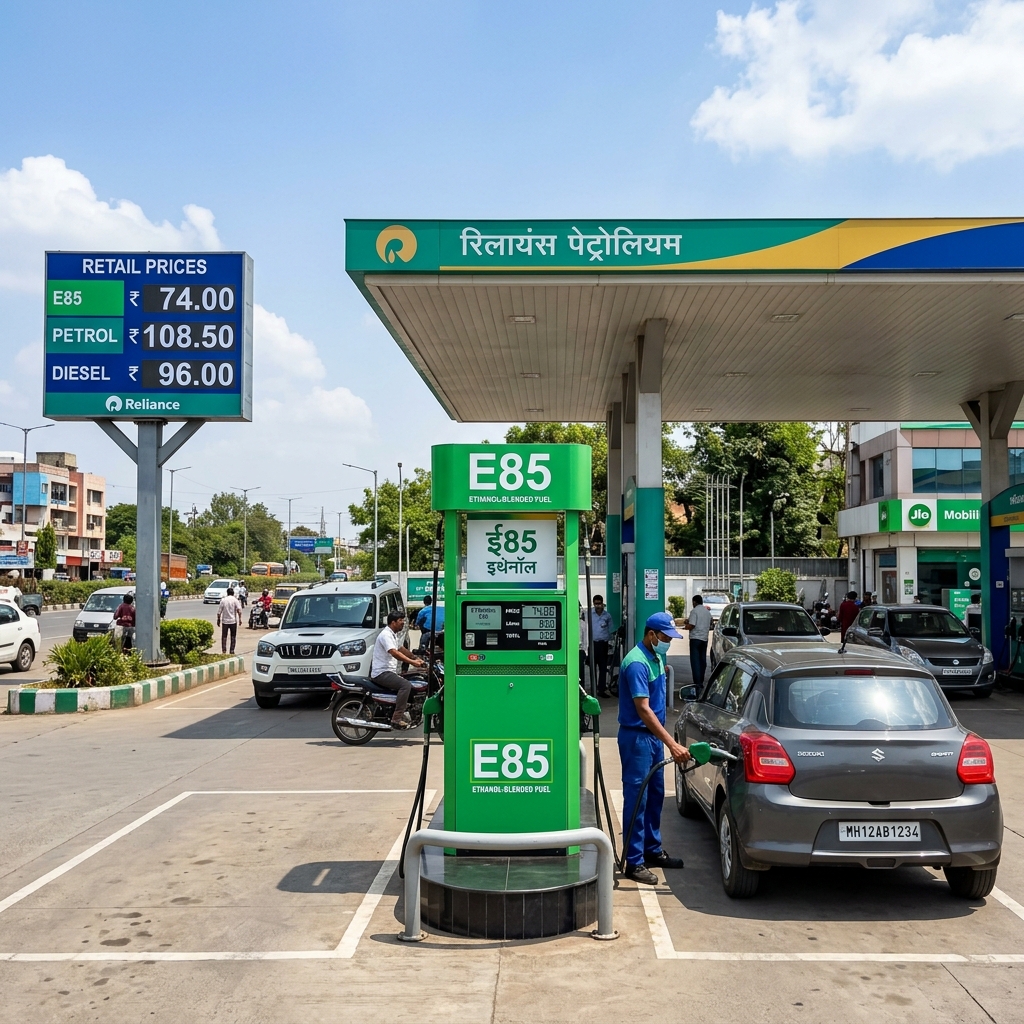
E85 is a blended fuel containing 85% ethanol and 15% unleaded gasoline (petrol). Ethanol is a renewable, plant-based alcohol fuel produced primarily from the fermentation of sugars and starches found in crops such as sugarcane, maize (corn), and broken rice.
The Evolution of India's Ethanol Blending Program
India is not new to ethanol blending. The government's Ethanol Blended Petrol (EBP) program has seen remarkable success in recent years. Moving from a mere 1.5% blending rate in 2014, India successfully achieved its target of 10% ethanol blending (E10) ahead of schedule and has accelerated its goal to achieve 20% blending (E20) nationwide.
While E20 is a significant milestone, E85 represents a paradigm shift. Unlike lower blends, utilizing E85 requires Flex-Fuel Vehicles (FFVs) designed with specialized engine components capable of handling high concentrations of ethanol. If India were to aggressively promote FFVs and the accompanying E85 infrastructure, it would effectively replace 85% of the gasoline in those vehicles with domestically produced biofuel.
Leveraging Agricultural Abundance
India's unique advantage lies in its vast agricultural sector. As one of the world's largest producers of sugarcane and rice, India possesses the requisite feedstock to support a massive expansion in ethanol production. By converting agricultural surpluses and crop residues into fuel, India can transform a persistent agrarian challenge into a strategic economic asset, perfectly aligning agricultural policy with energy security goals.
Direct Economic Benefits of Reducing Crude Oil Imports
The most immediate and quantifiable economic impact of widespread E85 adoption is the dramatic reduction in crude oil imports. This reduction cascades through the economy, generating profound financial benefits at the national level.
Massive Foreign Exchange Savings
Every liter of domestically produced ethanol that replaces a liter of imported gasoline represents foreign exchange saved. If a substantial portion of India's passenger vehicle fleet were to transition to E85, the volume of displaced gasoline would be immense.
To illustrate, consider the scale of India's petrol consumption. Replacing even 10% to 20% of the total nationwide petrol consumption with ethanol would save billions of dollars in foreign exchange annually. These savings are not a one-time windfall but a recurring, compounding benefit that structurally reduces the country's import burden. The capital previously funneled out of the country to foreign oil producers is instead retained within the domestic economy.
Mitigation of the Current Account Deficit
The current account deficit (CAD) is a critical indicator of a country's economic health, reflecting the balance of trade in goods and services. India's CAD has historically been dominated by its oil import bill. By significantly curbing these imports through E85, India can structurally improve its trade balance. A lower CAD enhances sovereign credit ratings, reduces the risk premiums associated with international borrowing, and creates a more favorable environment for foreign direct investment (FDI).
Shielding Against Price Volatility
Beyond the absolute savings, substituting imported oil with domestic E85 provides a vital buffer against global oil price volatility. The domestic price of ethanol can be largely decoupled from international crude markets, governed instead by government pricing mechanisms and domestic agricultural yields. This decoupling provides predictability and stability to fuel prices, shielding Indian consumers and businesses from sudden, inflationary price hikes triggered by external geopolitical events.
The Ripple Effect: Currency Stabilization and Trade Balance
The economic implications of reduced oil imports extend far beyond the direct monetary savings, fundamentally influencing India's macroeconomic stability, particularly concerning the value of the Indian Rupee.
Supporting the Indian Rupee
The value of the INR is heavily influenced by the demand for US Dollars (USD) required to pay for oil imports. When oil prices rise or import volumes increase, the demand for USD spikes, leading to the depreciation of the INR. A weaker Rupee, in turn, makes all imports more expensive, creating a vicious cycle of "imported inflation."
By adopting E85 and cutting down the oil import bill, the structural demand for USD diminishes. This reduced demand helps stabilize the INR, preventing sharp depreciations. A stable currency is the bedrock of economic confidence; it lowers the cost of essential non-oil imports (like electronics, machinery, and critical raw materials), reduces the debt servicing burden for external corporate borrowing, and bolsters the purchasing power of the average Indian citizen.
Enhancing Sovereign Fiscal Health
A lower import bill and a stable currency improve the overall fiscal health of the government. The government frequently intervenes to subsidize fuel prices or cut excise duties during periods of high crude prices to protect consumers from inflation. These interventions strain the fiscal deficit. By utilizing E85 to maintain price stability, the government can allocate fiscal resources more efficiently, directing funds toward productive infrastructure investments, healthcare, and education rather than subsidizing imported fossil fuels.
Agricultural Revitalization: The Domestic Beneficiaries
The transition to E85 is not merely an energy strategy; it is inherently an agricultural stimulus package. The shift from importing energy from the Middle East to procuring it from rural India facilitates one of the largest wealth transfers in the nation's history, driving rural economic growth.
Guaranteed Markets and Income Security for Farmers
The most direct beneficiaries of the E85 economy are Indian farmers. The ethanol production chain requires a continuous and massive supply of feedstock—primarily sugarcane, but increasingly maize, broken rice, and agricultural residues (for second-generation ethanol).
A robust E85 ecosystem guarantees a massive, domestic, and predictable market for these agricultural products. The government's policy of fixing remunerative procurement prices for ethanol ensures that sugar mills and distilleries can offer prompt and fair payments to farmers. This income security is revolutionary for the agricultural sector, which has historically suffered from price volatility, surplus-induced market crashes, and delayed payments.
Addressing the Sugar Surplus
India frequently grapples with surplus sugar production, which depresses market prices and strains the financial health of sugar mills, leading to mounting arrears in farmer payments. By diverting excess sugarcane juice and B-heavy molasses toward ethanol production for E85, India can effectively clear the sugar glut, stabilize domestic sugar prices, and improve the liquidity of the sugar industry. This creates a financially viable agro-industrial complex capable of continuous investment and growth.
Rural Wealth Creation and Consumption
The infusion of capital into rural India through ethanol procurement has a high economic multiplier effect. When farmers' incomes increase and become more predictable, rural consumption rises. This increased purchasing power stimulates demand for manufactured goods, FMCG products, two-wheelers, and tractors, driving overall economic growth and industrial production. The rural economy transitions from a state of subsistence to a powerful engine of domestic consumption.
Infrastructure Investments and Job Creation
Building the ecosystem for widespread E85 adoption requires massive capital investment across the value chain, from distilleries and logistics to retail distribution and automotive manufacturing. These investments act as a powerful catalyst for job creation and industrial expansion.
Expanding Distillation Capacity
To meet the enormous ethanol demand required for E85, India must vastly expand its domestic distillation capacity. This necessitates the construction of new greenfield ethanol plants and the expansion of existing facilities across multiple states. These infrastructure projects require significant capital expenditure, stimulating the construction, engineering, and capital goods sectors.
Job Creation Across the Value Chain
The economic impact is perhaps most visible in employment generation. The E85 value chain creates jobs at every stage: 1. Agriculture: Increased demand for crops leads to more intensive farming and agricultural labor requirements. 2. Manufacturing: The construction and operation of distilleries create high-quality industrial jobs, particularly in rural and semi-urban areas, bridging the rural-urban employment divide. 3. Logistics and Supply Chain: Transporting massive volumes of ethanol from distilleries to oil marketing companies (OMCs) and eventually to retail outlets requires a massive expansion of the logistics sector, creating jobs in transportation and storage. 4. Automotive Sector: The manufacturing of Flex-Fuel Vehicles (FFVs) and specialized engine components requires skilled labor and drives research and development within the domestic auto industry.
Technological Advancements and Second-Generation (2G) Ethanol
While first-generation (1G) ethanol relies on food crops, the true long-term potential of E85 lies in second-generation (2G) ethanol, produced from agricultural waste (like rice stubble) and biomass. Investing in 2G ethanol technology not only resolves the "food vs. fuel" debate but also addresses critical environmental issues like stubble burning, which causes severe air pollution in northern India. The development and commercialization of 2G technology will position India as a global leader in advanced biofuels, fostering a new high-tech green industry.
Challenges and Transition Costs
While the economic benefits of E85 are profound, the transition is not without significant challenges and associated costs. A realistic assessment of the economic impact must account for these hurdles.
Capital Investment Required for Infrastructure
The transition to E85 requires an overhaul of the existing fuel distribution infrastructure. Ethanol is corrosive and hygroscopic (absorbs water), meaning it cannot be transported through existing petroleum pipelines. Dedicated storage tanks, specialized dispensing pumps at retail outlets, and specialized transport tankers are required. The capital expenditure required by OMCs to upgrade thousands of fuel stations across the country is immense and must be factored into the overall economic cost.
The Cost of Flex-Fuel Vehicles (FFVs)
For consumers, utilizing E85 requires the purchase of FFVs. While the core engine technology is similar to standard ICE vehicles, FFVs require modified fuel lines, specialized sensors, and corrosion-resistant components. These modifications increase the manufacturing cost of the vehicle. For the economic model to succeed, the price differential between E85 and standard petrol must be substantial enough to offset the higher upfront cost of an FFV and the slightly lower energy density (fuel efficiency) of ethanol compared to gasoline.
Managing Food Inflation Risks
Perhaps the most sensitive economic challenge is managing the delicate balance between fuel production and food security. If the demand for ethanol aggressively encroaches upon crops meant for human or animal consumption, it could trigger food inflation. The government must employ sophisticated agricultural planning and dynamic pricing models to ensure that ethanol production relies strictly on surpluses, non-food crops (like maize), and eventually, cellulosic biomass (2G ethanol) to prevent adverse impacts on the domestic food supply.
Tax Revenue Implications for the Government
The Indian government relies heavily on taxes levied on petroleum products for its revenue. Currently, ethanol enjoys a lower tax rate than petrol to incentivize blending. If E85 replaces a vast quantity of heavily taxed petrol, it could lead to a significant shortfall in excise duty collections. The government will need to carefully calibrate its taxation strategy—perhaps by widening the tax base elsewhere or gradually rationalizing the tax on high-blend biofuels—to ensure fiscal stability while maintaining the economic incentive for consumers to choose E85.
Conclusion
The economic impact of E85 on India's oil imports and the broader economy is unequivocally transformative. By aggressively pursuing a high-blend ethanol strategy, India can fundamentally rewrite its macroeconomic narrative.
The direct benefits are clear: billions of dollars saved in foreign exchange, a structurally lower current account deficit, and enhanced protection against global oil price volatility. However, the true genius of the E85 strategy lies in its domestic ripple effects. It turns an imported liability (crude oil) into a domestic asset (agricultural produce), facilitating a massive transfer of wealth to the rural economy, guaranteeing farmer incomes, and revitalizing the agricultural sector.
While the transition requires substantial upfront investments in infrastructure and careful policy management to prevent food inflation and fiscal shortfalls, the long-term economic dividends far outweigh the costs. E85 offers India a unique pathway to achieve energy security, foster sustainable domestic growth, and build a more resilient and self-reliant economy in the 21st century. It is not just a change in fuel; it is a catalyst for national economic empowerment.