The automotive landscape in 2026 has witnessed a massive shift. As traditional petrol and diesel prices continue their unpredictable fluctuations driven by global market dynamics and environmental taxes, the everyday driver is left searching for viable, cost-effective alternatives. Enter the trio of alternative fuels that have taken center stage: E85 Flex Fuel, Compressed Natural Gas (CNG), and Liquefied Petroleum Gas (Auto LPG).
Each of these fuels promises significant savings at the pump, lower emissions, and a step towards energy independence. However, the true measure of their economic viability lies not just in the price per liter or kilogram, but in the ultimate metric for any driver: the Cost Per Kilometer (CPKM).
In this comprehensive 2026 guide, we will break down the economics of E85, CNG, and LPG. We will analyze current prices, fuel efficiency, maintenance factors, and initial setup costs to give you a definitive answer on which fuel reigns supreme in the battle for your wallet.
---
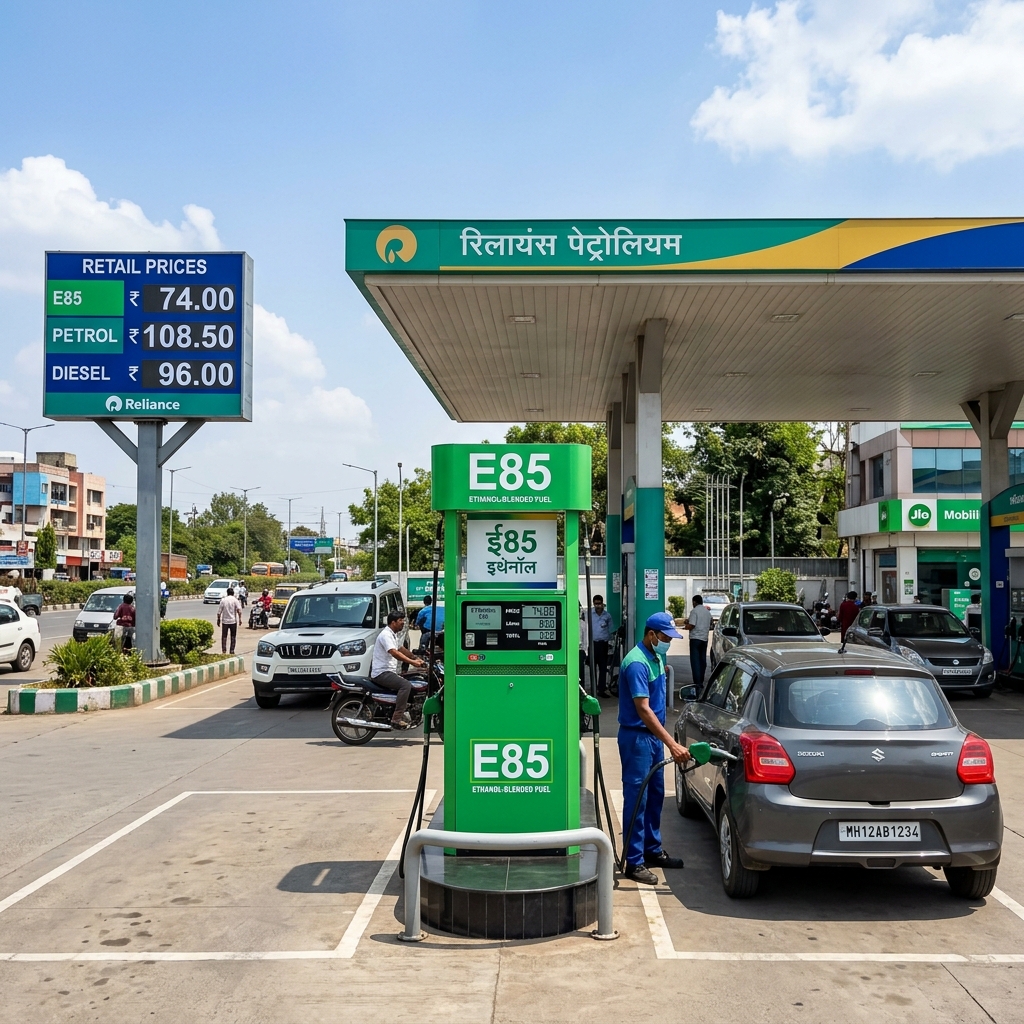
1. Understanding the Contenders
Before diving into the numbers, it is crucial to understand what these fuels are, how they work, and why they have become so prominent in the 2026 automotive market.
What is E85 Flex Fuel?
E85 is a high-level ethanol blend consisting of 85% ethanol and 15% petrol (gasoline). Ethanol is a renewable biofuel primarily made from plant materials like sugarcane, corn, and agricultural waste. Vehicles designed to run on this fuel are called Flex Fuel Vehicles (FFVs). They possess specialized fuel lines, robust fuel pumps, and advanced engine control units (ECUs) capable of detecting the ethanol blend ratio and adjusting the ignition timing and fuel injection accordingly.In recent years, E85 has gained immense traction due to aggressive government blending mandates aimed at reducing crude oil import bills and lowering carbon footprints.
What is Compressed Natural Gas (CNG)?
CNG is primarily composed of methane gas compressed to less than 1% of the volume it occupies at standard atmospheric pressure. It is stored in heavy, thick-walled cylindrical tanks, usually placed in the trunk of a vehicle. CNG has long been the darling of the commercial transport sector and budget-conscious private owners. It burns much cleaner than traditional petrol, emitting significantly fewer greenhouse gases.What is Liquefied Petroleum Gas (Auto LPG)?
Auto LPG is a blend of propane and butane. Unlike CNG, it is stored as a liquid under moderate pressure. LPG has been a popular alternative fuel for decades, though its market share has seen fluctuations in response to the rise of CNG and, more recently, E85. It burns cleaner than petrol and offers a higher energy density per volume compared to highly compressed CNG.---
2. Factors Influencing Fuel Costs in 2026
To understand the Cost Per KM for each fuel, we must first look at the macroeconomic factors that dictate their retail prices in 2026.
The Rise of Biofuels and E85 Pricing
The pricing of E85 is heavily influenced by agricultural yields and government subsidies. By 2026, many nations, particularly agricultural powerhouses, have heavily subsidized ethanol production. The push for the E20 mandate (20% ethanol blending) served as a stepping stone, establishing the infrastructure needed to seamlessly introduce E85 pumps. Because ethanol is produced locally, it is largely insulated from global crude oil price shocks, making its price remarkably stable and substantially lower than pure petrol.Natural Gas Geopolitics and CNG Prices
CNG prices depend largely on domestic natural gas production and international liquefied natural gas (LNG) import contracts. While CNG remains a cheap fuel, the cost of compression and the establishment of high-pressure pipeline infrastructure often lead to price disparities between urban centers and rural areas. In 2026, CNG prices have seen a steady, albeit slow, increase due to rising global demand for natural gas as a transition fuel.LPG Market Dynamics
LPG is a byproduct of both natural gas processing and petroleum refining. Therefore, its price is somewhat tethered to the global crude oil market, although it generally remains cheaper than petrol. Government policies on taxing LPG versus CNG also play a significant role. In many regions, LPG has lost some of its policy advantages to CNG, making its pricing less competitive than it was a decade ago.---
3. The Math: Calculating Cost Per Kilometer (CPKM)
The Cost Per Kilometer is calculated using a simple formula:
CPKM = Price of Fuel (per Liter/Kg) / Vehicle Mileage (Km per Liter/Kg)
However, the True Cost of Ownership also involves: - Upfront Costs: The premium paid for a factory-fitted CNG/LPG kit or a Flex Fuel engine, or the cost of aftermarket conversion. - Maintenance Costs: The wear and tear on engine components specific to each fuel type. - Performance Trade-offs: The hidden cost of lost boot space, reduced engine life, or time spent in refueling queues.
For the sake of our 2026 baseline calculation, we will use average market prices and efficiency metrics for a standard mid-size sedan or compact SUV.
(Note: Prices and mileage figures are representative averages for 2026 to provide a comparative baseline.)
---
4. E85 Flex Fuel: The 2026 Cost Analysis
Current Price Trends
In 2026, the local production of ethanol has scaled massively. With government tax rebates favoring high-blend biofuels, the retail price of E85 is significantly lower than standard petrol. Estimated Average Price in 2026: ₹65 per Liter.Mileage Expectations
It is a well-known fact that ethanol has a lower energy density than petrol (about 25-30% less). This means that you need to burn more E85 to achieve the same power output as petrol, resulting in a drop in volumetric fuel economy. If a standard car delivers 15 km/l on pure petrol, a flex-fuel engine running on E85 might deliver around 11.5 km/l. However, modern 2026 FFV engines are highly optimized with higher compression ratios to squeeze more efficiency out of ethanol. Estimated Average Mileage: 12 KM/L.Calculated CPKM for E85
CPKM = ₹65 / 12 = ₹5.41 per KilometerAdditional E85 Factors
- Upfront Cost: Flex Fuel Vehicles generally carry a marginal premium over standard petrol cars (roughly ₹30,000 to ₹40,000), significantly cheaper than factory-fitted CNG systems. - Maintenance: Ethanol burns cleaner, leaving fewer carbon deposits, potentially prolonging the life of engine oil. - Performance: E85 has a high octane rating (around 100-105). This results in better engine performance, smoother acceleration, and no knocking.---
5. Compressed Natural Gas (CNG): The 2026 Cost Analysis
Current Price Trends
CNG remains the darling of the fleet operator. While prices have crept up slightly due to international gas market pressures, government price-capping mechanisms in many regions keep it highly competitive. Estimated Average Price in 2026: ₹85 per Kg.Mileage Expectations
CNG offers excellent fuel economy. A vehicle that gives 15 km/l on petrol can easily deliver 20-22 km/kg on CNG, depending on the tuning and whether it is a factory-fitted sequential kit. Estimated Average Mileage: 21 KM/Kg.Calculated CPKM for CNG
CPKM = ₹85 / 21 = ₹4.04 per KilometerAdditional CNG Factors
- Upfront Cost: Factory-fitted CNG cars command a high premium, often ₹80,000 to ₹1,00,000 over their petrol counterparts. - Maintenance: CNG engines run hotter and drier, which can lead to faster wear on spark plugs and valve seats. Regular hydro-testing of the heavy high-pressure cylinder is legally mandated and adds to the long-term cost. - Practicality: The massive CNG tank consumes nearly the entire boot space. Furthermore, refueling takes longer, and despite infrastructure improvements in 2026, highway availability can still be patchy compared to liquid fuels.---
6. Liquefied Petroleum Gas (Auto LPG): The 2026 Cost Analysis
Current Price Trends
Auto LPG suffers from being somewhat neglected in the policy landscape compared to E85 and CNG. However, it still maintains a price advantage over standard petrol. Estimated Average Price in 2026: ₹70 per Liter.Mileage Expectations
LPG has a lower energy density than petrol but higher than CNG by volume. Expect a mileage drop of about 10-15% compared to petrol. Estimated Average Mileage: 13 KM/L.Calculated CPKM for Auto LPG
CPKM = ₹70 / 13 = ₹5.38 per KilometerAdditional LPG Factors
- Upfront Cost: LPG kits are generally cheaper to install than CNG kits and operate at much lower pressures. - Practicality: LPG tanks are often designed as "toroidal" (donut-shaped) tanks that fit into the spare wheel well, thereby preserving precious boot space—a massive advantage over CNG. - Availability: Auto LPG dispensing stations are less common than they were a decade ago, as many operators shifted focus to CNG or EV charging infrastructure.---
7. Head-to-Head Comparison: The 2026 Verdict
Let us look at a direct comparison of the fundamental metrics:
| Metric | E85 Flex Fuel | CNG | Auto LPG | Standard Petrol (For Ref) | | :--- | :--- | :--- | :--- | :--- | | Fuel Price (Est.) | ₹65 / Liter | ₹85 / Kg | ₹70 / Liter | ₹100 / Liter | | Mileage (Est.) | 12 KM / L | 21 KM / Kg | 13 KM / L | 15 KM / L | | Cost Per KM (CPKM)*| **₹5.41** | **₹4.04** | **₹5.38** | *₹6.66 | | Upfront Vehicle Premium| Low | High | Medium | N/A | | Boot Space Impact | None | Severe | Low (Toroidal tank)| None | | Performance | High (More Power)| Low (Power drop) | Moderate | Standard | | Refueling Speed | Fast (Like Petrol) | Slow | Fast | Fast |
Analyzing the Results
At a strict Cost Per Kilometer level, CNG remains the undisputed king of cheap running costs in 2026 at ₹4.04/km. If your sole objective is to travel from point A to point B as cheaply as possible, and you cover a massive amount of kilometers daily (like a taxi or delivery driver), CNG is the logical choice.
However, CPKM does not tell the whole story.
When you factor in the upfront cost, it takes a significant amount of driving to recover the ₹1,00,000 premium paid for a factory CNG car.
This is where E85 Flex Fuel* shines as the ultimate all-rounder for 2026. At *₹5.41/km, E85 offers substantial savings over standard petrol (₹6.66/km). More importantly, E85 requires almost zero compromise. - You retain 100% of your boot space. - You enjoy a high-performance, high-octane driving experience rather than the sluggish acceleration often associated with CNG. - You can refuel as quickly as you would with petrol, avoiding long CNG queues. - If an E85 pump is unavailable, a Flex Fuel vehicle can simply be filled with standard petrol, offering unmatched range anxiety relief.
Auto LPG sits in an awkward middle ground. Its CPKM is nearly identical to E85, and it saves boot space compared to CNG. However, its dwindling infrastructure in 2026 makes it a less attractive option for new buyers compared to the rapidly expanding E85 network.
---
8. Lifestyle and Practicality Considerations
Choosing a fuel type in 2026 is as much a lifestyle choice as it is an economic one. Let us break down how each fuel fits into different driving profiles.
The Urban Commuter
If you drive 40-50 km a day strictly within city limits, a CNG vehicle makes a lot of financial sense. City speeds rarely expose the power deficit of CNG, and the dense urban network of CNG stations means you won't struggle to find a pump. The lack of boot space is also less of an issue for daily office runs.The Highway Cruiser and Weekend Warrior
If you frequently take weekend trips, travel with family luggage, and drive on highways, E85 Flex Fuel is the clear winner. The full boot space allows for luggage, the higher octane provides excellent highway overtaking power, and the liquid fuel network (petrol/E85) is universally available across rural and highway routes.The Performance Enthusiast
For those who love driving, the choice is simple. CNG and LPG both result in a noticeable drop in horsepower and torque. E85, on the other hand, is practically race fuel. With an octane rating exceeding 100, turbocharged engines can be tuned to produce significantly more power on E85 than on standard premium petrol. In 2026, many driving enthusiasts actively seek out E85 for its performance benefits as much as its cost savings.---
9. Environmental Impact: Which is Greener?
In 2026, environmental consciousness is a massive factor in automotive choices.
CNG and LPG are fossil fuels. While they burn much cleaner than petrol or diesel—producing virtually no particulate matter and lower carbon monoxide—they still release carbon dioxide that was trapped underground for millions of years into the atmosphere.
E85 is a biofuel. The plants used to create ethanol (like sugarcane or corn) absorb carbon dioxide from the atmosphere as they grow. When E85 is burned in an engine, it releases that same carbon dioxide back, creating a closed-loop carbon cycle. While the production, refining, and transportation of ethanol do have a carbon footprint, the overall lifecycle greenhouse gas emissions of E85 are substantially lower than those of fossil fuels. From a long-term sustainability perspective, E85 is the most ecologically sound liquid fuel available.
---
10. The Future Outlook Beyond 2026
As we look toward the end of the decade, the trajectories of these three fuels are quite clear.
E85 Flex Fuel is on an aggressive upward curve. Automakers are increasingly standardizing Flex Fuel engines, recognizing that biofuels are the most practical way to reduce fleet emissions without forcing consumers into expensive electric vehicles (EVs) prematurely. The infrastructure for ethanol is scaling rapidly, supported by strong agricultural lobbies and energy independence mandates.
CNG will remain a stalwart of the commercial sector. Heavy-duty trucks, buses, and taxi fleets will continue to rely on CNG for its unbeatable running costs. However, in the private vehicle sector, the compromises in space and performance are pushing buyers toward either E85 or pure EVs.
Auto LPG appears to be fading. Without strong policy backing or distinct advantages over the rising E85 network, it is becoming a niche fuel, primarily sustained by existing older conversions rather than new vehicle sales.
---
11. Conclusion: Making Your Choice in 2026
The Cost Per Kilometer comparison of 2026 reveals a nuanced picture of the automotive landscape.
If absolute penny-pinching is your goal and you can live with compromised boot space and long refueling times, CNG remains the king of low-cost commuting at ₹4.04/km.
However, if you want a vehicle that offers significant savings over standard petrol, helps the environment, delivers high performance, and demands zero compromises on practicality, E85 Flex Fuel is undeniably the best choice for the modern driver in 2026. At ₹5.41/km, it represents the perfect sweet spot between economic viability and everyday usability.
As alternative fuels become the norm, E85 stands out not just as a fuel for the transition, but as a robust, sustainable, and highly practical solution for the future of motoring.
--- Disclaimer: The prices, mileage, and cost calculations provided are estimates based on 2026 market averages. Actual costs may vary depending on local taxes, specific vehicle models, driving habits, and regional infrastructure.