As India aggressively pushes towards a greener and more sustainable automotive future, ethanol-blended fuels have taken center stage. With the successful rollout of E20 (20% ethanol blend), the next big frontier is E85 fuel—a blend containing 85% ethanol and 15% petrol. Designed for Flex-Fuel Vehicles (FFVs), E85 promises significant reductions in tailpipe emissions and, crucially, massive savings at the fuel pump.
But what exactly is the E85 fuel price in India today? How does it compare to standard petrol, and more importantly, how much money can you save by switching? In this comprehensive guide, we will break down the current state of E85 pricing, the factors that influence its cost, and provide a detailed cost calculator to help you understand the economics of running a flex-fuel vehicle in India.
---
Table of Contents
1. Introduction to E85 Fuel in India 2. Current E85 Fuel Price in India 3. State-wise Expected E85 Fuel Rates 4. Factors Influencing E85 Prices in India 5. E85 vs. Petrol vs. E20: A Detailed Price Comparison 6. E85 Cost Calculator: Estimate Your Savings 7. The Economics of Flex-Fuel Vehicles (FFVs) 8. Why is E85 Expected to be Cheaper than Regular Petrol? 9. Challenges in E85 Pricing and Distribution 10. Government Subsidies and Tax Benefits on Ethanol 11. Future Projections: Where Are E85 Prices Heading? 12. Frequently Asked Questions (FAQs) 13. Conclusion---
1. Introduction to E85 Fuel in India
E85 is a high-level ethanol blend consisting of 51% to 83% ethanol (though nominally 85%) and the remaining balance being standard unleaded petrol. In countries like Brazil and the United States, E85 is already a mainstream fuel, powering millions of flex-fuel vehicles daily. For India, the adoption of E85 represents a strategic move to reduce the nation's immense crude oil import bill—which runs into billions of dollars annually—and to mitigate urban air pollution.
The Indian government, spearheaded by the Ministry of Road Transport and Highways, has been actively promoting the transition to flex-fuel engines. Major automakers like Toyota, Maruti Suzuki, and Honda have already showcased flex-fuel prototypes in India that can seamlessly run on E85. However, for the common consumer, the biggest incentive to adopt a new fuel technology is the economic benefit. The price per liter of fuel is the ultimate deciding factor.
Because ethanol is domestically produced from agricultural byproducts—primarily sugarcane juice, B-heavy molasses, damaged food grains, and maize—its fundamental cost structure is entirely different from crude oil, which is subjected to international market volatility, geopolitical tensions, and heavy import duties.
2. Current E85 Fuel Price in India
As of the current phase of India’s Ethanol Blended Petrol (EBP) program, E85 fuel is not yet commercially available at standard retail fuel stations across the country. The nation is currently in the widespread rollout phase of E20 fuel.
However, based on pilot projects, government pricing for bulk ethanol procurement, and statements from policymakers, we can confidently project the introductory pricing structure for E85.
Currently, the Oil Marketing Companies (OMCs) like Indian Oil (IOCL), Bharat Petroleum (BPCL), and Hindustan Petroleum (HPCL) procure ethanol at roughly ₹65.61 to ₹71.86 per liter, depending on the feedstock (sugarcane juice vs. broken rice/maize). When blended to create E85, the high percentage of cheaper ethanol significantly dilutes the cost of the more expensive petrol component.
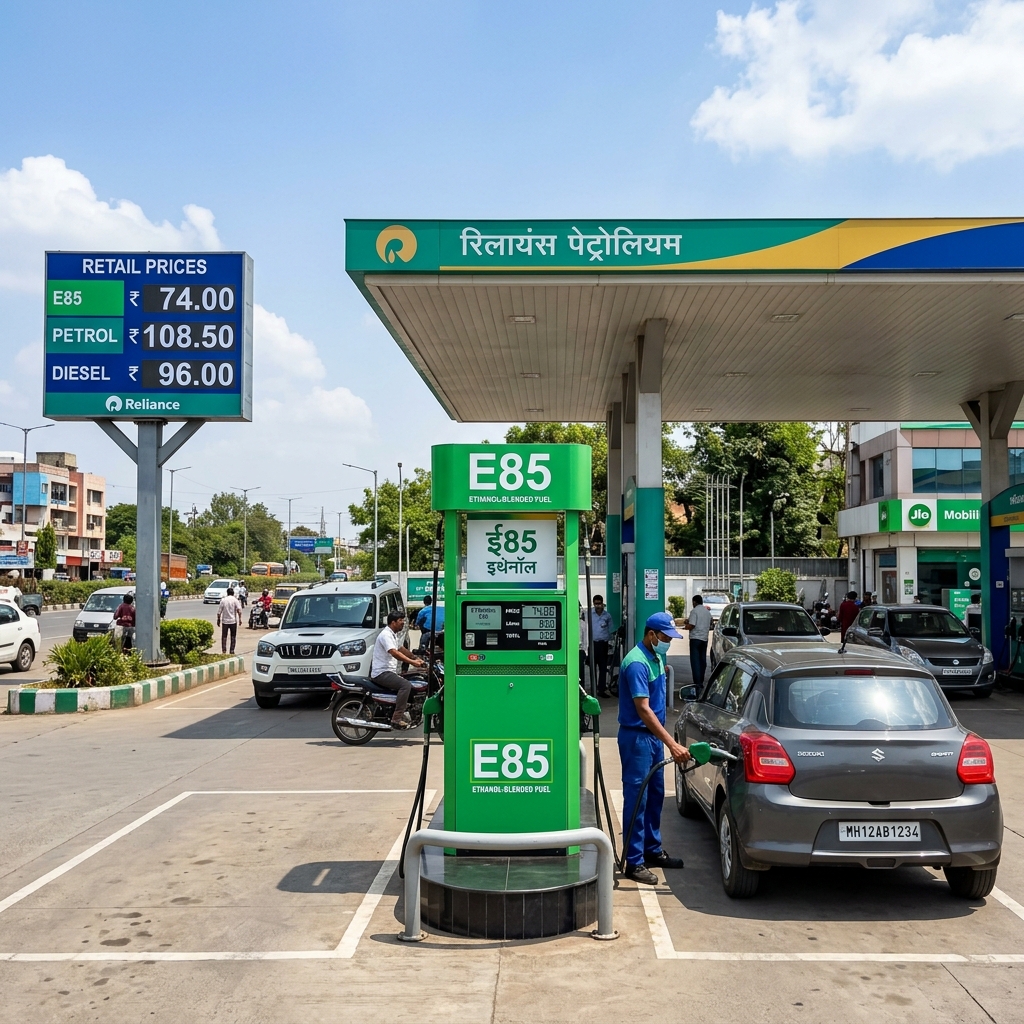
Projected E85 Retail Price Estimate: * Expected Price Range: ₹65.00 to ₹75.00 per liter. * Comparison to Standard Petrol: Standard petrol currently retails between ₹95 to ₹110 per liter across different Indian states. This means E85 is expected to be launched at a price point that is roughly ₹30 to ₹40 cheaper per liter than regular unblended or E10 petrol.
Disclaimer: The above prices are projected estimates based on current ethanol procurement rates and anticipated taxation structures for high-ethanol blends. Actual retail prices upon widespread commercial launch may vary.
3. State-wise Expected E85 Fuel Rates
Just like regular petrol and diesel, E85 prices will not be uniform across India. The final retail price will depend heavily on state-level Value Added Tax (VAT), transportation costs from ethanol distilleries to the depots, and local subsidies.
States that are major producers of sugarcane and ethanol—such as Uttar Pradesh, Maharashtra, and Karnataka—are likely to see the lowest prices for E85 due to minimal transportation overheads. Conversely, northeastern states or those far from major distilleries might see slightly higher rates.
Projected State-wise Price Chart for E85 (Estimated)
| State / Union Territory | Estimated E85 Price (₹/Liter) | Current Petrol Price (₹/Liter, Approx.) | Expected Savings per Liter (₹) | | :--- | :--- | :--- | :--- | | New Delhi | ₹68.50 | ₹96.72 | ₹28.22 | | Maharashtra (Mumbai) | ₹72.10 | ₹106.31 | ₹34.21 | | Uttar Pradesh (Lucknow) | ₹66.00 | ₹96.57 | ₹30.57 | | Karnataka (Bengaluru) | ₹69.20 | ₹101.94 | ₹32.74 | | Tamil Nadu (Chennai) | ₹71.00 | ₹102.63 | ₹31.63 | | West Bengal (Kolkata) | ₹71.50 | ₹106.03 | ₹34.53 | | Gujarat (Ahmedabad) | ₹67.80 | ₹96.42 | ₹28.62 | | Punjab (Chandigarh) | ₹68.00 | ₹96.20 | ₹28.20 |
Note: These are estimated projections to help consumers understand the potential pricing dynamics once E85 becomes fully commercialized.
4. Factors Influencing E85 Prices in India
The retail price of E85 in India will be determined by a complex interplay of several domestic and policy-driven factors. Unlike crude oil, which is driven by international markets, E85 pricing is largely localized.
A. Cost of Feedstock
The biggest determinant of ethanol pricing in India is the cost of raw materials. The government fixes the procurement price of ethanol based on what it is made from: * Sugarcane Juice/Syrup: Generally commands the highest procurement price due to its efficiency and the need to compensate farmers adequately. * B-Heavy Molasses: An intermediate byproduct of sugar making. * C-Heavy Molasses: The final byproduct, usually the cheapest but yields less ethanol. * Food Grains (Maize, Damaged Rice): Increasingly being used to boost ethanol production beyond what the sugar industry can provide. Fluctuations in crop yields due to monsoons can impact these prices.B. Taxation and GST
Currently, to promote biofuels, the Goods and Services Tax (GST) on ethanol meant for blending with petrol was drastically reduced from 18% to 5%. This favorable tax structure is a primary reason why E85 can be priced so aggressively. State-level VAT on the final blended product will also play a critical role.C. Transportation and Logistics
Ethanol is highly corrosive and has an affinity for water. It cannot be easily transported through existing petroleum pipelines. It must be transported via dedicated tanker trucks or rail wagons. States that are far from the ethanol production hubs (primarily UP, Maharashtra, and Karnataka) will incur higher freight charges, leading to slightly higher retail prices.D. Global Crude Oil Prices
While E85 is 85% ethanol, it still contains 15% petrol. If global crude oil prices spike, the cost of the 15% petrol component will rise, pulling the overall price of the E85 blend up slightly. However, E85 provides a massive buffer against global oil shocks compared to standard petrol.5. E85 vs. Petrol vs. E20: A Detailed Price Comparison
To truly appreciate the value proposition of E85, one must compare it against the fuels currently dominating the market: standard unblended petrol (or E10) and the newly rolling out E20.
| Feature | Standard Petrol (E10) | E20 Fuel | E85 Fuel | | :--- | :--- | :--- | :--- | | Ethanol Content | Up to 10% | 20% | 85% | | Base Price (Estimated) | ₹95 - ₹110 / Liter | ₹93 - ₹108 / Liter | ₹65 - ₹75 / Liter | | Octane Rating | 91 - 95 | 93 - 96 | 100 - 105 | | Engine Requirement | Standard ICE | E20 Compatible ICE | Flex-Fuel Vehicle (FFV) | | Tailpipe Emissions | Baseline | Moderately Reduced | Significantly Reduced | | Fuel Efficiency (Mileage) | Baseline (100%) | ~2-3% Drop | ~15-25% Drop | | Cost per Kilometer (CPK) | Baseline | Marginally Cheaper | Substantially Cheaper |
The Mileage Caveat: It is crucial to understand that ethanol has approximately 30% less energy density by volume than pure petrol. This means that a vehicle running on E85 will generally return lower mileage (kilometers per liter) than the same vehicle running on regular petrol. The drop is typically between 15% and 25%.
However, because the price per liter of E85 is expected to be 30% to 40% lower, the overall Cost Per Kilometer (CPK)—which is what actually matters to your wallet—will still be significantly lower with E85.
6. E85 Cost Calculator: Estimate Your Savings
To make this tangible, let's do the math. How much money would you actually save running a flex-fuel car on E85 instead of standard petrol?
Assumptions for Calculation: * Monthly Driving Distance: 1,500 kilometers * Standard Petrol Price: ₹100 per liter * Petrol Vehicle Mileage: 15 km/l * Expected E85 Price: ₹70 per liter * E85 Vehicle Mileage (assuming 20% drop): 12 km/l
Calculation for Standard Petrol:
* Total Liters Required = 1,500 km / 15 km/l = 100 liters Total Monthly Cost = 100 liters ₹100/liter = ₹10,000Calculation for E85 Fuel:
* Total Liters Required = 1,500 km / 12 km/l = 125 liters Total Monthly Cost = 125 liters ₹70/liter = ₹8,750Your Savings:
Monthly Savings:** ₹10,000 - ₹8,750 = *₹1,250 Annual Savings:** ₹1,250 * 12 months = *₹15,000Over a typical vehicle ownership period of 5 to 7 years, switching to an E85 Flex-Fuel vehicle could save an Indian consumer anywhere from ₹75,000 to over ₹1,00,000 in running costs, not to mention the environmental benefits.
(For our developers: We highly recommend integrating a dynamic interactive widget here on the live blog where users can input their own daily driving distance, local petrol price, and vehicle mileage to instantly calculate their personal E85 savings.)
7. The Economics of Flex-Fuel Vehicles (FFVs)
Understanding the price of E85 is only one side of the coin. To use E85, consumers must purchase Flex-Fuel Vehicles (FFVs). How does the economics of the vehicle itself factor in?
An FFV is designed with specialized engine components—such as corrosion-resistant fuel lines, upgraded fuel pumps, and intelligent Engine Control Units (ECUs) equipped with ethanol sensors. These sensors detect the exact blend of ethanol in the tank (anywhere from 0% to 100%) and adjust the spark timing and fuel injection instantly.
Initial Purchase Cost: Historically, in markets like Brazil, the price difference between a standard petrol car and its flex-fuel variant is negligible. In India, as automakers ramp up domestic production of these specialized components, it is expected that a flex-fuel variant might carry a slight premium of ₹15,000 to ₹30,000 over a standard petrol model.
Return on Investment (ROI): If you refer back to our cost calculator, a consumer saving ₹15,000 a year on fuel will recover the slight premium of a flex-fuel vehicle in just 1 to 2 years. After that, every kilometer driven is pure savings.
Furthermore, FFVs provide incredible flexibility. If you are traveling through a remote part of India where E85 is not yet available, you can simply fill up with standard petrol or E20 without any issues. The car does the thinking for you.
8. Why is E85 Expected to be Cheaper than Regular Petrol?
Consumers often wonder how a fuel with a higher octane rating can be cheaper. The pricing logic behind E85 in India is built on structural economic advantages rather than just market competition.
1. Domestic Sourcing: Petrol is refined from crude oil, over 85% of which India imports. This subjects the price to international dollar exchange rates, shipping costs, and global market volatility. Ethanol is 100% "Made in India" by Indian farmers and local distilleries. 2. Lower Taxes: The central and state governments levy heavy excise duties and VAT on petrol, making taxes account for almost 40-50% of the retail price you pay. To promote green energy, the government keeps taxes on ethanol extremely low (currently 5% GST). 3. Agricultural Subsidy Structure: The ethanol ecosystem is inherently linked to agricultural support. Assuring a fixed, profitable price for ethanol helps sugarcane and maize farmers, making it a socio-economic imperative for the government to support it, rather than treat it as a pure profit center like fossil fuels. 4. Carbon Credits and Green Financing: Production of renewable fuels opens up avenues for green financing and carbon credits for oil marketing companies, effectively subsidizing the downstream retail price.
9. Challenges in E85 Pricing and Distribution
While the picture looks rosy, achieving and maintaining a stable, low E85 price across India comes with significant logistical hurdles.
A. Storage and Dispensing Infrastructure: E85 requires dedicated underground storage tanks and distinct dispensing pumps at petrol stations. Upgrading thousands of fuel stations across India requires massive capital expenditure from OMCs (IOCL, BPCL, HPCL). This infrastructure cost could temporarily put upward pressure on the retail price during the initial rollout years.
B. Water Affinity: Ethanol is hygroscopic; it absorbs moisture from the air. This makes it unsuitable for transport via traditional multiproduct pipelines used for petrol and diesel. Moving large volumes of ethanol via trucks and rail is inherently more expensive and slower, particularly in the rainy season.
C. Feedstock Availability and Food Security: The "Food vs. Fuel" debate is a real challenge. While India currently has surplus sugar and grains, a severe drought year could force the government to prioritize food security over ethanol production. If ethanol supply drops, the price of E85 could surge, or availability could be restricted. To counter this, the government is heavily pushing second-generation (2G) ethanol, which is made from agricultural waste (like stubble) rather than edible crops.
10. Government Subsidies and Tax Benefits on Ethanol
The attractive pricing of E85 today and in the future relies heavily on the Indian government's policy framework. The National Policy on Biofuels – 2018 (amended in 2022) laid the groundwork.
* Interest Subvention Schemes: The government provides financial assistance (interest subvention) to distilleries to set up new ethanol plants or expand existing ones. This reduces the capital cost of producing ethanol. * Assured Offtake: OMCs are mandated to purchase ethanol, providing a guaranteed market for producers. This removes market risk and keeps wholesale prices stable. * Future Consumer Tax Incentives: Policymakers have hinted at potential tax rebates or lower registration fees for Flex-Fuel Vehicles in the future, similar to the benefits currently offered to Electric Vehicles (EVs). If realized, this would make the entire E85 ecosystem even more financially compelling.
11. Future Projections: Where Are E85 Prices Heading?
Looking ahead to 2025 and beyond, the trajectory for E85 fuel prices in India appears stable to slightly downward.
As the ethanol blending program scales up, economies of scale will kick in. The proliferation of 2G ethanol refineries (like the one inaugurated in Panipat) will utilize cheaper agricultural waste, decoupling ethanol prices from food inflation.
Furthermore, as global crude oil resources become scarcer and harder to extract, fossil fuel prices are on a long-term upward trajectory. The price gap between standard petrol and E85 is therefore expected to widen over the next decade. Ten years from now, running a car on standard petrol might be viewed as a luxury, while E85 becomes the economical standard for internal combustion engines.
12. Frequently Asked Questions (FAQs)
Q1: Is E85 available at local petrol pumps in India right now? Answer: Not universally. India is currently focused on rolling out E20 (20% blend) nationwide. E85 is primarily in the pilot testing phase and is expected to hit commercial retail pumps in select metro cities alongside the launch of commercial flex-fuel vehicles in the coming years.
Q2: Will using E85 lower my car's mileage? Answer: Yes. Ethanol has lower energy density than petrol. You can expect a 15% to 25% drop in kilometers per liter. However, because E85 is significantly cheaper per liter, your overall running cost per kilometer will still decrease.
Q3: Can I put E85 fuel in my current petrol car? Answer: No. Putting E85 in a standard, non-flex-fuel vehicle can cause severe engine damage. Ethanol is corrosive and can degrade rubber seals, fuel lines, and plastics not designed for it. Furthermore, a standard car's ECU cannot adjust the fuel injection to handle the lean burn conditions created by high ethanol blends. You MUST have a specifically designated Flex-Fuel Vehicle (FFV).
Q4: Will the E85 price fluctuate daily like petrol? Answer: It is expected that E85 prices will be much more stable than standard petrol. Because ethanol is produced domestically from agricultural produce, its pricing is determined by government procurement rates fixed annually, rather than the daily volatility of international crude oil markets.
Q5: Is E85 better for the environment? Answer: Absolutely. E85 significantly reduces greenhouse gas emissions, carbon monoxide, and particulate matter compared to pure petrol. It is a cleaner-burning, renewable fuel.
13. Conclusion
The impending arrival of E85 fuel in the Indian market represents a paradigm shift for motorists. The E85 fuel price in India today (in terms of its projected economics) showcases a massive opportunity for consumers to reduce their daily commuting costs while simultaneously contributing to a cleaner environment and a stronger national economy.
While you may have to accept a slight drop in fuel efficiency, the drastically lower cost per liter of E85 ensures that the mathematics firmly favor the flex-fuel approach. As automakers gear up to launch their FFV portfolios in India, staying informed about the live rates and economic realities of E85 will empower you to make the smartest choice for your next vehicle purchase.
Keep an eye on this space, as we will continually update our live E85 price trackers and cost calculators the moment this revolutionary fuel hits your local neighborhood petrol station!
--- For more deep dives into flex-fuel technology, ethanol blending updates, and comprehensive vehicle reviews, explore the rest of our articles on e85india.com.