The Indian automotive and energy sectors are undergoing a massive transformation in 2026. While Electric Vehicles (EVs) have dominated headlines for the past decade, a silent revolution has been brewing in the internal combustion engine (ICE) space: Ethanol. More specifically, the push towards E85 fuel.
As the Government of India accelerates its Ethanol Blended Petrol (EBP) program, moving aggressively beyond the successful E20 (20% ethanol) rollout, E85 is emerging as a critical pillar in the nation's strategy for energy independence, agricultural economic growth, and environmental sustainability.
This comprehensive guide breaks down everything you need to know about E85 fuel in India, how it works, the vehicles that use it, its economic impact, and what the landscape looks like in 2026.
---
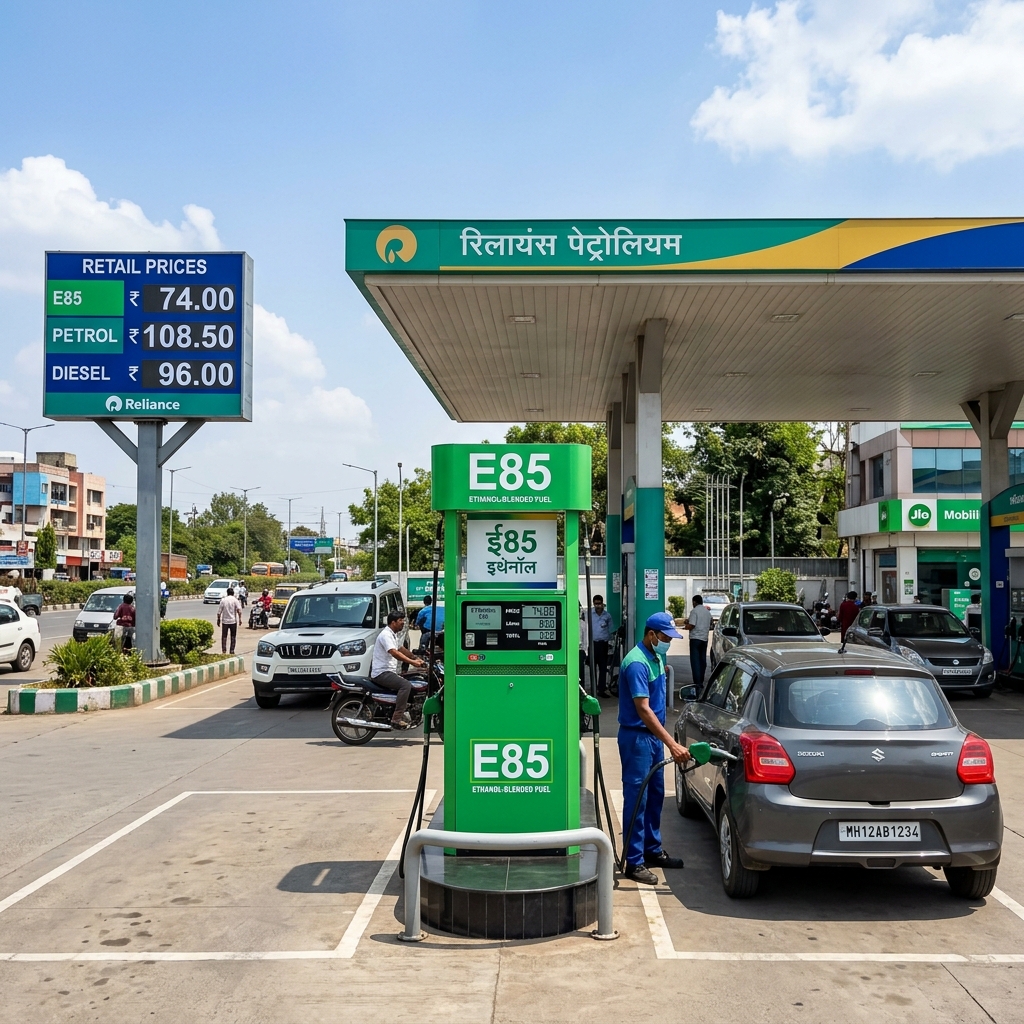
1. The Dawn of the E85 Era in India
For years, India has heavily relied on imported crude oil to meet its massive energy demands, making the economy vulnerable to global geopolitical shocks and fluctuating oil prices. In response, the push for homegrown, renewable fuels has become a national priority.
The journey started with E10 (10% ethanol blend), which was successfully achieved nationwide ahead of schedule. The subsequent leap to E20 (20% ethanol) by 2025 laid the groundwork for the next ambitious phase. Today, in 2026, the focus has shifted to high-ethanol blends, specifically E85.
E85 represents a paradigm shift. It’s no longer just an additive to stretch petrol supplies; it is a primary fuel source in its own right, requiring dedicated infrastructure and specially designed Flex-Fuel Vehicles (FFVs).
2. What Exactly is E85 Fuel?
E85 is a high-level ethanol-petrol blend consisting of up to 85% ethanol and 15% petrol (gasoline) by volume.
The Composition
Ethanol ($C_2H_5OH$) is a renewable biofuel made from plant materials (biomass). In India, it is primarily produced from sugarcane molasses, but increasingly from surplus grains like maize and damaged rice (known as 2G or second-generation ethanol). The 15% petrol is kept in the mixture primarily to aid with engine starting in cold weather and to maintain certain combustion properties.E10 vs. E20 vs. E85
* E10 (10% Ethanol): Standard fuel compatible with almost all existing ICE vehicles on the road without any modifications. * E20 (20% Ethanol): The standard fuel grade across most Indian petrol pumps as of 2025. Requires vehicles manufactured with E20-compatible material (most vehicles post-2023). E85 (85% Ethanol): A specialized fuel that can *only be used in Flex-Fuel Vehicles (FFVs). Standard car engines will suffer severe damage if run on E85.Characteristics of E85
* Higher Octane Rating: E85 naturally has a higher octane rating (often over 100) compared to standard unleaded petrol (91-95 RON). This allows for higher engine compression ratios and increased performance. * Lower Energy Density: Ethanol contains about 30% less energy per volume than petrol. This means you will experience a decrease in fuel efficiency (lower mileage/KMPL) when running on E85 compared to pure petrol. * Corrosive Nature: Ethanol is hygroscopic (absorbs water) and can be corrosive to certain metals, plastics, and rubbers used in older fuel systems.3. India's Ethanol Blending Program (EBP) Timeline
To understand the reality of E85 in 2026, we must look at the roadmap that brought us here:
* 2014: Ethanol blending in India stood at a mere 1.5%. * 2022: India achieved its 10% ethanol blending (E10) target, five months ahead of the November 2022 deadline. * 2023-2024: Phased rollout of E20 fuel begins at select petrol pumps. Original Equipment Manufacturers (OEMs) mandate E20 compatibility for all new two-wheelers and four-wheelers. * 2025: E20 becomes available nationwide, effectively becoming the new baseline petrol. * 2026 (Current): Pilot programs for E85 dispensing stations expand rapidly in major agricultural and metropolitan hubs (Maharashtra, Uttar Pradesh, Karnataka, Delhi-NCR). Major OEMs launch mass-market Flex-Fuel Vehicles.
The rapid acceleration of this timeline was driven by the "National Policy on Biofuels," which was aggressively revised to fast-track energy security goals.
4. Why E85? The Trifecta of Benefits for India
The transition to E85 is not merely an environmental initiative; it is a multifaceted strategy designed to address three core pillars of the Indian economy.
A. Economic Independence and Import Substitution
India is the world's third-largest consumer of crude oil, importing over 85% of its requirements. This massive import bill drains foreign exchange reserves. By substituting 85% of petrol with domestically produced ethanol in a growing segment of vehicles, India saves billions of dollars annually. This money is re-injected into the domestic economy rather than being sent overseas. It shields the Indian consumer from the volatility of Middle Eastern politics and global oil cartels.B. Environmental Impact: Reducing Emissions
While E85 still produces tailpipe emissions, its overall carbon footprint is significantly lower than fossil fuels. * Lifecycle CO2 Emissions: The crops used to produce ethanol (like sugarcane) absorb carbon dioxide as they grow, offsetting a significant portion of the CO2 released when the fuel is burned. This "closed-loop" cycle drastically reduces greenhouse gas emissions. * Air Quality: E85 burns cleaner than pure petrol, producing fewer harmful tailpipe emissions like carbon monoxide, nitrogen oxides (NOx), and particulate matter (PM). In heavily polluted cities like Delhi and Mumbai, widespread adoption of E85 can contribute to cleaner air.C. Empowering the Agricultural Sector (The "Annadata" to "Urjadata" Shift)
Perhaps the most significant socio-economic benefit of E85 in India is its impact on farmers. Historically, surplus sugarcane or grain led to crashing prices and farmer distress. The ethanol program transforms farmers from mere food producers (Annadata*) to energy producers (*Urjadata). Sugar mills and distilleries now have a guaranteed, profitable market for their byproducts (molasses) and surplus crops. This ensures timely payments to sugarcane farmers and revitalizes the rural economy.5. Flex-Fuel Vehicles (FFVs): The Engine of the E85 Revolution
You cannot simply pump E85 into a standard Maruti Swift or Hyundai Creta. E85 requires a specific type of car: The Flex-Fuel Vehicle (FFV).
What is a Flex-Fuel Vehicle?
An FFV is designed with an internal combustion engine capable of operating on petrol, or any blend of petrol and ethanol up to 85%. The vehicle contains special sensors (like an ethanol content analyzer) that detect the ratio of ethanol to petrol in the fuel tank. The Engine Control Unit (ECU) then instantaneously adjusts the fuel injection and spark timing to ensure optimal combustion, regardless of whether the tank contains E20, E50, or E85.Key Modifications in an FFV:
1. Fuel Lines and Tank: Upgraded to corrosion-resistant materials (stainless steel, specialized plastics) to handle the hygroscopic and corrosive nature of high-ethanol blends. 2. Fuel Pump and Injectors: Upgraded to deliver a higher volume of fuel, compensating for ethanol's lower energy density. 3. Engine Mapping: Advanced ECUs capable of dynamic spark timing adjustment.Major Automakers Leading the Charge in India (2026)
The Indian auto industry has embraced the FFV mandate. * Maruti Suzuki: Following their initial showcases in 2023, Maruti Suzuki has launched FFV variants of their popular models like the WagonR, Brezza, and Fronx. Their focus remains on affordable, mass-market flex-fuel mobility. * Toyota Kirloskar Motor: Pioneers in flex-fuel technology globally (especially in Brazil), Toyota has introduced electrified flex-fuel vehicles (Strong Hybrid FFVs). The Corolla Altis and Innova Hycross FFV variants offer the combined benefits of battery hybrid efficiency and E85 lower fuel costs. * TVS & Bajaj (Two-Wheelers): The two-wheeler market, the backbone of Indian mobility, is rapidly adopting flex-fuel. TVS with its Apache series and Bajaj with the Pulsar line have released dedicated E85-capable motorcycles, recognizing the immense cost-saving potential for daily commuters.6. The Challenges of E85 Adoption
Despite the massive push, the road to E85 is not without significant hurdles in 2026.
A. Infrastructure and Dispensing Stations
You can't buy an E85 car if you can't fuel it. While E20 is available nationwide, dedicated E85 pumps are still rolling out. Setting up separate underground storage tanks and specialized dispensing units requires substantial capital investment from Oil Marketing Companies (OMCs like IOCL, BPCL, HPCL). Currently, E85 availability is concentrated in ethanol-producing states (UP, Maharashtra, Karnataka) and select metro cities.B. The Mileage Drop (Fuel Efficiency)
Because ethanol has less energy per litre than petrol, FFVs running on E85 will experience a drop in fuel efficiency—typically 20% to 30% lower KMPL compared to running on pure petrol. For the extremely mileage-conscious Indian consumer ("Kitna deti hai?"), this is a psychological and practical barrier. For E85 to be viable, the price per litre of E85 must be significantly lower than standard petrol to offset the loss in mileage.C. The Food vs. Fuel Debate
As more ethanol is demanded, there is a risk of agricultural land being diverted from essential food crops to cash crops meant for fuel (like sugarcane and maize). In a country with a massive population, food security cannot be compromised for energy security. The government is strictly monitoring this, capping first-generation (sugarcane/molasses) ethanol and heavily subsidizing second-generation (2G) plants that convert agricultural waste (stubble, stalks) into ethanol, mitigating the food-vs-fuel risk.7. E85 vs. Electric Vehicles (EVs): The Indian Context
A common question is: Why invest in E85 when the whole world is moving to EVs?
In India, E85 and EVs are not mutually exclusive; they are parallel, complementary solutions. * Cost Barrier of EVs: Despite falling battery prices, EVs still carry a high upfront purchase cost. For rural and semi-urban India, affordable mobility is paramount. FFVs offer a green alternative at a price point closer to traditional ICE vehicles. * Charging Infrastructure: India's vast geography makes building a ubiquitous fast-charging EV network a decades-long project. E85 leverages the existing, massive network of petrol stations with relatively minor modifications. The Hybrid Sweet Spot:** The most effective implementation in 2026 is the *Electrified Flex-Fuel Vehicle (Strong Hybrid FFV). These vehicles run on E85 but also have a battery and electric motor, solving the mileage drop issue of E85 while eliminating the range anxiety of pure EVs.
8. Pricing and Availability: What to Expect in 2026
The success of E85 hinges entirely on its retail price.
To incentivize consumers to buy FFVs and accept the lower mileage, E85 is priced significantly lower than standard E20 petrol. In 2026, with standard E20 petrol hovering around ₹95-100 per litre, E85 is strategically priced between ₹60-₹65 per litre.
This price differential is achieved through: 1. Lower GST: The government has slashed the GST on E85 fuel. 2. Subsidized Production: Support for ethanol distilleries keeps the base cost low.
Cost Analysis Example: If a car gets 15 KMPL on E20 (Cost: ₹100/L) = Running cost is ₹6.66 per KM. If the same car gets 11 KMPL on E85 (Cost: ₹60/L) = Running cost is ₹5.45 per KM.
Even with the mileage drop, running an FFV on E85 is economically beneficial for the daily commuter in 2026.
9. Government Policies and Subsidies
The Indian government's commitment to E85 is backed by robust policy frameworks: * PLI Scheme for Auto: The Production Linked Incentive scheme explicitly rewards OEMs for manufacturing Flex-Fuel Vehicles and components in India. * Interest Subvention for Distilleries: Financial assistance is provided to set up new ethanol plants or expand existing ones, particularly 2G ethanol refineries. * Mandatory Blending Targets: OMCs are legally obligated to meet blending targets, ensuring a guaranteed market for ethanol producers.
10. The Future of Biofuels in India: Beyond E85
While E85 is the focus of 2026, the roadmap extends further:
* E100 (100% Ethanol): The ultimate goal is pure ethanol mobility, similar to what Brazil has achieved in certain segments. Pilot projects for E100 two-wheelers are already underway in Pune and Bangalore. * Sustainable Aviation Fuel (SAF): India is scaling up production of SAF derived from ethanol to decarbonize the aviation sector. * Compressed Biogas (CBG): Alongside ethanol, CBG generated from agricultural and municipal waste is being promoted as a green alternative for commercial vehicles and industrial use.
Conclusion
The year 2026 marks a watershed moment for India's automotive sector. E85 fuel is no longer an experimental concept; it is a mass-market reality.
For the consumer, it offers a cheaper, greener alternative to traditional petrol without the high upfront cost or range anxiety of an EV. For the farmer, it guarantees income. For the nation, it is a giant leap towards energy independence and a cleaner environment.
As infrastructure scales and automakers expand their FFV portfolios, E85 is poised to become the dominant fuel for internal combustion engines in India for the foreseeable future. The transition from Annadata* to *Urjadata is complete, and the Indian roads are running greener because of it.
--- Disclaimer: Fuel prices and vehicle mileage figures are estimates based on market projections for the year 2026 and may vary by region and driving conditions.