The Indian automotive sector is undergoing a massive transformation, driven by the government's aggressive push towards biofuels. With the successful nationwide rollout of E20 (20% ethanol blended petrol) well underway and moving ahead of its original 2025 target, the conversation has rapidly shifted toward the next big frontier: E85 and pure flex-fuel vehicles. As fuel prices continue to fluctuate and environmental concerns take center stage, Indian drivers are increasingly curious about running their existing petrol cars on cheaper, greener, high-ethanol blends like E85.
This growing interest has sparked a surge of inquiries about E85 conversion kits—aftermarket modifications that promise to turn standard internal combustion engine (ICE) vehicles into flex-fuel machines. But what exactly is the ground reality of E85 conversion kits in India? Are they legally permitted on our roads? How much do they cost, and which brands are leading the global market? Most importantly, is it safe for your engine?
In this comprehensive guide, we will dive deep into everything you need to know about E85 conversion kits in the Indian context. We will explore the technical mechanics, break down the pricing and legal implications, review the top global brands, and help you decide whether retrofitting your vehicle is a smart move or a risky gamble.
For more background on ethanol blending, check out our guide on What is E85 Fuel?.
---
Table of Contents
1. Introduction: The Ethanol Revolution in India 2. What Exactly is an E85 Conversion Kit? 3. How Do E85 Conversion Kits Work? 4. E85 Conversion Kit Price in India 5. Legality: Is it Legal to Install an E85 Kit in India? 6. Top E85 Conversion Kit Brands Globally 7. Technical Risks: Should You Convert Your Standard Petrol Car? 8. Factory-Fitted Flex-Fuel Vehicles (FFVs) vs. Conversion Kits 9. Future Outlook for Flex Fuel Retrofitting in India 10. Conclusion: The Verdict on E85 Kits 11. Frequently Asked Questions (FAQs)---
What Exactly is an E85 Conversion Kit?
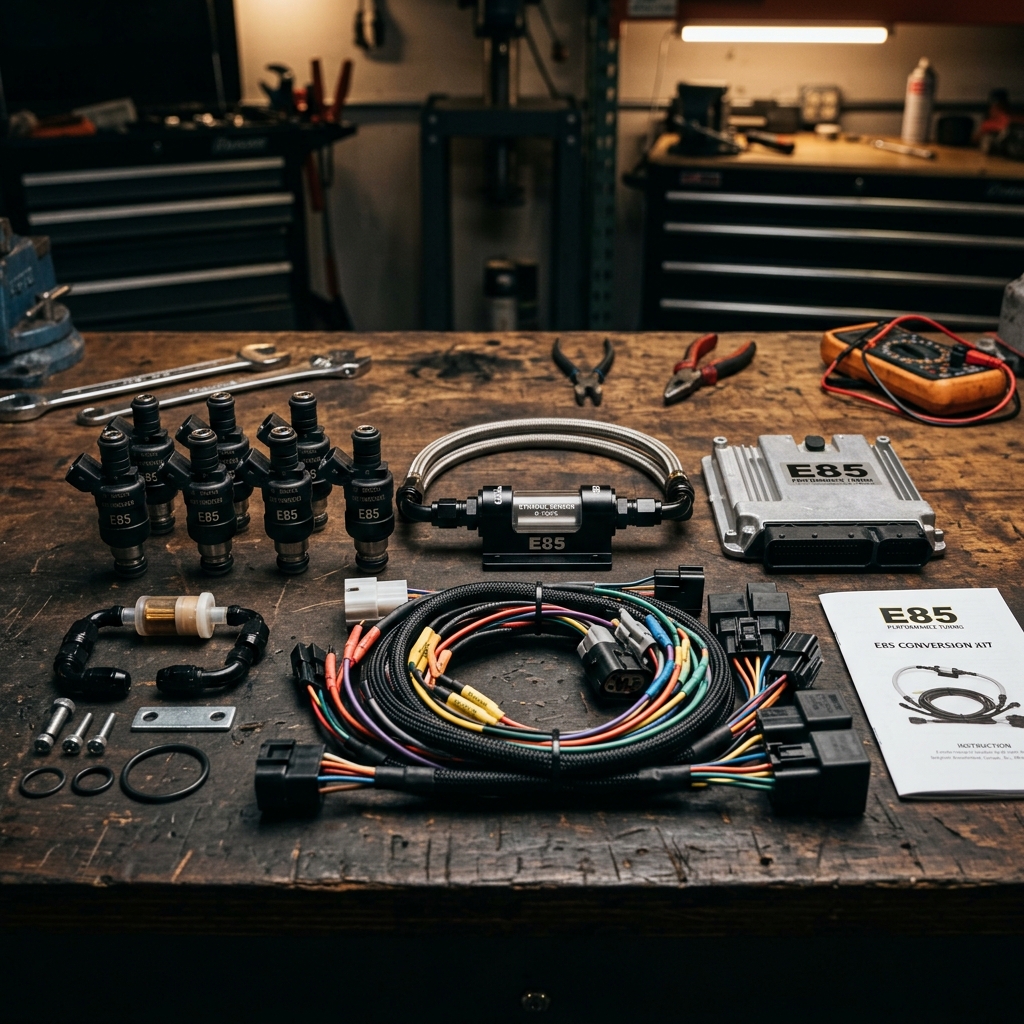
An E85 conversion kit, also known as a flex-fuel conversion kit, is an aftermarket electronic and mechanical system designed to allow a standard gasoline (petrol) vehicle to operate on high-ethanol fuel blends, primarily E85 (a mixture of 85% ethanol and 15% petrol), or any combination of ethanol and petrol.
Standard petrol engines are calibrated at the factory to run optimally on specific grades of unleaded petrol. When you introduce a fuel with a significantly higher ethanol content, the engine's standard Engine Control Unit (ECU) struggles to manage the combustion process effectively. This is because ethanol has a lower energy density than standard petrol, meaning the engine needs to inject a larger volume of fuel (roughly 30% to 40% more) to achieve the same power output and maintain a safe air-to-fuel ratio.
If you simply pour E85 into a standard, unmodified petrol car, the engine will run "lean" (too much air, not enough fuel), which can cause hesitation, stalling, engine knocking, overheating, and ultimately, catastrophic engine failure.
An E85 conversion kit intervenes to solve this problem. It acts as an intelligent intermediary between the vehicle's original sensors, the ECU, and the fuel injectors, dynamically adjusting the engine's parameters to safely burn high-ethanol fuel.
Key Components of a High-Quality E85 Kit
* Ethanol Content Sensor: This is the heart of the system. Plumbed directly into the fuel line, it continuously measures the exact percentage of ethanol in the fuel mixture as it flows from the tank to the engine. * Piggyback ECU / Control Module: A dedicated micro-computer that intercepts the signals from the factory ECU. It receives real-time data from the ethanol sensor. * Wiring Harness: Custom wiring that connects the control module to the factory fuel injectors and other necessary sensors without requiring permanent wire cutting (in plug-and-play kits).---
How Do E85 Conversion Kits Work?
Understanding the mechanics of a conversion kit is crucial for appreciating why they are complex and why they carry certain risks.
When you install a full flex-fuel conversion kit, you are essentially upgrading your vehicle's nervous system to handle a new type of energy source. Here is the step-by-step process of how it functions in real-time:
1. Refueling and Mixing: You fill your tank with E85, E20, regular petrol, or any random mixture of the three. Because the kit is "flex-fuel," it doesn't matter what the exact ratio is in the tank. 2. Continuous Monitoring: As the fuel pump pushes the fuel toward the engine, it passes through the inline ethanol content sensor. This sensor uses electrical capacitance to instantly determine the percentage of ethanol in the fuel. It also usually measures the fuel temperature. 3. Data Transmission: The sensor sends this data (e.g., "The current fuel mixture is 72% ethanol at 30 degrees Celsius") to the conversion kit's control module. 4. Signal Interception and Modification: The vehicle's factory ECU calculates how long to keep the fuel injectors open based on its assumption that standard petrol is being used. It sends an electrical pulse to fire the injectors. The conversion kit's control module intercepts this signal before it reaches the injectors. 5. Dynamic Adjustment: Based on the data from the ethanol sensor, the control module mathematically recalculates the required fuel volume. If it detects a high ethanol blend, it artificially extends the pulse width (the duration the injector stays open). For example, it might hold the injector open 35% longer than the factory ECU intended, ensuring enough fuel enters the combustion chamber to prevent a lean condition. 6. Seamless Combustion: The engine receives the perfect amount of fuel for the specific blend currently in the lines, resulting in smooth combustion, optimal power delivery, and safe operating temperatures.
This real-time adjustment happens hundreds of times per second, allowing you to switch between fuel types seamlessly without needing to manually retune the vehicle or drain the tank.
---
E85 Conversion Kit Price in India
One of the most frequent questions from Indian motorists is: “How much does an E85 conversion kit cost in India?”
The short answer is that there are currently no legally approved, mass-market E85 conversion kits officially sold for standard consumer vehicles in India. Therefore, a standard Maximum Retail Price (MRP) does not exist in the domestic market.
However, we can look at cost estimates based on industry projections and the grey market for imported kits.
1. Estimated Costs for Future Domestic Kits
Industry bodies like the Indian Sugar & Bio-energy Manufacturers Association (ISMA) and various automotive think tanks have been lobbying for the creation of a regulatory framework that would allow the homologation and sale of retrofit kits.If local manufacturing of these kits is legalized and scaled up under initiatives like "Make in India," experts estimate that a basic, locally produced E85 conversion kit could cost around ₹15,000 to ₹25,000.
This price point would make it an attractive proposition for high-mileage drivers, such as taxi fleets and daily commuters, who could recover the upfront cost relatively quickly through savings on cheaper E85 fuel.
2. The Cost of Imported Kits (Grey Market)
While not officially certified for use on Indian roads, some enthusiasts and niche tuning shops import kits from established global brands (which we will discuss later).If you were to import a high-quality, sensor-based E85 conversion kit from the USA or Europe, the costs are significantly higher: * Base Kit Price: $400 to $900 USD (approx. ₹33,000 to ₹75,000 INR). * Customs Duty and Taxes: Importing automotive electronics attracts high import duties in India, often adding 30% to 40% to the base cost. * Shipping: $50 to $100 USD (approx. ₹4,000 to ₹8,000 INR). * Installation Labor: Specialized mechanics may charge anywhere from ₹5,000 to ₹15,000 for installation and testing.
Total Estimated Cost for an Imported Kit:* *₹50,000 to ₹1,20,000 INR.
Cost Comparison Table: Projected Domestic vs. Imported E85 Kits
| Cost Component | Projected Domestic Kit (Future) | Imported Premium Kit (Current Grey Market) | | :--- | :--- | :--- | | Hardware (Module, Sensor, Harness) | ₹12,000 - ₹20,000 | ₹35,000 - ₹75,000 | | Import Duties & Taxes | ₹0 (Locally Made) | ₹10,000 - ₹30,000 | | Shipping | ₹500 - ₹1,000 | ₹4,000 - ₹8,000 | | Installation | ₹3,000 - ₹5,000 | ₹5,000 - ₹15,000 | | Total Estimated Price* | **₹15,500 - ₹26,000** | *₹54,000 - ₹1,28,000 |
Note: These are estimates. Currently, importing and installing these kits for on-road use is legally precarious.
---
Legality: Is it Legal to Install an E85 Kit in India?
This is the most critical section for any Indian vehicle owner considering a conversion. The legal landscape regarding aftermarket fuel modifications in India is incredibly strict.
As of [Current Year], it is strictly ILLEGAL to install an unapproved aftermarket E85 conversion kit on a passenger vehicle meant for public roads in India.
Here is a detailed breakdown of the legal ramifications and why the government currently prohibits these retrofits.
The Motor Vehicles Act, 1988
Under Section 52 of the Motor Vehicles Act, 1988, no owner of a motor vehicle can alter the vehicle in a way that the particulars contained in the certificate of registration (RC) are at variance with those originally specified by the manufacturer.When you buy a petrol car, its RC explicitly states its fuel type as "Petrol." Modifying the fuel delivery system to accommodate a different fuel type (like high-ethanol blends) constitutes a major structural and technical alteration.
Currently, the Regional Transport Offices (RTOs) across India only have established frameworks for endorsing CNG (Compressed Natural Gas) and LPG (Liquefied Petroleum Gas) retrofits, provided they are done using government-approved kits (like those certified by ARAI or ICAT) installed by authorized centers.
There is currently no ARAI or ICAT certification framework for E85 aftermarket retrofit kits. Because no kits are certified, no RTO will endorse the modification on your RC book.
Penalties and Consequences of Unauthorized Conversion
If you are caught driving a vehicle with an unapproved fuel system modification, you face severe consequences:
1. Heavy Fines: Traffic police and RTO officials can levy substantial fines for driving an illegally modified vehicle. 2. Seizure of Vehicle: Law enforcement has the authority to impound vehicles deemed mechanically unsafe or illegally altered. 3. Cancellation of Registration Certificate (RC): The RTO can permanently cancel your vehicle's registration, rendering it illegal to drive anywhere in the country. 4. Voiding of Vehicle Warranty: The moment you splice a wire or alter the fuel injection system, your Original Equipment Manufacturer (OEM) engine and drivetrain warranties are instantly and irrevocably voided. If your engine fails, you bear 100% of the repair costs. 5. Rejection of Insurance Claims: This is perhaps the most dangerous financial risk. If you are involved in an accident, the insurance surveyor will inspect the vehicle. If they discover an illegal, unendorsed fuel system modification, your comprehensive insurance claim will be outright rejected. You will be held personally liable for all third-party damages and injuries, as well as the loss of your own vehicle.
When Will It Become Legal?
The Indian government is actively studying the feasibility of flex-fuel retrofits. Organizations like ARAI (Automotive Research Association of India) have been conducting trials. For E85 kits to become legal, the government must formally notify standards for these kits, test them extensively for safety and emissions, and create a streamlined process for RTO endorsement—similar to the CNG retrofit model. Until this official notification is published in the Gazette of India, E85 conversion kits remain restricted strictly to off-road or track-use vehicles only.---
Top E85 Conversion Kit Brands Globally
While you cannot legally use them on Indian roads right now, understanding the global leaders in E85 conversion technology provides insight into what high-quality systems look like. If and when India opens the doors to flex-fuel retrofitting, these brands—or domestic companies utilizing similar technology—will likely lead the charge.
1. eFlexFuel
Based in Finland, eFlexFuel is arguably the most well-known brand in the global consumer flex-fuel market. They have built a reputation for highly reliable, true "plug-and-play" systems.* Key Features: eFlexFuel kits utilize advanced, fully automatic inline ethanol sensors. They are known for not requiring any manual tuning or laptop calibration after installation. Product Tiers: They offer the *eFlexEco* (focused on emissions and economy), *eFlexPro* (for performance enthusiasts and tuned engines), and *eFlexMoto (for motorcycles). * Global Reputation: They have gained massive popularity through endorsements by major automotive YouTubers (such as ChrisFix) who have demonstrated the simplicity of their installation process. They offer a strong 5-year warranty globally, showcasing confidence in their hardware.
2. Advanced Fuel Dynamics (ProFlex Commander)
Headquartered in the USA, Advanced Fuel Dynamics focuses heavily on the performance and motorsport aspect of E85 conversions. Their flagship product, the ProFlex Commander, is highly sought after by car enthusiasts looking to extract maximum horsepower from high-octane ethanol.* Key Features: The ProFlex Commander is an adaptive flex-fuel system that works seamlessly with the factory ECU. It boasts high-quality aerospace-grade components and a proprietary algorithm designed to maximize performance gains on E85. * Target Audience: Owners of muscle cars (Mustangs, Camaros), high-performance European cars (BMW M-series), and track enthusiasts. * Connectivity: They offer smartphone connectivity to monitor ethanol content and system performance in real-time.
3. ECOFUELBOX
ECOFUELBOX has been manufacturing E85 conversion kits since 2008 and is a prominent player in the European market.* Key Features: They focus on broad compatibility, offering kits that work with a massive variety of injection systems, including complex multi-point setups and even older vehicle architectures. * Durability: Their control units are built in robust, waterproof aluminum casings, making them highly durable for harsh engine bay environments.
4. FuelFlex Finland
Another Finnish company, FuelFlex provides robust digital E85 controllers. They have extensive experience adapting diverse vehicle applications, including complex hybrid powertrains, to run on ethanol.Comparison of Top Global Brands
| Brand | Origin | Primary Focus | Best Suited For | Plug & Play | | :--- | :--- | :--- | :--- | :--- | | eFlexFuel | Finland | Reliability, Ease of Use | Daily drivers, broad compatibility | Yes (mostly) | | Advanced Fuel Dynamics | USA | High Performance, Motorsports | Enthusiasts, track cars, high HP builds | Yes | | ECOFUELBOX | Europe | Versatility, European cars | Wide range of older and newer vehicles | Varies |
---
Technical Risks: Should You Convert Your Standard Petrol Car?
Even if the legal hurdles were suddenly removed tomorrow, there are significant technical realities that every Indian car owner must face before considering an E85 conversion.
A conversion kit only solves the electronic* problem of fueling; it does not solve the *mechanical* and *chemical challenges posed by high-ethanol blends. Standard petrol cars sold in India were built to withstand E10, and newer ones to withstand E20. They were not built for E85.
Here are the severe technical risks associated with running E85 in a standard ICE vehicle, even with a conversion kit:
1. The Corrosive Nature of Ethanol
Ethanol is an alcohol, and high concentrations (like 85%) are highly corrosive to certain materials commonly used in standard petrol fuel systems. * Rubber and Plastic Degradation: E85 can rapidly degrade standard rubber fuel lines, O-rings, and plastic fittings. Over time, these components can dry out, crack, and leak, creating a severe fire hazard. * Metal Corrosion: Ethanol absorbs water from the atmosphere (it is hygroscopic). This water-ethanol mixture can cause galvanic corrosion in standard steel fuel tanks and aluminum fuel rails, leading to rust and debris contaminating the fuel system.2. Fuel Pump Failure
Because E85 has lower energy density, the fuel pump must work up to 40% harder to deliver the required volume of fuel. Standard fuel pumps are not designed for this sustained increased load, leading to premature burnout. Furthermore, the internal components of a standard pump may not be chemically compatible with E85, causing the pump to seize.3. Injector Limitations
While the conversion kit's piggyback ECU tells the factory injectors to stay open longer, standard injectors have a physical flow limit. In high-demand situations (like heavy acceleration or climbing hills), the factory injectors may "max out" (reach 100% duty cycle) and still fail to deliver enough E85. This results in the engine running dangerously lean, which can melt pistons and destroy the engine.4. Cold Start Issues
Ethanol does not vaporize as easily as petrol at low temperatures. In colder regions of India (like the northern states during winter), a vehicle running on E85 can be exceptionally difficult to start. Factory-built flex-fuel vehicles have special cold-start assistance systems (like engine block heaters or specialized fuel injection mapping) that a simple conversion kit cannot replicate.The Bottom Line on Technical Risks: Slapping an electronic conversion kit onto a standard car is a half-measure. To truly and safely run E85 long-term, you also need to upgrade the physical hardware: ethanol-compatible fuel lines, a high-flow E85-rated fuel pump, larger fuel injectors, and potentially a stainless-steel fuel tank. The cost of these mechanical upgrades far exceeds the cost of the electronic kit itself.
---
Factory-Fitted Flex-Fuel Vehicles (FFVs) vs. Conversion Kits
Given the legal and technical minefield of aftermarket conversion kits, how is the Indian market actually planning to transition to high-ethanol blends? The answer lies in Factory-Fitted Flex-Fuel Vehicles (FFVs).
An FFV is a vehicle designed, engineered, and built from the ground up by the manufacturer to run on any blend of petrol and ethanol, up to E85 (and in some countries, E100).
Major manufacturers in India, such as Toyota, Maruti Suzuki, and TVS (in the two-wheeler segment), have already showcased prototype FFVs customized for the Indian market.
Why Factory FFVs are Superior to Aftermarket Kits
1. Hardware Compatibility: FFVs come straight from the factory with specialized, corrosion-resistant fuel lines, stainless steel fuel tanks, and ethanol-compatible seals. They do not suffer from the degradation risks associated with converted cars. 2. Upgraded Fuel Delivery: FFVs are equipped with high-capacity fuel pumps and larger injectors designed specifically to handle the higher flow rates required by E85. 3. Integrated ECU Mapping: Instead of relying on a "piggyback" system that intercepts signals, an FFV has a factory ECU that is natively programmed with multi-dimensional fuel maps for every possible ethanol blend. This results in smoother idle, better power delivery, and superior emission control. 4. Optimized Engine Internals: In some cases, manufacturers alter the compression ratio and valve timing in FFVs to better take advantage of ethanol's high octane rating, improving efficiency. 5. 100% Legal and Warrantied: Factory FFVs are fully homologated by the ARAI, completely legal to drive on Indian roads, and come with standard manufacturer warranties that protect the consumer.
If your ultimate goal is to run E85 in India, waiting to purchase a factory-certified FFV is an infinitely safer, more reliable, and legally sound choice compared to attempting an aftermarket conversion on your current vehicle.
---
Future Outlook for Flex Fuel Retrofitting in India
Will E85 conversion kits ever become legal in India? The door is not entirely closed.
As the government aims to reduce its massive crude oil import bill and lower urban pollution, maximizing ethanol consumption is a top priority. While the primary focus is on forcing automakers to manufacture new FFVs, there are millions of existing petrol cars on Indian roads. Transitioning these older vehicles to higher ethanol blends would accelerate the nation's biofuel goals significantly.
Industry insiders suggest that a regulatory framework might be developed in the coming years. If it happens, it will likely follow a strict protocol: * Kits will have to undergo rigorous ARAI testing. * Only certified brands will be permitted for sale. * Installations will only be allowed at government-authorized retrofitting centers. * The RC will need official RTO endorsement.
Until that highly regulated ecosystem is built, E85 conversion kits will remain a concept relegated to engineering discussions and off-road experimentation in India.
---
Conclusion: The Verdict on E85 Kits
The idea of installing an E85 conversion kit in your current petrol car is undoubtedly appealing—the promise of utilizing a cheaper, greener, locally produced fuel. However, the reality of the Indian market dictates extreme caution.
Currently, we strongly advise against attempting to install an E85 conversion kit on any passenger vehicle in India.
The lack of legal framework means you risk severe penalties, cancellation of your registration, and the complete invalidation of your insurance policy. Furthermore, the technical risks of running highly corrosive E85 through standard fuel lines and pumps present a significant danger to your engine's longevity and your personal safety.
While global brands like eFlexFuel offer impressive technology, it is designed for markets where the surrounding regulatory and automotive infrastructure supports it. For Indian consumers eager to join the ethanol revolution, patience is key. The smartest, safest, and most economical route is to wait for the imminent launch of factory-built Flex-Fuel Vehicles by major automakers in the Indian market.
---
Frequently Asked Questions (FAQs)
Q1: Can I use an E85 conversion kit to save money on fuel in India today? A: No. Aside from the fact that it is currently illegal and voids your insurance, E85 fuel itself is not yet widely available at public retail pumps in India. The infrastructure is currently geared toward E20 rollout.
Q2: I saw an E85 kit online for ₹5,000. Is it a good idea to buy it? A: Absolutely not. Cheap, non-sensor-based kits found on generic e-commerce sites often just trick the engine into injecting more fuel blindly, without measuring the actual ethanol content. These "dumb" kits are incredibly dangerous and are almost guaranteed to cause engine failure. True sensor-based kits from reputable brands cost significantly more.
Q3: If I install a kit, do I have to use E85 all the time? A: No. The benefit of a proper "flex-fuel" conversion kit (like those from eFlexFuel) is that the sensor detects the mixture in real-time. You can fill up with 100% petrol, E20, or E85, and the system will adapt automatically. However, as noted, this is still illegal in India.
Q4: Will an E85 kit increase my car's horsepower? A: Simply installing a kit on a standard, naturally aspirated car will yield negligible power gains. To take advantage of E85's high octane rating (which prevents engine knock), the engine requires advanced tuning (advancing the ignition timing) or forced induction (turbochargers/superchargers). Without these modifications, you will likely just experience a drop in fuel efficiency without a noticeable power increase.
Q5: What is the difference between E20 and E85 compatibility? A:* E20 contains 20% ethanol, while E85 contains 85%. The Indian government mandates that new vehicles be E20 material compliant, meaning their rubber and plastic parts won't degrade at 20% ethanol. However, E20 material compliance does *not mean the vehicle can handle the extreme corrosiveness or fuel volume requirements of E85. E85 requires a completely different tier of heavy-duty hardware.
--- Disclaimer: The information provided in this article is for educational and informational purposes only. Modifying vehicle fuel systems involves significant safety risks and legal implications. Always consult with authorized automotive professionals and adhere to local Indian RTO regulations regarding vehicle modifications.