The modern automotive world is constantly evolving, seeking alternative fuels that offer better performance, reduced emissions, and greater economic viability. Ethanol blends have taken center stage in this transition, with E20 and E85 becoming increasingly popular choices among everyday drivers and automotive enthusiasts alike. But what exactly separates these two fuel types, and more importantly, how do they influence the critical phenomena of engine knock and detonation?
In this comprehensive guide, we will delve deep into the science of combustion, explain the mechanisms behind engine knock and detonation, and explore how E20 and E85 fuels compare in their ability to protect your engine while maximizing performance.
Understanding the Basics: Combustion in an Internal Combustion Engine
To grasp the concepts of engine knock and detonation, we first need to understand how a standard internal combustion engine (ICE) operates. Most modern vehicles are powered by four-stroke engines, which go through a continuous cycle of intake, compression, combustion (power), and exhaust.
During the intake stroke, a mixture of air and fuel is drawn into the cylinder. The piston then rises during the compression stroke, squeezing this mixture into a very small volume. As the piston approaches top dead center (TDC), the spark plug ignites the compressed air-fuel mixture. The resulting controlled explosion creates a rapidly expanding pocket of hot gas that forces the piston down—this is the power stroke. Finally, the exhaust stroke expels the spent gases out of the cylinder.
For the engine to run smoothly and efficiently, the combustion process must be precisely timed and controlled. The flame front initiated by the spark plug should propagate evenly across the combustion chamber, burning the fuel smoothly.
What is Engine Knock and Detonation?
While often used interchangeably, engine knock, detonation, and pre-ignition represent slightly different, yet equally harmful, anomalies in the combustion process.
Detonation
Detonation occurs when the air-fuel mixture in the cylinder ignites spontaneously and violently after the spark plug has fired, but before the primary flame front can reach it. As the spark plug ignites the mixture, the expanding gases compress and heat the unburned mixture at the edges of the cylinder (the "end gas"). If the pressure and temperature exceed the fuel's auto-ignition threshold, this end gas explodes simultaneously rather than burning smoothly.
This sudden secondary explosion creates a massive, localized pressure spike that slams into the piston and cylinder walls, sending a shockwave through the engine block. This shockwave is what produces the characteristic metallic "pinging" or "knocking" sound.
Pre-Ignition
Pre-ignition is slightly different. It happens when the air-fuel mixture is ignited by a hot spot in the combustion chamber (such as a glowing spark plug tip, carbon deposit, or sharp edge on a valve) before the spark plug is timed to fire.
When pre-ignition occurs, the expanding gases fight against the piston as it is still moving upward on the compression stroke. This places immense stress on the engine internals and often leads rapidly to destructive detonation, sometimes referred to as "super-knock."
The Dangers of Knock and Detonation
Regardless of the exact mechanism, knock and detonation are highly destructive. The severe pressure spikes and extreme heat can cause catastrophic engine failure in a matter of seconds. Common damage includes:
* Piston Ring Failure: The shockwaves can shatter the brittle piston rings, leading to a loss of compression and severe oil consumption. * Melted or Broken Pistons: Extreme temperatures and pressure can melt holes straight through the crown of the piston or crack the piston ring lands. * Bent Connecting Rods: The immense downward force against an upward-moving piston can bend or break the connecting rods. * Blown Head Gaskets: The sudden pressure spikes can blow out the seal between the cylinder head and the engine block. * Damaged Bearings: The violent shockwaves are transmitted through the connecting rods into the crankshaft bearings, causing them to deform or fail.
Modern engines are equipped with knock sensors—specialized microphones bolted to the engine block that "listen" for the specific frequencies of detonation. When knock is detected, the engine control unit (ECU) takes immediate action, typically by retarding the ignition timing (firing the spark plug later) or adding more fuel (running richer) to cool the combustion chamber and prevent further knock. While this saves the engine, it significantly reduces power output and efficiency.
The Role of Octane Rating
The primary defense against knock and detonation is the fuel's octane rating. The octane rating is a measure of a fuel's resistance to auto-ignition under pressure and heat.
* Low Octane Fuel: Ignites more easily under pressure. Suitable for lower-compression engines. * High Octane Fuel: Resists auto-ignition, allowing for higher compression ratios, more aggressive ignition timing, and increased turbocharger or supercharger boost pressures without knocking.
In many parts of the world, standard unleaded gasoline has an octane rating (AKI) of 87, while premium gasoline ranges from 91 to 93.
Enter Ethanol: The Ultimate Knock Inhibitor
Ethanol (ethyl alcohol) has long been recognized as a phenomenal performance fuel, primarily due to its incredible resistance to knock. Pure ethanol has an octane rating well in excess of 100. Furthermore, ethanol has a very high latent heat of vaporization. This means that as liquid ethanol is injected into the hot intake manifold or directly into the cylinder and vaporizes, it absorbs a massive amount of heat, dramatically cooling the incoming air charge.
This combination of sky-high octane and incredible cooling capacity makes ethanol the ultimate weapon against detonation.
E20 Fuel Explained
E20 is a fuel blend consisting of 20% ethanol and 80% gasoline.
Characteristics of E20
E20 represents a stepping stone between standard E10 (10% ethanol, the most common gasoline blend in many countries) and higher ethanol blends.
1. Octane Boost: Adding 20% ethanol provides a noticeable bump in the overall octane rating compared to standard E10 or pure gasoline. This allows engines to run slightly more aggressive timing or handle slightly more heat without knocking. 2. Cooling Effect: While not as pronounced as higher blends, the 20% ethanol content does offer a measurable cooling effect on the intake charge, further reducing the propensity for knock. 3. Emissions: E20 burns cleaner than standard gasoline, reducing tailpipe emissions of carbon monoxide and unburned hydrocarbons. 4. Compatibility: Most modern vehicles designed for E10 can handle E20 without significant issues, though long-term use in older vehicles might degrade some fuel system components. Many newer vehicles are explicitly certified for E20 use.
E20 and Engine Knock
E20 provides a moderate but valuable buffer against engine knock. For the average commuter car, E20 ensures smooth operation even under heavy loads (such as towing or climbing steep hills) where a lower-octane fuel might induce mild pinging.
For lightly modified vehicles or those running "canned" performance tunes, E20 can be an excellent choice, providing just enough extra knock resistance to safely extract a bit more power without the need for major fuel system upgrades.
E85 Fuel Explained
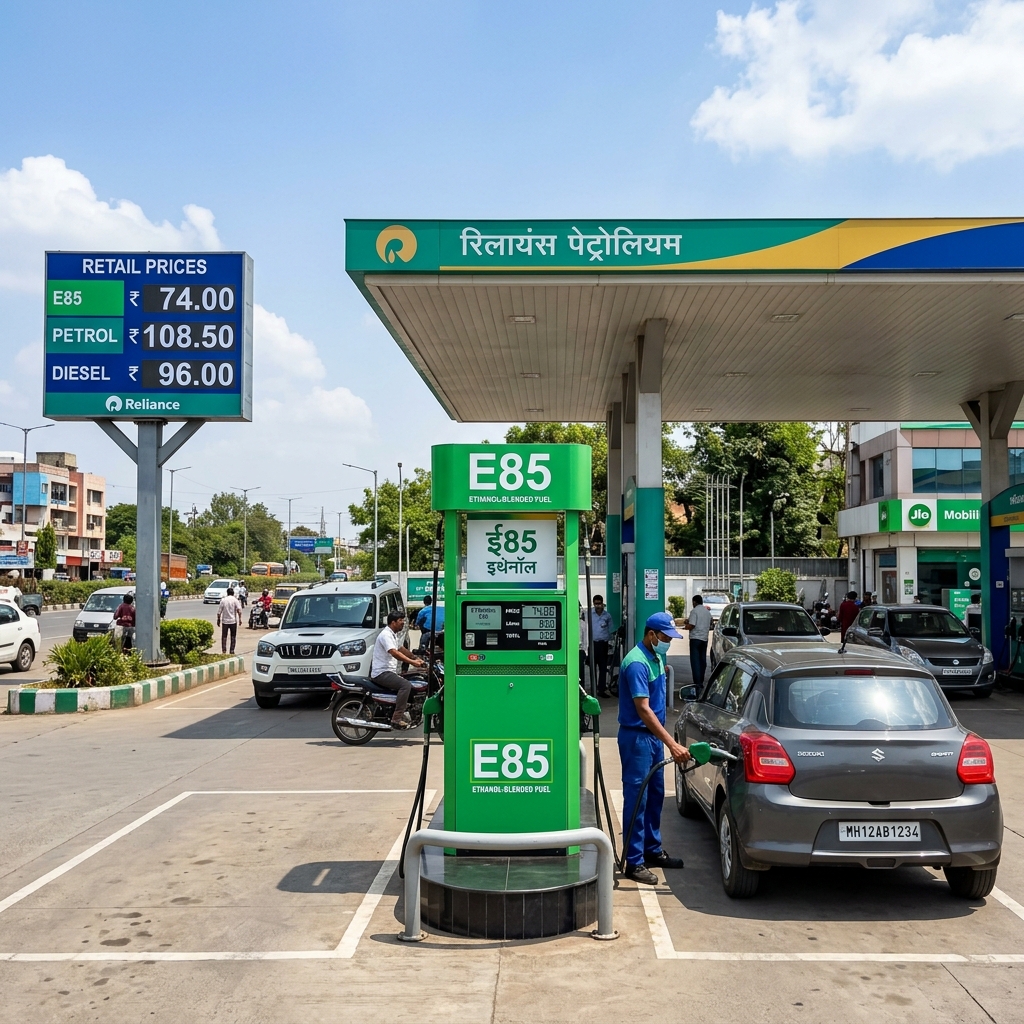
E85 is a high-level ethanol blend consisting of 51% to 83% ethanol, with the remainder being gasoline. The exact percentage varies depending on the season and geographic location to ensure reliable starting in cold weather (more gasoline is added in the winter).
Characteristics of E85
E85 is widely revered in the automotive performance community as "cheap race gas."
1. Massive Octane Rating: E85 boasts an effective octane rating typically ranging from 100 to 105 AKI (Anti-Knock Index). This puts it on par with expensive, specialized racing fuels. 2. Incredible Cooling: The high volume of ethanol in E85 provides a massive latent heat of vaporization. An engine running on E85 runs significantly cooler combustion temperatures, dramatically lowering the risk of pre-ignition and detonation. 3. High Volume Requirement: Ethanol contains roughly 30% less energy per unit of volume than gasoline. Therefore, to achieve the proper air-fuel ratio, the engine must burn roughly 30% more E85 than it would gasoline. This requires a robust fuel system, including larger fuel injectors and a high-flow fuel pump. 4. Corrosion and Compatibility: Ethanol is hygroscopic (absorbs water) and can be corrosive to certain metals and rubber compounds used in older fuel systems. Vehicles running E85 must be "Flex-Fuel" vehicles (FFVs) from the factory or have their fuel systems specifically upgraded with ethanol-compatible components.
E85 and Engine Knock
When it comes to preventing engine knock and detonation, E85 is in a league of its own. Its massive octane rating and immense cooling properties make the fuel incredibly stable under extreme cylinder pressures and temperatures.
For forced induction engines (turbocharged or supercharged), E85 is a game-changer. Tuners can safely increase boost pressures dramatically and advance ignition timing significantly further than would ever be possible on premium pump gas. The result is massive gains in horsepower and torque.
With E85, the limitation is rarely engine knock; it is more often the physical strength of the engine internals (rods, pistons, block) or the capacity of the turbocharger/fuel system.
E20 vs E85: A Detailed Comparison
Now let's directly compare these two fuels across several key metrics relevant to knock prevention and overall performance.
1. Knock Resistance (Octane)
* E20: Offers a respectable bump in octane over standard pump gas, typically pushing 93-95 octane depending on the base gasoline used. It's great for light tuning and providing a safety margin on hot days. * E85: Offers race-gas levels of octane (100-105+). It provides near-invulnerability to knock under conditions that would instantly destroy an engine running on standard premium fuel.
2. Cylinder Cooling
* E20: Provides a slight cooling effect, aiding in overall engine temperature management and slightly reducing the chances of hot-spot induced pre-ignition. * E85: Acts almost like chemical intercooling. The massive amount of heat absorbed as the ethanol vaporizes drastically lowers intake air temperatures (IATs) and in-cylinder temperatures, fundamentally changing the thermal dynamics of the engine.
3. Tuning Potential
* E20: Allows for mild timing advancement and perhaps slight increases in boost on turbocharged cars. It's an excellent "set it and forget it" fuel for daily drivers looking for a bit more pep and reliability. * E85: Unlocks the true potential of high-performance engines. Tuners can run massive amounts of boost and highly aggressive timing. Switching from 93 octane to E85 on a modern turbocharged car can often yield horsepower gains of 15% to 30% with no other mechanical changes (provided the fuel system can handle the flow).
4. Fuel System Requirements
* E20: Very low barrier to entry. Most modern fuel systems (post-2010) can handle E20 without any mechanical modifications. The stock injectors and fuel pump are generally sufficient. * E85: High barrier to entry. Running E85 requires 30-40% more fuel volume. This necessitates larger, specialized fuel injectors, a high-capacity fuel pump (sometimes multiple pumps), and ethanol-safe fuel lines and fittings. Furthermore, a Flex-Fuel sensor is highly recommended so the ECU can adapt in real-time to varying ethanol contents.
5. Fuel Economy
* E20: You will notice a slight drop in fuel economy (perhaps 5-8%) compared to pure gasoline, due to the lower energy density of the 20% ethanol content. * E85: Fuel economy drops significantly, often by 25% to 35%. While the fuel is cheaper per gallon, the cost per mile may actually be higher due to the increased consumption.
6. Availability
* E20: Increasingly available in certain regions (like parts of India and South America) as governments push for higher renewable fuel standards, but less common at standard pumps in North America compared to E10 or E15. * E85: Availability varies wildly. In the US Midwest, it is abundant. In other regions, it can be extremely difficult to find, often requiring enthusiasts to buy it in drums from specialized suppliers.
The Tuning Perspective: Managing Knock
From an engine calibrator's (tuner's) perspective, tuning for E20 versus E85 requires entirely different approaches.
Tuning for E20
When tuning for E20, the goal is usually optimization. The tuner will carefully monitor the knock sensors while gradually advancing the ignition timing. Because E20 has a defined knock limit (though higher than standard gas), the tuner will eventually encounter knock. The tune is then backed off slightly to create a safety margin.
The tuner will also adjust the target air-fuel ratio. E20 requires slightly more fuel than E10, so the fuel maps must be scaled accordingly to ensure the engine doesn't run dangerously lean (which increases combustion temperatures and induces knock).
Tuning for E85
Tuning for E85 is a different animal altogether. Because the knock resistance is so incredibly high, tuners rarely rely on knock sensors to find the limit of the tune.
If a tuner keeps advancing timing on E85, the engine will eventually reach MBT (Maximum Brake Torque) timing—the point at which the engine is making the maximum possible power from the combustion event. Advancing the timing beyond MBT on E85 will actually lose power, long before any detonation occurs.
Therefore, on E85, the engine is tuned to MBT (or limited by cylinder pressure to save the connecting rods), rather than being limited by the fuel's knock threshold. This is why E85 is so powerful—it removes the fuel as the limiting factor in the engine's performance equation.
Real-World Scenarios
To illustrate the practical differences, let's look at a few scenarios.
Scenario 1: The Daily Commuter
You drive a modern, naturally aspirated sedan. You live in a hot climate and occasionally notice a faint pinging sound when accelerating hard up a steep hill. * Switching to E20: The slight bump in octane and cooling effect will likely eliminate the pinging entirely. The engine will run happier, and the ECU won't pull timing, ensuring consistent power. * Switching to E85: Impractical and unnecessary. You would need to spend thousands on fuel system upgrades, your fuel economy would plummet, and a naturally aspirated commuter car cannot take advantage of the massive octane to make significantly more power.
Scenario 2: The Lightly Modified Turbo Car
You have a turbocharged hatchback with an aftermarket intake and exhaust. You want a bit more power without tearing the engine apart. * E20: An excellent choice. A tuner can create a custom map for E20 that allows for slightly higher boost and better timing, yielding a noticeable bump in mid-range torque and top-end horsepower while keeping the engine safe from knock. * E85: An option, but it requires commitment. You'll need bigger injectors and a pump. If you make the investment, the power gains will be far more substantial than with E20, but you must ensure you have reliable access to E85 pumps.
Scenario 3: The Dedicated Track/Drag Car
You are building a high-horsepower, heavily turbocharged engine designed to run at the absolute limit. * E20: Insufficient. The immense cylinder pressures generated by high boost will quickly overcome E20's knock resistance, leading to catastrophic detonation. * E85: The mandatory choice (short of expensive race fuels like C16 or methanol). E85 provides the necessary octane and cooling to survive the extreme conditions of a high-boost track car.
Environmental and Economic Considerations
Beyond performance and knock resistance, the choice between E20 and E85 involves broader factors.
Emissions: Both E20 and E85 reduce greenhouse gas emissions and harmful pollutants compared to pure gasoline. E85 offers the most significant reduction in lifecycle carbon emissions, provided the ethanol is produced sustainably.
Cost: Ethanol is generally cheaper to produce than gasoline. Consequently, E85 is often cheaper per gallon at the pump. However, because you burn roughly 30% more of it, the cost per mile is often a wash, or slightly more expensive. E20 typically is priced competitively with standard gasoline, offering a slight performance bump for little to no extra cost.
Agriculture and Policy: The widespread adoption of ethanol blends is heavily influenced by government policy and the agricultural sector. In countries with massive agricultural output (like the US and Brazil), ethanol is a major industry. Policies promoting E20 or E85 aim to reduce reliance on imported oil and support domestic farmers.
The Future of Ethanol Blends
As the automotive industry slowly transitions toward electrification, internal combustion engines will remain prevalent for decades. During this long transition phase, higher ethanol blends like E20 are likely to become the new standard, replacing E10 in many regions as governments push for lower emissions from the existing fleet of vehicles.
E85 will likely remain a niche fuel, cherished by the performance and racing communities, but impractical for mass adoption due to the specific vehicle requirements and reduced fuel economy.
Conclusion
Understanding engine knock and detonation is crucial for anyone looking to maximize their vehicle's performance or longevity. These destructive phenomena are the primary limiters of an internal combustion engine's potential.
Ethanol, with its high octane rating and exceptional cooling properties, is the ultimate defense against knock.
* E20 serves as an excellent, accessible middle ground. It provides a meaningful buffer against knock, allows for mild performance tuning, and is compatible with most modern vehicles without modification. It is the fuel of the future for the average driver. * E85 is the undisputed king of pump-gas performance. Its race-gas characteristics unlock massive potential in forced-induction engines, making detonation a thing of the past, provided the engine's mechanical components can withstand the incredible forces generated.
Choosing between them ultimately depends on your vehicle's capabilities, your performance goals, and the availability of the fuel in your region. But whether you run E20 or E85, you are harnessing the power of ethanol to keep engine knock at bay.