When switching to alternative fuels or tuning a high-performance vehicle, E85 (a blend of 85% ethanol and 15% petrol) is often the go-to choice for enthusiasts and eco-conscious drivers alike. With its high octane rating and cooling properties, it offers significant performance advantages. However, one of the most common questions raised by drivers and mechanics is about the physical properties of the fuel itself, specifically: Does E85 evaporate faster than petrol?
The short answer is no, E85 does not evaporate faster than regular petrol. In fact, under standard atmospheric conditions, regular petrol (gasoline) is more volatile and evaporates more quickly than high-ethanol blends like E85.
However, the complete answer is far more nuanced. While E85 doesn't evaporate faster, it suffers from other environmental susceptibilities—most notably water absorption—that cause it to degrade differently than traditional petrol. This degradation is often mistakenly attributed to rapid evaporation.
In this comprehensive guide, we will dive deep into the science of fuel evaporation, vapor pressure, the chemical differences between ethanol and petrol, and how you should store your E85 to maximize its shelf life.
---
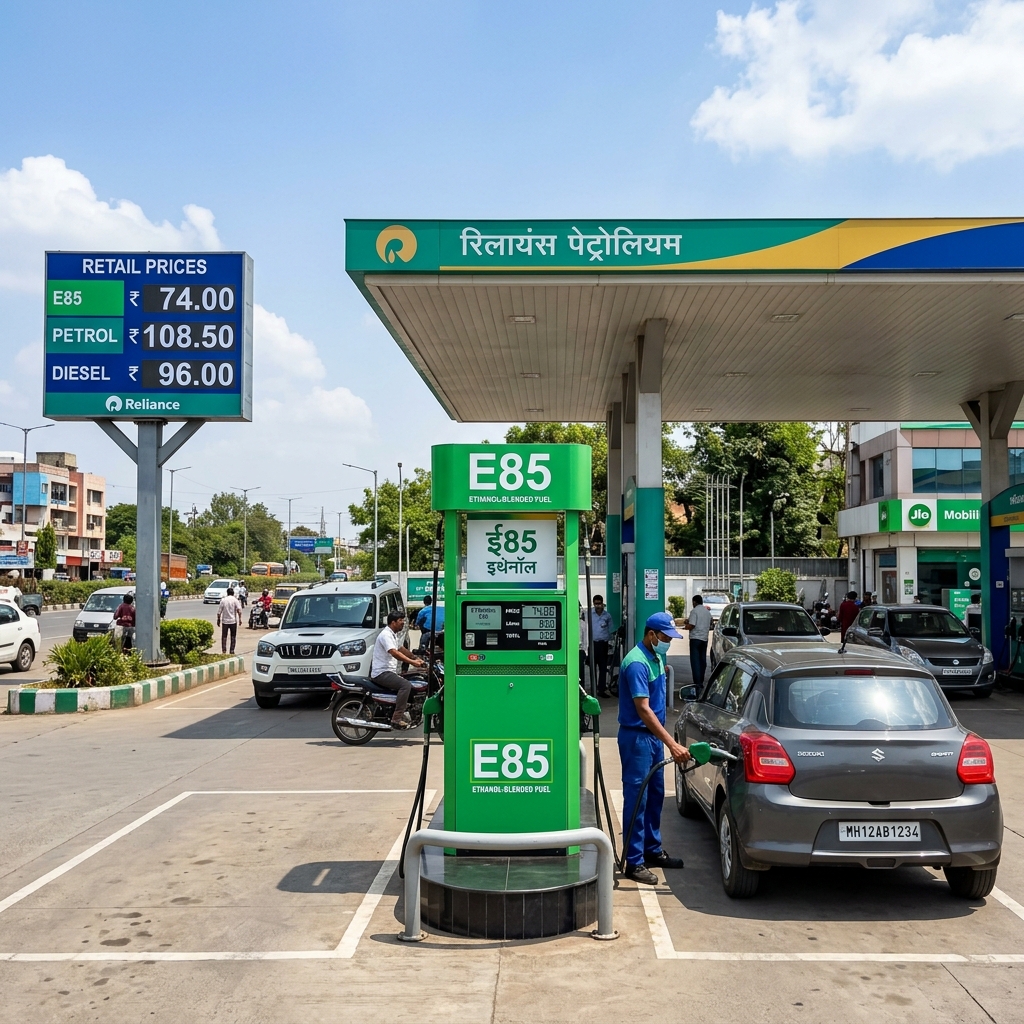
1. Understanding the Contenders: E85 vs. Regular Petrol
To understand how these fuels evaporate, we first need to understand what they are made of.
What is Regular Petrol?
Petrol (or gasoline) is not a single chemical; it is a complex, highly refined mixture of hundreds of different hydrocarbons derived from crude oil. These hydrocarbons include alkanes, cycloalkanes, and alkenes. Because it is a mixture of many different molecules, petrol boils and evaporates over a wide range of temperatures. Some of the lighter hydrocarbons in petrol are designed to be extremely volatile so that the engine can start easily in cold weather.What is E85?
E85 is a blended biofuel consisting of up to 85% ethanol (ethyl alcohol) and 15% regular petrol. Ethanol is a single chemical compound (C2H5OH). Unlike the complex mixture of hydrocarbons in petrol, pure ethanol has a specific, fixed boiling point (about 78.37°C or 173°F). Because E85 is overwhelmingly made of ethanol, its physical properties closely mirror those of pure alcohol, modified slightly by the 15% petrol added to aid in cold starting and lubrication.---
2. The Science of Evaporation: Reid Vapor Pressure (RVP)
Evaporation is the process by which a liquid turns into a gas. The rate at which a liquid evaporates is primarily determined by its vapor pressure. In the fuel industry, this is measured using the Reid Vapor Pressure (RVP) standard, which gauges how quickly a fuel turns into vapor at 37.8°C (100°F).
- Higher RVP = Higher volatility = Faster evaporation. - Lower RVP = Lower volatility = Slower evaporation.
The Volatility of Petrol
Petrol is formulated by refineries to have a specific RVP depending on the season. - Winter-blend petrol has a higher RVP (is more volatile) to help engines start when it's freezing outside. - Summer-blend petrol has a lower RVP (is less volatile) to prevent fuel from boiling in the lines (vapor lock) and to reduce smog-causing evaporative emissions in hot weather. Regardless of the season, regular petrol typically has an RVP ranging from 7 to 15 psi.The Volatility of Ethanol and E85
Pure ethanol has a surprisingly low vapor pressure—around 2.3 psi at standard testing temperatures. Because it has such a low RVP, pure ethanol evaporates much slower than even the lowest-volatility summer petrol.When you blend 85% ethanol with 15% petrol to create E85, the resulting RVP is generally between 5 and 7 psi. This is lower than standard petrol.
Conclusion on Evaporation Rates: Because E85 has a substantially lower Reid Vapor Pressure than regular unleaded petrol, it is less volatile. Therefore, if you were to place a cup of E85 and a cup of regular petrol in the same room, the regular petrol would evaporate significantly faster than the E85.
---
3. The "Vapor Pressure Bump": Why E10 is Different from E85
There is a fascinating chemical quirk that often causes confusion regarding ethanol and evaporation. It is known as the "vapor pressure bump."
When a small amount of ethanol (like 10%, known as E10) is added to pure petrol, the chemical interaction between the alcohol molecules and the hydrocarbon molecules actually increases the overall vapor pressure of the mixture. E10 evaporates slightly faster than pure petrol.
Because many consumers know that standard pump gas (E10) is highly volatile, they incorrectly assume that adding more ethanol will make it even more volatile. However, the vapor pressure bump only occurs at low concentrations of ethanol. As the ethanol concentration increases past 20% and moves toward E85, the vapor pressure drops dramatically, settling much closer to the low volatility of pure ethanol.
---
4. If E85 Doesn't Evaporate Faster, Why Does It "Go Bad" So Quickly?
This is where the confusion usually lies. Many drivers notice that if they leave E85 in a vented fuel tank or an improperly sealed jug, the fuel seems to lose its potency, the engine runs poorly, or the fuel volume appears to drop.
People often blame this on rapid evaporation. In reality, the culprit is hygroscopy.
The Danger of Water Absorption
Ethanol is a hygroscopic substance, meaning it actively attracts and absorbs moisture from the surrounding air. Petrol, on the other hand, is hydrophobic (it repels water).If E85 is left exposed to the atmosphere, the ethanol will pull water vapor out of the air. As the water content in the fuel tank increases, the mixture eventually reaches a saturation point.
Phase Separation
Once E85 absorbs too much water, a catastrophic chemical event occurs known as phase separation. The water and ethanol bind tightly together and drop to the bottom of the fuel tank, leaving a low-octane layer of degraded petrol floating on top.If you try to start a car with phase-separated fuel, the fuel pump will suck up the water-ethanol mixture from the bottom of the tank. This mixture will not burn in the engine, leading to sputtering, stalling, and potentially severe internal engine corrosion.
When E85 is left to sit and subsequently performs poorly, it hasn't evaporated—it has absorbed water and separated.
---
5. Factors Influencing Fuel Evaporation Rates
While E85 is fundamentally less volatile than petrol, evaporation is not solely dependent on the chemical makeup of the liquid. Environmental and physical factors play a massive role in how quickly any fuel will evaporate.
Temperature
Heat gives molecules the kinetic energy required to break their liquid bonds and escape into the air as a gas. Both petrol and E85 will evaporate much faster at 35°C (95°F) than they will at 10°C (50°F). However, because petrol's lighter hydrocarbons boil at very low temperatures, a hot summer day will cause petrol to vaporize much more aggressively than E85.Surface Area
The rate of evaporation is directly proportional to the surface area exposed to the air. Fuel left in a wide, shallow pan will evaporate much faster than the same volume of fuel left in a tall, narrow cylinder. In a vehicle fuel tank, the surface area is relatively constant, but sloshing during driving can temporarily increase the surface area and encourage vaporization.Airflow and Wind
If fuel vapors are allowed to sit in a stagnant layer just above the liquid surface, they create vapor pressure that pushes back against the liquid, slowing down further evaporation. Wind sweeps these vapors away, allowing the liquid to continue evaporating rapidly. An unsealed container outdoors will lose fuel much faster than one in a still garage.Atmospheric Pressure
At higher altitudes, atmospheric pressure is lower. Lower pressure means there is less force pushing down on the surface of the liquid, making it easier for molecules to escape. Both E85 and petrol will evaporate faster in Denver, Colorado (high altitude) than they will at sea level, though petrol will still evaporate faster than E85.---
6. Real-World Implications: Cold Starts and Vapor Lock
The lower volatility (slower evaporation) of E85 has significant real-world implications for how your vehicle operates, presenting both challenges and benefits.
The Cold Start Problem with E85
Internal combustion engines do not burn liquid fuel; they burn fuel vapor mixed with air. When you try to start your car on a cold morning, the fuel must evaporate instantly in the intake manifold or cylinder to ignite via the spark plug.Because petrol has a high vapor pressure and evaporates easily, it creates plenty of combustible vapor even in freezing temperatures. Because E85 has a low vapor pressure and evaporates slowly, it struggles to vaporize in cold engines. The liquid fuel just wets the cylinder walls, and the spark plug has nothing to ignite.
This is why many high-performance cars running on E85 require special ECU tuning to inject massive amounts of fuel during cold starts (cranking enrichment) just to get enough vapor to catch fire. It is also why winter blends of E85 are often adjusted down to E70 (70% ethanol, 30% petrol) to artificially increase the evaporation rate and make cold starting possible.
The Benefit: Resistance to Vapor Lock
Vapor lock is a condition that occurs when liquid fuel evaporates too early, turning into gas inside the fuel lines or fuel rail before it reaches the injectors. The fuel pump cannot push vapor efficiently, causing the engine to starve for fuel and stall.Because regular petrol is highly volatile, cars can suffer from vapor lock on extremely hot track days or if fuel lines are routed too close to hot exhaust components. Because E85 is much less volatile and evaporates slower, it is highly resistant to vapor lock. It remains in its liquid state even when fuel rail temperatures get extremely high, which is a massive benefit for endurance racing and high-horsepower applications.
---
7. Comparing the Shelf Life of E85 and Petrol
If you are putting your car away for the winter, or storing fuel in jerry cans for your race car, you need to understand the shelf life of these liquids.
Petrol Shelf Life
Regular unleaded petrol stored in a sealed container in a cool, dark place can last for up to 6 months without degrading significantly. If a high-quality fuel stabilizer is added, petrol can remain viable for 12 to 24 months. When petrol degrades, its lighter (more volatile) hydrocarbons evaporate, leaving behind a stale, varnish-like residue that can clog fuel injectors and carburetors.E85 Shelf Life
E85 has a much shorter practical shelf life than regular petrol, primarily due to its water-absorbing properties rather than evaporation. - In an open or vented container*, E85 can go bad (absorb enough water to phase separate) in as little as *2 to 4 weeks in a humid climate. - In a properly sealed fuel tank or airtight jug*, E85 can last *3 to 6 months.Even in a sealed container, the organic nature of ethanol means it will slowly oxidize and degrade over time. Fuel stabilizers designed for regular petrol do not work well with E85; you must use ethanol-specific stabilizers, and even then, long-term storage is generally not recommended.
---
8. Best Practices for Storing E85 Fuel
To protect your E85 from degradation (and to prevent the slow evaporation of its 15% petrol content), you must adopt rigorous storage habits. Here is how to keep your ethanol fuel fresh:
1. Use Airtight, High-Quality Containers
Never store E85 in cheap, thin plastic jugs that are not perfectly sealed. Use high-density polyethylene (HDPE) racing jugs with heavy-duty O-ring seals, or DOT-approved metal jerry cans. The goal is to completely isolate the fuel from the humidity in the ambient air.2. Store in a Cool, Dry Place
Temperature fluctuations cause the air inside fuel cans to expand and contract. This can force air out of the can during the day and suck humid night air into the can as it cools. Store your E85 in a climate-controlled garage or a cool, shaded area with a stable temperature to minimize this "breathing" effect.3. Keep Tanks Full
If you are storing a vehicle that runs on E85, the best practice is to drain the tank entirely and run regular petrol through the lines before storage.If you must store the car with E85 in it, fill the tank to the very brim. A full tank leaves almost no room for humid air. Less air means less moisture available for the ethanol to absorb. Conversely, a tank that is only 1/4 full contains a massive volume of air, rapidly accelerating water absorption and phase separation.
4. Use Ethanol-Specific Fuel Treatments
If you know the fuel will sit for more than a month, treat it with an E85-specific fuel stabilizer (such as Lucas Safeguard Ethanol Fuel Conditioner or Driven Racing Fuel Defender). These products help inhibit corrosion and slow the rate of water absorption, though they cannot reverse phase separation once it has occurred.5. Test Before You Pour
If E85 has been sitting in your garage for a few months, use an ethanol content tester (a simple glass or plastic vial that uses water to measure ethanol percentage) before pouring it into your tank. It is also wise to visually inspect the fuel in a clear glass jar; if it looks cloudy or has a distinct layer of water at the bottom, dispose of it properly. Do not put it in your engine.---
9. Environmental Impact: Evaporative Emissions (EVAP)
Fuel evaporation isn't just a concern for your wallet and engine performance; it is a major environmental issue. When fuel evaporates, it releases Volatile Organic Compounds (VOCs) into the atmosphere. In the presence of sunlight, VOCs react with nitrogen oxides to form ground-level ozone, a primary component of smog.
Modern vehicles are equipped with an Evaporative Emission Control System (EVAP). This system uses a charcoal canister to capture fuel vapors evaporating from the gas tank. When the engine is running, the system purges these trapped vapors into the engine to be burned.
Because regular petrol is highly volatile, EVAP systems are heavily taxed on hot days, working overtime to capture petrol fumes.
Because E85 is less volatile, it generates fewer evaporative emissions inside the fuel tank. However, ethanol vapor is still a VOC, and if it escapes, it still contributes to air pollution. The EVAP systems on flex-fuel vehicles are specially designed with upgraded materials to handle the corrosive nature of ethanol vapors, ensuring that E85 does not escape into the atmosphere.
---
10. Frequently Asked Questions (FAQs)
Does E85 evaporate out of the gas tank?
Yes, all liquid fuels will slowly evaporate out of a gas tank if it is vented to the atmosphere. However, modern cars have sealed fuel systems (EVAP systems) that capture these vapors, meaning almost zero fuel is lost to evaporation while the car is parked. If you smell fuel around your car, you likely have a leak, not normal evaporation.Why does it seem like I burn through E85 faster than petrol?
You do! But this has nothing to do with evaporation. E85 contains about 25% to 30% less energy per gallon than regular petrol. To make the same amount of power, your engine has to inject significantly more fuel. Consequently, your miles per gallon (MPG) drops significantly when running E85, causing the fuel gauge to drop faster.Will leaving the cap off an E85 jug ruin it?
Absolutely. Leaving the cap off allows the E85 to absorb moisture from the air constantly. Depending on the ambient humidity, the fuel could be ruined by phase separation in a matter of days. Always keep E85 containers tightly sealed.Can E85 evaporate and leave water behind?
No. Evaporation does not create water. Water gets into E85 because the ethanol chemically pulls water vapor out of the air. When the ethanol and water phase-separate and drop to the bottom, the lighter petrol components may evaporate over time, leaving the separated water/ethanol sludge behind.---
11. Conclusion: The Final Verdict on E85 Evaporation
To summarize the scientific facts: E85 does not evaporate faster than regular petrol.
Because pure ethanol has a significantly lower Reid Vapor Pressure than the complex hydrocarbons found in standard gasoline, E85 is actually less volatile and evaporates at a slower rate. This low volatility is exactly why engines running on E85 can be difficult to start in freezing weather, and why E85 is highly resistant to vapor lock in extreme racing conditions.
When E85 "goes bad" in an unsealed container or a parked car, it is almost never due to rapid evaporation. Instead, the degradation is caused by ethanol's hygroscopic nature—its relentless tendency to pull moisture out of the air until the fuel becomes saturated and separates.
If you treat E85 with respect, store it in perfectly sealed containers, keep your fuel tanks full during downtime, and use the fuel relatively quickly, you will circumvent the pitfalls of water absorption. By understanding the true physical properties of E85, you can ensure that your engine remains healthy, powerful, and ready to perform.