The Indian auto rickshaw market is on the cusp of a major revolution. For decades, these three-wheeled wonders have been the lifeline of urban and semi-urban transportation across the country, weaving through traffic and providing affordable last-mile connectivity. First came the transition from highly polluting two-stroke to efficient four-stroke engines. Then came the shift from petrol and diesel to cleaner alternatives like Compressed Natural Gas (CNG) and Liquefied Petroleum Gas (LPG) in metropolitan areas. Recently, Electric Vehicles (EVs) have taken center stage in the mobility conversation.
However, another crucial technology is quietly but rapidly gaining momentum, promising a perfect blend of sustainability, lower running costs, and unmatched range confidence: Flex Fuel, specifically the high-blend E85 ethanol variant.
At the absolute forefront of this green mobility revolution is Bajaj Auto, the undisputed king of the three-wheeler segment in India and globally. The highly anticipated Bajaj RE E85 is poised to disrupt the commercial market, offering drivers and fleet operators an alternative that could brilliantly bridge the gap between traditional Internal Combustion Engine (ICE) vehicles and pure electric models.
In this comprehensive, deep-dive guide, we explore everything you need to know about the upcoming Bajaj RE E85 flex-fuel auto rickshaw. From its expected launch date, technological specifications, and estimated pricing to a detailed analysis of what makes E85 the pragmatic fuel of the future for Indian public transport, we cover it all.
---
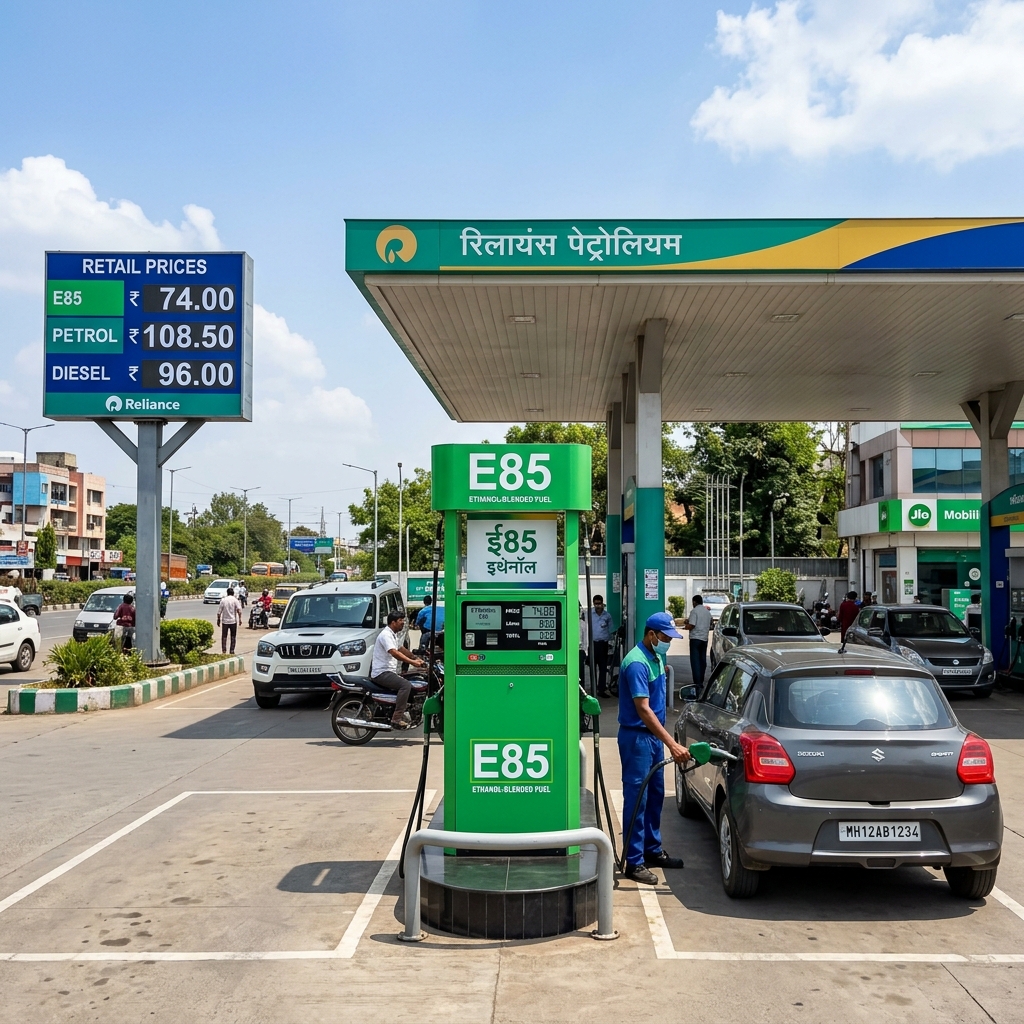
1. Demystifying Flex Fuel and E85
Before we dive into the specifics of the Bajaj RE E85, it is absolutely essential to understand what flex-fuel technology entails, what E85 means, and why it is creating such a massive buzz in the Indian automotive sector.
Understanding Flex-Fuel Technology
A Flexible Fuel Vehicle (FFV) or flex-fuel vehicle features an internal combustion engine designed to seamlessly run on more than one type of fuel. Usually, this means a mixture of standard gasoline (petrol) and ethanol. Unlike standard ICE vehicles on the road today that can only handle a small percentage of ethanol (like the E10 or E20 blends currently being mandated across India), a true flex-fuel engine is engineered with heavily modified components. These include specialized fuel lines, robust fuel pumps, larger and corrosion-resistant injectors, and highly advanced engine mapping software to handle much higher concentrations of ethanol without stalling or damaging the engine internals.The E85 Blend Explained
The term "E85" refers to a high-level ethanol blend consisting of 85% ethanol and 15% petrol. Ethanol is a renewable biofuel primarily made from plant materials. In the Indian context, this ethanol is largely derived from sugarcane molasses, maize, and broken rice.Running a vehicle on an E85 blend has profound implications on multiple fronts: - Reduced Emissions: E85 burns significantly cleaner than pure petrol. It drastically reduces greenhouse gas emissions, carbon monoxide, and particulate matter, leading to cleaner air. - Higher Octane Rating: Ethanol naturally possesses a higher octane rating (around 100-105) compared to standard petrol (87-91). This allows for higher compression ratios in the engine, which can lead to better engine performance, more torque, and reduced engine knocking. - Economic Independence: By blending 85% domestically produced ethanol into the fuel mix, India can drastically reduce its reliance on imported crude oil, saving billions in foreign exchange reserves. - Lower Fuel Costs: Ethanol is generally much cheaper to produce domestically than refined petrol is to import and refine. When subsidized or taxed favorably by the government, E85 can significantly lower the daily running costs for commercial vehicle operators.
---
2. Bajaj Auto's Unrivaled Legacy in the Three-Wheeler Segment
To truly grasp the significance of the upcoming Bajaj RE E85, one must look at Bajaj Auto's historical dominance in the three-wheeler space. Bajaj is not merely a market leader in India; it is the world's largest manufacturer of three-wheelers, exporting to dozens of countries across Latin America, Africa, and Southeast Asia.
A History of Pragmatic Innovation
From the iconic, buzzing two-stroke rear-engine autos of the 1980s and 90s to the introduction of the modern RE (Rear Engine) four-stroke series that prioritized driver comfort, fuel efficiency, and reliability, Bajaj has consistently evolved with the times. When the government pushed for cleaner fuels in major highly polluted cities like New Delhi, Mumbai, and Pune, Bajaj was incredibly quick to introduce factory-fitted CNG and LPG models. These variants quickly became the gold standard for auto drivers across the nation due to their tank-like reliability and extremely low total cost of ownership (TCO).The EV Transition vs. The Flex Fuel Reality
More recently, Bajaj launched the RE E-Tec 9.0, marking its highly anticipated entry into the electric passenger three-wheeler segment. However, the ground reality is that the EV infrastructure in India is still in its developmental phase, especially outside Tier-1 cities. Range anxiety, multi-hour charging times, lack of standardized charging stations, and high upfront battery replacement costs remain significant hurdles for many daily-wage drivers who rely on their rickshaws to be running continuously to make a living.This is exactly where flex-fuel technology, specifically embodied in the Bajaj RE E85, comes into play as a highly pragmatic, immediate solution. It offers the familiar, two-minute refueling experience of a traditional ICE vehicle, tailpipe emissions that are akin to or better than CNG, and potentially lower daily running costs. It makes for an incredibly attractive proposition for the massive demographic of commercial drivers not yet ready, financially or practically, to transition to pure EVs.
---
3. The Bajaj RE E85: What We Know So Far
The Bajaj RE E85 is expected to be a monumental game-changer. While Bajaj management has kept many specific details under wraps to maintain a competitive edge, industry insiders, government mobility showcases, and technological prototypes have provided a very clear picture of what consumers and drivers can expect.
Design, Aesthetics, and Ergonomics
Aesthetically, the Bajaj RE E85 is highly unlikely to deviate significantly from the beloved, tried-and-tested, and aerodynamic design of the current RE lineup. The philosophy is "if it isn't broken, don't fix it." - Cabin Space: It will continue to offer best-in-class legroom for both the driver and the rear passengers, ensuring comfort during long city rides. - Dashboard and Console: Expect a slightly updated, modernized semi-digital instrument cluster. This new cluster will likely prominently display the current fuel mix ratio (ethanol vs. petrol percentage) and feature customized efficiency metrics tailored for ethanol usage. - Chassis and Body: The robust chassis, renowned for withstanding pothole-ridden Indian roads and heavy passenger loads, will remain intact. However, there will be minor structural tweaks to accommodate a specially coated, heavy-duty fuel tank designed explicitly to handle the highly corrosive nature of high-ethanol blends safely.The Heart of the Machine: The Advanced Engine
The engine block is where the true engineering magic happens. The RE E85 will feature a heavily modified, modernized version of Bajaj’s ultra-reliable 236cc DTS-i (Digital Twin Spark Ignition) engine. - Corrosion Resistance: Pure ethanol is hygroscopic (meaning it absorbs water from the air) and is notoriously corrosive to standard rubber, plastics, and certain metals used in standard fuel lines. The RE E85's engine will feature upgraded stainless steel fuel rails, specialized polymer hoses, heavy-duty injectors, and an uprated fuel pump designed to survive E85 indefinitely. - Intelligent Engine Control Unit (ECU): The vehicle will boast a highly advanced, intelligent ECU equipped with a flex-fuel sensor. This sensor detects the exact blend of ethanol and petrol currently in the tank. Whether the driver fills up with standard E20 petrol, E85, or any random mixture of the two, the ECU will automatically, in milliseconds, adjust the ignition timing and air-fuel ratio to ensure optimal combustion and smooth performance. - Power Output and Torque: Because of ethanol’s incredibly high octane rating, Bajaj engineers can tune the engine for a slightly higher compression ratio. This means the engine could potentially offer slightly better low-end torque—an absolutely crucial factor for a commercial vehicle carrying a full load of passengers up steep inclines or flyovers.---
4. Expected Specifications of the Bajaj RE E85
While official homologation figures from the ARAI (Automotive Research Association of India) are pending, based on the current RE platform architecture and the established physics of E85 tuning, here are the highly probable expected specifications for the Bajaj RE E85:
| Technical Parameter | Expected Specification Details | | :--- | :--- | | Engine Type | 4-Stroke, Single Cylinder, DTS-i (Flex Fuel Modified & Hardened) | | Displacement | ~236.2 cc | | Fuel Type Compatibility | Flex Fuel (Any blend of Petrol and Ethanol up to E85) | | Maximum Power | ~10.5 to 11.8 PS @ 4500 RPM (Slight bump due to high octane) | | Maximum Torque | ~20.5 Nm @ 3500 RPM | | Transmission System | 4 Forward + 1 Reverse Gear, Constant Mesh | | Clutch Type | Wet Multiplate | | Cooling System | Forced Air / Oil Cooled | | Fuel Tank Capacity | 8 Liters (Specially coated internally for corrosion resistance) | | Starting System | Electric Start with robust starter motor | | Top Speed | ~65 kmph (Electronically limited for safety) | | Seating Capacity | Driver + 3 Passengers (Standard Auto Configuration) | | Front Suspension | Helical Coil Spring & Hydraulic Double Acting Shock Absorber | | Rear Suspension | Independent trailing arm with Helical Spring & Hydraulic Shock Absorber | | Braking System | Hydraulic Drum Brakes (Front & Rear) |
---
5. Fuel Efficiency and Running Costs: The Driver's Bottom Line
For a commercial auto rickshaw driver in India, the vehicle is their livelihood. Every single rupee saved on fuel translates directly to putting food on the table for their family. The ultimate market success of the Bajaj RE E85 will hinge entirely on its running costs when compared head-to-head with CNG and standard petrol models.
Energy Density and The Mileage Reality
It is a fundamental scientific fact that ethanol has a lower energy density than standard petrol by about 30%. This means that a literal liter of E85 contains less combustible energy than a liter of pure petrol. Consequently, the volumetric fuel efficiency (kilometers per liter) of the Bajaj RE E85 running on 85% ethanol will undoubtedly be lower than the exact same engine running on petrol.If a standard petrol-powered Bajaj RE delivers around 25-28 kmpl in real-world city conditions, the E85 variant might yield around 18-22 kmpl when running on pure E85 fuel.
The Cost Equation: Why E85 Still Wins
However, volumetric mileage is only half the story. Commercial drivers calculate success by the cost per kilometer.The Indian government is aggressively pushing ethanol blending specifically to reduce the import bill and heavily support the domestic agricultural sector. Because of this, E85 is expected to be priced significantly lower than heavily taxed petrol at the pumps.
Let's look at a hypothetical but highly realistic cost calculation: Assume standard Petrol is priced at ₹100/liter and subsidized E85 is priced at ₹65/liter. - Standard Petrol Auto:* 25 kmpl @ ₹100/L = *₹4.00 per kilometer - Bajaj RE E85 Auto:* 20 kmpl @ ₹65/L = *₹3.25 per kilometer
This calculation clearly demonstrates that despite the drop in volumetric mileage (kmpl), the overall daily running cost per kilometer is significantly cheaper. This makes the E85 highly competitive, easily rivaling the running costs of CNG, especially in regions where CNG prices have surged recently due to global gas market fluctuations.
---
6. Environmental Impact: A Massively Greener Ride
The aggressive push for the Bajaj RE E85 isn't just an economic strategy; it's a desperately needed environmental intervention. Auto rickshaws run for 10 to 14 hours a day in densely populated urban centers, idling in traffic and accelerating constantly. Their cumulative emissions have a massive, direct impact on the ambient air quality and the respiratory health of millions of citizens.
Slashing Tailpipe Emissions
Burning an E85 blend produces significantly fewer harmful emissions than petrol or diesel. It dramatically reduces output of carbon monoxide (CO), volatile organic compounds (VOCs), and harmful microscopic particulate matter (PM2.5 and PM10). While burning ethanol does produce slightly higher levels of acetaldehyde, the modern catalytic converters (which the RE E85 will be equipped with to meet stringent BS-VI Phase 2 norms) neutralize this specific emission effectively before it leaves the tailpipe.The Closed Carbon Cycle
Perhaps the most crucial environmental benefit is the source of the fuel. Ethanol is derived directly from growing crops like sugarcane and maize. As these crops grow in the fields, they photosynthesize and absorb massive amounts of carbon dioxide (CO2) from the atmosphere. When the refined ethanol is eventually burned in the rickshaw's engine on the streets of Mumbai or Delhi, that exact same CO2 is released back into the air.This creates what scientists call a "closed carbon cycle." It means the net greenhouse gas emissions of E85 are drastically lower—up to 70% lower across the lifecycle—than extracting ancient fossil fuels from deep underground and burning them. For India's highly polluted cities, a mass commercial fleet transition to E85 could result in a highly measurable, life-saving improvement in urban air quality.
---
7. Bajaj RE E85 Launch Date in India
The burning question for fleet operators and drivers is: When can we actually buy the Bajaj RE E85 and put it on the roads?
Bajaj Auto has been conducting extensive, secretive R&D, engine dyno testing, and rigorous road trials for its flex-fuel engines across varying Indian climates. They have confidently showcased their flex-fuel prowess at various global mobility expos, including the Bharat Mobility Global Expo. Simultaneously, the Indian government has fast-tracked ambitious targets for E20 availability nationwide by 2025 and is aggressively pushing OEMs to release E85 and pure E100 ethanol vehicles shortly thereafter.
Based on strict industry timelines, supply chain readiness, and government directives, the expected launch timeline for the Bajaj RE E85 is as follows:
* Official Public Unveiling: Expected in late 2026 or early 2027 at a major mobility expo, complete with full technical reveals. * Targeted Pilot Launch: Q2 2027. This will likely happen first in states with massive sugarcane and ethanol production (such as Maharashtra, Uttar Pradesh, and Karnataka). These states will be the first to have dedicated E85 dispensing pumps set up by Oil Marketing Companies. * Pan-India Rollout: A phased rollout from late 2027 through 2028, strictly aligning with the geographical expansion of the E85 fuel station network by OMCs like Indian Oil, Bharat Petroleum, and Hindustan Petroleum.
It is absolutely vital to note that the commercial launch of the vehicle is tethered to the OMCs rolling out E85 dispensing infrastructure. An auto rickshaw cannot realistically run on E85 if the local fuel stations don't sell it, though its flex-fuel nature means it could temporarily run on standard petrol if needed.
---
8. Expected Price of the Bajaj RE E85
Pricing a commercial vehicle correctly is a matter of survival in the hyper-competitive Indian market. The Bajaj RE E85 will inherently require specialized, heavy-duty components—upgraded fuel injectors, corrosion-resistant tanks, specialized fuel lines, and a much smarter ECU with flex-fuel sensors. These high-tech components undeniably add to the manufacturing cost at the factory level.
However, Bajaj is globally renowned for its massive economies of scale, vertical integration, and aggressive, disruptive pricing strategies. Furthermore, the Indian government is highly likely to offer substantial subsidies, PLI (Production Linked Incentive) scheme benefits, or lower GST (Goods and Services Tax) rates specifically for flex-fuel vehicles to aggressively promote their rapid adoption, heavily mirroring the successful FAME subsidies provided for EVs.
* Expected Ex-Showroom Price: ₹2,75,000 to ₹3,10,000 * Expected On-Road Price Estimate: ₹3,10,000 to ₹3,50,000 (This will vary significantly depending on individual state taxes, RTO registration fees, and local commercial vehicle permits).
This aggressive pricing strategy would place the E85 variant slightly higher than standard base petrol variants but roughly on par with, or even marginally cheaper than, factory-fitted CNG variants. This makes it a highly accessible, logical option for both large fleet operators and individual owner-drivers.
---
9. Government Policies, Economic Impact, and The Ethanol Push
The inception of the Bajaj RE E85 isn't just an automotive engineering choice; it is a direct, calculated byproduct of the Government of India's strategic geopolitical and economic vision. The National Policy on Biofuels* and the *Ethanol Blended Petrol (EBP) Programme are the heavy driving forces behind this shift.
Why is the Government Pushing Ethanol So Aggressively?
1. Macro-Economic Energy Security: India currently imports over 80% of its crude oil requirements, leaving the economy highly vulnerable to global supply shocks and wars. Every single percentage increase in domestic ethanol blending saves billions of dollars in foreign exchange outflow, strengthening the Rupee. 2. Boosting Farmer Incomes (The Agrarian Economy): Ethanol production creates a massive, guaranteed new market for agricultural produce. By legally diverting excess sugarcane, damaged rice, and maize into fuel production, the government directly boosts the agrarian economy, ensuring farmers get better, more consistent remuneration for their crops. 3. Meeting Global Climate Commitments: Transitioning to sustainable biofuels is a core, non-negotiable pillar in India's international pledge to reduce carbon emission intensity and achieve net-zero targets by 2070.The government has successfully fast-tracked the E20 blending target. Following this monumental logistical achievement, the push for E85 and eventually E100 (pure ethanol) vehicles, particularly in the high-volume two-wheeler and three-wheeler segments, is the designated next logical step.
---
10. Potential Challenges and Roadblocks for Flex Fuel Autos
While the macroeconomic and environmental picture looks incredibly rosy, the physical rollout of the Bajaj RE E85 and similar flex-fuel vehicles faces several pragmatic hurdles that must be overcome:
1. The Fuel Dispensing Infrastructure
This is the classic "chicken and egg" logistical problem. Commercial drivers won't buy E85 autos if there are no convenient E85 pumps on their routes, and OMCs hesitate to invest millions in E85 underground tanks and pumps if there are no vehicles on the road to buy the fuel. A highly coordinated, government-mandated rollout in select agricultural states first is the likely strategy to forcefully overcome this gridlock.2. Consistency of Fuel Supply and Pricing
Ethanol production is inherently tied to natural agricultural cycles and weather. A severe drought or a bad monsoon could drastically affect sugarcane or maize yields across the country, potentially causing a sudden shortage of ethanol or wild price fluctuations. Ensuring a hyper-stable, year-round supply of E85 at a predictable, subsidized price is absolutely crucial to win the trust of commercial drivers whose livelihoods depend on it.3. Education, Awareness, and Myth-Busting
Auto drivers need to be educated extensively about how flex-fuel technology actually works. They need to understand the physics of why dropping volumetric mileage (kmpl) is completely normal and acceptable, provided the cost-per-km remains cheaper. They also need to be heavily assured by mechanics and dealerships that the engine won't be damaged by using wildly varying blends of fuel on different days.4. Cold Starting Issues in Winter
In significantly colder climates (like North India during winter), high ethanol blends can sometimes cause engine starting issues because ethanol simply doesn't vaporize as easily as petrol at low ambient temperatures. While not a massive issue for the majority of the tropical Indian subcontinent, winter mornings in Delhi or Punjab might require the vehicle's ECU to artificially inject more petrol during startup, or the OMCs might legally need to dispense a "winter blend" with a slightly higher petrol percentage (e.g., E70 instead of E85) during those specific months.---
11. The Ultimate Showdown: Bajaj RE E85 vs. CNG vs. EV
For an auto rickshaw driver looking to invest their life savings in a new commercial vehicle in 2027, the choice will be highly complicated. Let's objectively compare the Bajaj RE E85 against its two main modern competitors: the CNG RE and the Electric RE E-Tec 9.0.
Bajaj RE E85 vs. CNG
* Refueling Time: Both take just a few minutes to refuel. It is a tie. * Infrastructure: CNG is currently very well-established in major cities but remains sparse in deep rural areas. E85 will take years to build up nationally but might actually penetrate rural and agricultural areas much faster than expensive underground CNG pipelines ever could. * Running Cost: CNG is currently very cheap in some states, but prices have proven to be highly volatile globally. E85 aims to offer a domestically controlled, stable, low-cost alternative. * Engine Performance: E85 engines inherently offer better power and torque due to the higher octane rating compared to CNG engines, which often feel slightly sluggish. E85 means better performance under heavy passenger loads.Bajaj RE E85 vs. Electric (EV)
* Refueling/Recharging Time: E85 wins hands down (3 minutes vs. 3 to 6 hours of charging for an EV). Time is money for a commercial driver. * Running Cost (Fuel vs Electricity): EV is undeniably the absolute cheapest to run per kilometer. * Upfront Acquisition Cost: EVs are generally much more expensive upfront due to the immense cost of lithium-ion battery packs. The E85 ICE vehicle will likely be significantly cheaper to buy outright. * Range Anxiety: E85 autos have absolute zero range anxiety; if E85 isn't available, the driver just fills up with standard petrol and keeps earning. EVs require careful, stressful route planning and rely on finding a working charging station.The Final Verdict: The Bajaj RE E85 serves as the absolute perfect middle ground. It is the ideal, practical vehicle for drivers in tier-2 and tier-3 cities, for those who work exhausting 14-hour double shifts, or for those who simply cannot afford the immense downtime and upfront cost required to transition to an EV today.
---
12. Maintenance, Servicing, and Longevity of the RE E85
A highly common and valid concern among commercial vehicle operators is the cost of long-term maintenance. Will this fancy new flex-fuel engine require more expensive servicing?
Bajaj possesses a massive, deeply penetrated, and highly trained service network across every corner of India. Because the base engine block of the RE E85 is the familiar, decades-old DTS-i block, local mechanics will not face a steep learning curve. * Engine Oil Changes: The standard service intervals for engine oil might be slightly adjusted depending on the specific combustion characteristics and soot production of E85, but they will remain largely similar and as cheap as standard petrol variants. * Fuel Filters: The fuel filter might require slightly more frequent replacements initially. Ethanol acts as an excellent solvent and can clean out old deposits in fuel station storage tanks, sending them into the vehicle. However, on a brand-new vehicle system, this shouldn't be a major long-term issue. * Spare Parts Cost: Specialized parts like the flex-fuel sensor, the heavy-duty fuel pump, and the injectors will be slightly more expensive than standard petrol parts. However, Bajaj's legendary localized manufacturing and massive scale will undoubtedly keep these spare part costs aggressively in check.
Overall, the total lifecycle maintenance cost of the Bajaj RE E85 is expected to be nearly identical to the current ICE variants, ensuring hard-working drivers don't face unexpected financial burdens.
---
13. Conclusion: The Future of Auto Rickshaws in India
The upcoming launch of the Bajaj RE E85 represents a crucial, highly pragmatic transitional phase in Indian mobility. While the ultimate, utopian goal for the distant future might be 100% electrification of all vehicles, the sheer immense scale, geographical diversity, and harsh economic realities of India dictate that Internal Combustion Engine vehicles will be around, and necessary, for a very long time.
Flex-fuel technology is the golden bridge. It allows India to continue utilizing trillions of rupees worth of existing ICE manufacturing infrastructure, mechanic skillsets, and liquid fuel distribution networks, while simultaneously and massively decarbonizing it.
The three-wheeler segment, being a relentless commercial workhorse, is the absolute perfect testing ground for this revolution. If the Bajaj RE E85 proves successful, reliable, and profitable for the drivers, we can absolutely expect to see this flex-fuel technology rapidly scale into commercial four-wheelers, small delivery trucks, and eventually mass-market passenger cars.
By harnessing the power of domestically produced ethanol, Bajaj Auto is poised to offer a vehicle that hits the absolute sweet spot for the Indian market: affordable to buy, incredibly cheap to run, easy to maintain anywhere, and significantly better for the environment. For auto drivers looking to upgrade their livelihood in the next few years, keeping a very close eye on the launch of this Bajaj E85 marvel could be the smartest, most profitable business decision they ever make.
---